このページ:データセット参照アクティビティを使用して、実行時に Adobe Experience Platform レコードデータセットからデータを動的に取得し、外部データでジャーニーを強化してパーソナライゼーションや意思決定に役立てる方法について説明します。
データセットルックアップアクティビティを使用すると、実行時に Adobe Experience Platform レコードデータセットからデータを動的に取得できます。 この機能を活用すると、プロファイルやイベントペイロードに存在しない場合があるデータにアクセスでき、顧客とのインタラクションの関連性を高め、タイムリーにします。
主な利点:
- リアルタイムパーソナライゼーション:強化されたデータを使用して、カスタマーエクスペリエンスをカスタマイズします。
- 動的な意思決定:外部データを使用して、ジャーニーのロジックとアクションを推進します。
- データアクセスの強化:特定のキーに関連付けられた製品メタデータ、価格テーブルまたはリレーショナルデータを取得します。
必読 must-read
データセット参照を設定する前に、これらの要件を確認してください。
データセットのイネーブルメント
Adobe Experience Platform で参照するには、データセットを有効にする必要があります。 詳しくは、 Adobe Experience Platform データの使用の節を参照してください。
制限および制約事項
- ジャーニーあたり最大 10 個のデータセット参照アクティビティ。
- 最大 20 個の選択フィールド。
- 参照キー配列内に最大 50 個のキー。
- 強化されたデータサイズは 10 KB に制限されています。
その他のパフォーマンスに関する考慮事項
以下のレコメンデーションは、配信品質の遅延を回避するガイダンスです。
データセット参照アクティビティの設定 configure
データセット参照アクティビティを設定するには、次の手順に従います。
-
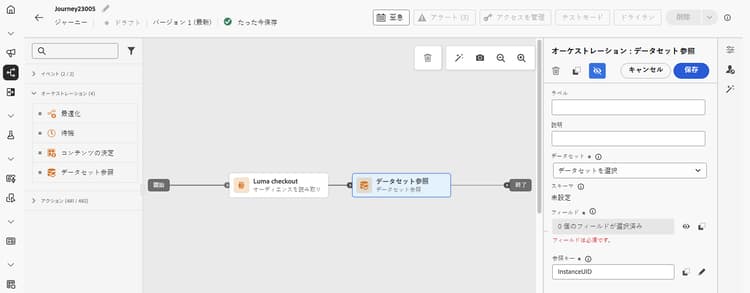
オーケストレーションカテゴリを展開し、データセット参照アクティビティをキャンバスにドロップします。
ジャーニーでの
-
ラベルと説明を追加します。
-
「データセット」フィールドで、必要な属性を持つデータセットを選択します。
note NOTE 探しているデータセットがリストに表示されない場合は、参照に対してデータセットが有効になっていることを確認します。 詳しくは、必読の節を参照してください。 -
データセットから取得する特定のフィールドを選択します。
-
リーフノード(スキーマの最下位レベルのフィールド)のみを選択できます。 フィールドは、プリミティブ値(文字列、数値、ブール値、日付など)にする必要があります。
-
リスト(配列)とマップ(キーと値のオブジェクト)は選択できません。
accordion 例 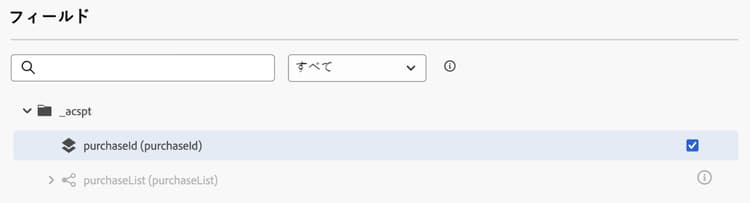
-
-
「参照キー」フィールドで、決定項目の属性とデータセットの両方に存在する結合キーを選択します。 このキーは、システムで選択したデータセット内を検索するのに使用されます。
-
キーは、SKU、メール ID、その他の識別子など、ジャーニーコンテキストから派生した式にすることができます。 例:
@profile.emailまたはlist(@event{purchase_event.products.sku})。 -
文字列または 文字列のリスト のみがサポートされます。
note important IMPORTANT データセット検索アクティビティの出力がコンテキスト属性としてダウンストリームで利用できるように、詳細モードを使用して検索キーを定義する必要があります。 @datasetLookup{}が条件で「データセット参照が見つかりません」エラーを返す場合は、原因と修正について、条件アクティビティ の「データセット参照が見つかりません」エラーを参照してください。ルックアップキーを設定し、その結果を別々の式エディターで使用します。 -
キーの設定: データセット検索アクティビティの 検索キー 式エディターで、詳細モードに切り替えて、キーを定義し、アクティビティを保存します。 これにより、ルックアップコンテキストをダウンストリームアクティビティで使用できるようになります。
-
結果を使用:条件の式エディターで、詳細モードに切り替えて、ルックアップ出力を参照します(例:
@datasetLookup{MyDatasetLookUpActivity1.entities})。MyDatasetLookUpActivity1をデータセット検索アクティビティの名前に置き換えます。
検索出力がダウンストリームで使用できない場合は、キーが 詳細モード で定義され、データセット検索アクティビティが保存されていることを確認します。 accordion 例 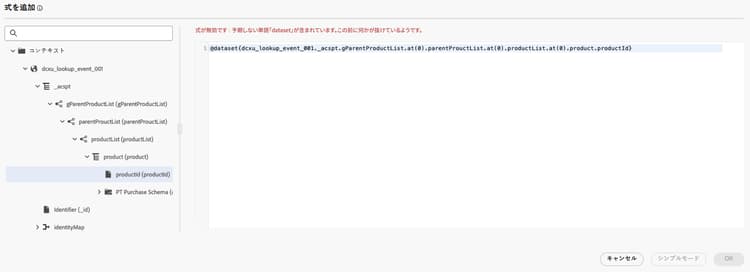
-
ジャーニーでの強化されたデータの使用
データセット参照アクティビティで取得されたデータは、オブジェクトの配列としてジャーニーコンテキストに保存されます。 これは、ジャーニー式エディターとパーソナライゼーションエディターで使用でき、強化されたデータに基づいて条件付きロジックとパーソナライズされたメッセージを有効にします。
-
ジャーニー式エディター:
詳細設定モードエディターにアクセスし、
@datasetLookup{MyDatasetLookUpActivity1.entities}構文を使用します。 詳しくは、高度な式エディターの操作方法を参照してください。 -
パーソナライゼーションエディター:
{{context.journey.datasetLookup.1482319411.entities}}構文を使用します。
ユースケースの例
シナリオ:Send家庭用品に 40 ドル以上を費やすユーザーへのクーポン。
ジャーニーフロー:
-
購入イベント:ユーザーの買い物かごから SKU を取得します。
-
データセット参照アクティビティ:
- データセット:
products-dataset(プライマリキーとしての SKU)。 - 参照キー:
list(@event{purchase_event.products.sku})。 - 返されるフィールド:
["SKU", "category", "price"]。
- データセット:
-
条件アクティビティ:
-
カテゴリが「household」の SKU をフィルタリングします。
code language-none @event{purchase_event.products.all( in(currentEventField.sku, @datasetlookup{MyDatasetLookupActivity1.entities.all(currentDatasetLookupField.category == 'household').sku} ) )}
または
-
家庭用品に対する総支出を集計し、40 ドルのしきい値と比較します。
code language-none sum(@event{purchase_event.products.all( in(currentEventField.sku, @datasetlookup{MyDatasetLookUpActivity1.entities.all(currentDatasetLookupField.category == 'household').sku} ) )}.price}, ',', true ) > 40
-
-
パーソナライゼーションエディター:
強化されたデータを使用して、メールのコンテンツをパーソナライズします。
code language-none {% let householdTotal = 0 %} {{#each journey.datasetlookup.3709000.entities as |product|}} {%#if get(product, "category") = "household"%} {% let householdTotal = householdTotal + product.price %}{%/if%} {{/each}} "Hi, thanks for spending " + {%= householdTotal %} + " on household products. Here is your reward!"
シナリオ:プラチナロイヤルティステータスを持っているプロファイルのメールアカウントを特定します。 このシナリオでは、ロイヤルティアカウントはメール ID に関連付けられており、ロイヤルティデータは標準のプロファイル参照ストアでは使用できません。
ジャーニーフロー:
-
プロファイルイベントトリガー:プロファイルまたはイベントコンテキストからメール ID を取得します。
-
データセット参照アクティビティ:
- データセット:
loyalty-member-dataset(プライマリキーとしてのメール)。 - 参照キー:
@profile.email。 - 返されるフィールド:
["email", "loyaltyTier"]。
- データセット:
-
条件アクティビティ:
ロイヤルティ層に基づいてジャーニーを分岐します。
code language-none @datasetLookup{MyDatasetLookUpActivity1.entity.loyaltyMember.loyaltyTier} == 'Platinum' -
パーソナライゼーションエディター:
強化されたロイヤルティ層のデータを使用して、アウトバウンド通信をパーソナライズします。
code language-none {{context.journey.datasetLookup.1482319411.entity.loyaltyMember.loyaltyTier}}
トラブルシューティング troubleshooting
条件アクティビティの「データセット参照が見つかりません」エラー troubleshooting-not-found
症状:条件アクティビティの高度な式エディターの @datasetLookup{} 構文は、ジャーニーでデータセット参照アクティビティが正しく設定されていても、「データセット参照が見つかりません」エラーを返します。
原因:データセット参照アクティビティの参照キーが、シンプルモードを使用して設定されました。 詳細設定モードでキーが定義されていない場合、アクティビティの出力は、ダウンストリームアクティビティのコンテキスト属性として公開されません。
修正:データセット参照アクティビティを開き、「参照キー」フィールドを見つけて、詳細設定モードに切り替え、キー式を再定義します。 アクティビティを保存し、ジャーニーを再公開します。
This section contains structured knowledge intended to support interpretation, retrieval, and question answering related to this topic.
For complete understanding, this information should be combined with the documentation on this page. Neither source is intended to stand alone; the page describes the feature, while this section provides additional context that helps disambiguate terminology, intent, applicability, and constraints.
- TL;DR: This page explains how to configure the Dataset lookup activity to dynamically retrieve data from Adobe Experience Platform record datasets at journey runtime for real-time personalization and conditional logic.
Intents:
- Add a Dataset lookup activity to a journey to fetch external Adobe Experience Platform record data at runtime
- Select specific dataset fields (leaf nodes / primitive values) to retrieve during lookup
- Define a lookup key in advanced mode to join journey context with dataset records
- Use enriched dataset data in the journey expression editor or personalization editor
- Troubleshoot “Dataset lookup not found” errors caused by using simple mode for the lookup key
Glossary:
- Dataset lookup activity: A journey orchestration activity that retrieves selected data from Adobe Experience Platform record datasets at runtime by matching a lookup key from the journey context to dataset records (product-specific)
- Leaf node: A field at the lowest level of a schema hierarchy that holds a primitive value (string, number, boolean, date) (product-specific)
- Lookup key: The joining expression (string or list of strings) used to match journey context data against records in the selected dataset (product-specific)
- Enriched data: Data retrieved by a Dataset lookup activity and stored transiently in the journey context for use in downstream activities (product-specific)
Guardrails:
- Maximum of 10 Dataset lookup activities per journey (hard limit).
- Maximum of 20 selected fields (hard limit).
- Maximum of 50 keys in the lookup keys array (hard limit).
- Enriched data size is limited to 10KB (hard limit).
- The dataset must be enabled for lookup in Adobe Experience Platform before it appears in the activity configuration.
- Only leaf nodes (primitive values) can be selected; arrays and maps cannot be selected.
- Only strings or lists of strings are supported as lookup keys.
- The lookup key must be defined in advanced mode; using simple mode causes the activity output to be unavailable as a context attribute downstream.
- Enriched data is transient and available only during journey runtime and in outbound activity personalization.
- To avoid delays in deliverability, up to 5 lookup activities per journey are recommended. Up to 20 attributes per lookup are also recommended.
Terminology:
- Canonical name: Dataset lookup activity
- Synonyms: “lookup key” = “joining key”
FAQ:
- Q: Why does my dataset not appear in the Dataset field dropdown? — The dataset must be enabled for lookup in Adobe Experience Platform. See the linked “Use Adobe Experience Platform data” section for details.
- Q: What should I check if lookup output is unavailable in a condition? — Confirm that the lookup key was defined in advanced mode and that the Dataset lookup activity was saved. In the condition’s separate expression editor, switch to advanced mode and reference the lookup output. If the key was defined using simple mode, redefine it in advanced mode and republish the journey.
- Q: Can I retrieve arrays or map fields from the dataset? — No, only primitive leaf node fields (string, number, boolean, date) can be selected.
- Q: How do I access enriched data in an email? — Use the personalization editor with the syntax
{{context.journey.datasetLookup.1482319411.entities}}. - Q: Is enriched data available after the journey runtime? — No, enriched data is transient and available only during journey runtime and in the personalization of outbound activities.