このページ:パーソナライズされた最適化モデルで、機械学習を使用して、顧客、オファー、コンテキストデータ(ユースケース、アンサンブルモデルコンポーネント、データセット要件、前提、コールドスタート動作など)から学習する方法について説明します。これにより、パーソナライズされたオファーを提供し、KPI を最大化するために、使用するタイミングを決定できます。
パーソナライズされた最適化では、監視された機械学習とディープラーニングの最先端のテクノロジーを活用することで、ビジネスユーザー(マーケター)はビジネス目標を定義し、顧客データを利用してビジネス指向モデルをトレーニングし、パーソナライズされたオファーを提供して KPI を最大化できます。
パーソナライズされた最適化では、各オファーのグローバルパフォーマンスに基づいて最適化される、パーソナライズされていないランキングとは異なり、個々の顧客の属性と、その顧客に対して選択された KPI を最も推進する可能性が高いオファーとの関係を学習します。 これにより、一人ひとりの顧客に最適なオファーを提供するのではなく、各プロファイルに合わせたオファーを選択できます。
ユースケースとメリット use-cases
パーソナライズされた最適化は、様々な顧客が使用可能なオファーに異なる反応をするシナリオや、オファーカタログが有意義に差別化され、頻繁に変更されないシナリオを決定するのに適しています。 一般的なユースケースは次のとおりです。
- 次善のオファーの選択:複数の競合するオファーまたはプロモーションのうち、各顧客にリアルタイムで提示するものを選択します。
- コンテンツのパーソナライゼーション:web、モバイル、メール、その他のチャネルをまたいで、各顧客に対するコンテンツ(例:バナー、クリエイティブ)またはメッセージを選択します。
- オーディエンスに応じたパーソナライゼーション: オーディエンスメンバーシップ、プロファイル属性、コンテキストシグナルを組み込むことで、顧客が誰で、インタラクションのコンテキストをレコメンデーションに反映することができます。
- 売上高と価値の最適化:クリック数やコンバージョン数などのバイナリ結果に加えて、売上高や顧客のライフタイムバリューなどの継続的な結果に向けて最適化します。
主なメリット:
- グローバルに最適な単一のオファーではなく、各顧客が最も反応する可能性の高いオファーを提供して、選択したビジネス KPI を最大化します。
- 新しいインタラクションデータの到着に合わせて継続的に適応し、テストが不十分なオファーの探索と実績のあるパフォーマーの活用のバランスを取ります。
- AI モデル数式ビルダー式で直接使用できるランキングスコアにより、バイナリ指標と連続最適化指標の両方をサポートします。
- オファーと顧客の適合性を自動的に学習して、A/B テストやルールのオーサリングにかかる手作業を削減します。
データセットの要件 dataset
パーソナライズされた最適化モデルをトレーニングするには、データセットに、過去30日以内に少なくとも250の表示イベント(インプレッションなど)と1つの成功イベント(クリックまたはコンバージョンなど)を含む少なくとも2つのオファーが必要です。
250件未満のディスプレイイベントや、過去30日以内に成功イベントがないオファーは、引き続き探索トラフィックと新しいオファーブースタートラフィックに含めることができます。 また、これらはパーソナライゼーショントラフィックに含まれる実施要件が満たされますが、必要な最小限の表示回数や成功イベント数を満たし、モデルが再トレーニングされるまでは、決定での予測スコアが最も低いオファーと同等に処理されます。
パーソナライズされた最適化モデルが初めてトレーニングされるまで、パーソナライズされた最適化モデルを利用した選択戦略内のオファーはランダムに提供されます。
仕組み how
モデルでは、オファー、ユーザー情報およびコンテキスト情報間の複雑な特徴量の相互作用を学習し、パーソナライズされたオファーをエンドユーザーに推奨します。 機能は、モデルへの入力です。
機能には4つの種類があります。
このモデルには次の 2 つのフェーズがあります。
- オフラインモデルトレーニングフェーズでは、履歴データで機能インタラクションを学習および記憶することによってモデルをトレーニングします。
- オンライン推論フェーズでは、モデルで生成されたリアルタイムスコアに基づいて候補オファーをランク付けします。 ユーザーやオファーの機能を組み込むのが困難な従来の協調フィルタリング手法とは異なり、パーソナライズされた最適化はディープラーニングベースのレコメンデーション手法であり、複雑な非線形の機能インタラクションパターンを含めて学習できます。
このモデルは、バイナリ変数(クリック数やコンバージョン数など)に加え、連続的な変数(売上高や顧客のライフタイムバリューなど)の最適化をサポートします。 クリック数などのバイナリ指標の予測値は、常 に0~1 の間になります。 注文値などの連続指標の予測値は、常に 0 以上の数値になります。 ランキングスコアは正規化され、数式や比較で使用される際に、両方の指標タイプで一貫した動作を確保します。
決定時にコンテキストを渡す pass-context
モデルでコンテキスト機能を使用する場合、決定リクエストにはそれらの機能の値が含まれている必要があります。 データストリームで設定したWeb SDKまたはモバイル SDKを使用して、これらのデータストリームを送信します。 決定時に、モデルはコンテキスト値とプロファイルの属性およびオーディエンスメンバーシップを使用して、適格なオファーをリアルタイムでスコアリングします。 コンテキストデータの設定方法を学ぶ
実例 illustrative-example
バイナリ応答(コンバージョン) binary-response
ユーザーとオファー間の過去のインタラクションに関する、簡素化されたデータセットを考慮します。 各行には、表示されたオファーが記録されます。2 つの顧客シグナルは、ロイヤルティ層(高= 1)および顧客が最近メールを開封したかどうか(はい= 1)と、顧客がコンバージョンしたかどうか(はい= 1)です。
オファー A では、両方のシグナルが一致する(高い場合も低い場合も)場合、コンバージョンの可能性が高くなります。 オファー B では、ロイヤルティ層に関係なく、メールが開封された場合、コンバージョンの可能性が高くなります。 学習したパターンに基づいて、このモデルは各顧客のシグナルに基づいて、より優れたオファーを予測できます。
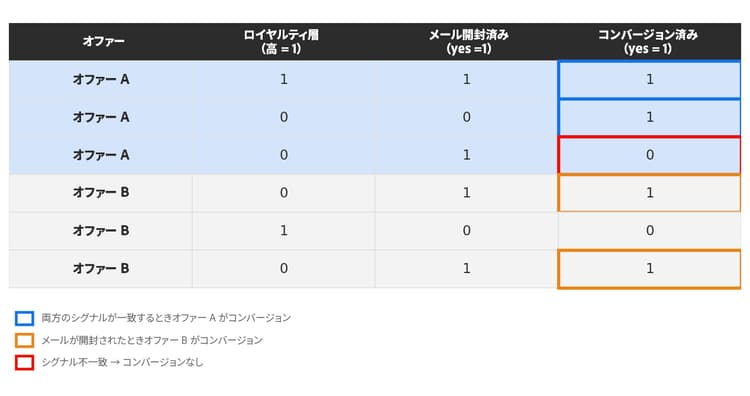
図 1:ハイライト表示された不一致の行で、シグナルが一致せず、コンバージョンしなかった場合にオファー A が表示されます。 学習したパターンに基づいて、オファー B は次回の顧客に対するレコメンデーションとして最適です。
これは、過去の機能インタラクションを学習および記憶し、適用して、各顧客向けのパーソナライズされた予測を生成するこのアプローチの本質です。
継続的応答(売上高) continuous-response
同じ考え方が継続的な成果にも及んでいます。 このモデルは、顧客がコンバージョンに至るかどうかを予測する代わりに、オファーと顧客セグメントごとに連続的な値(予想売上)を予測し、その予測値に基づいてオファーをランク付けします。
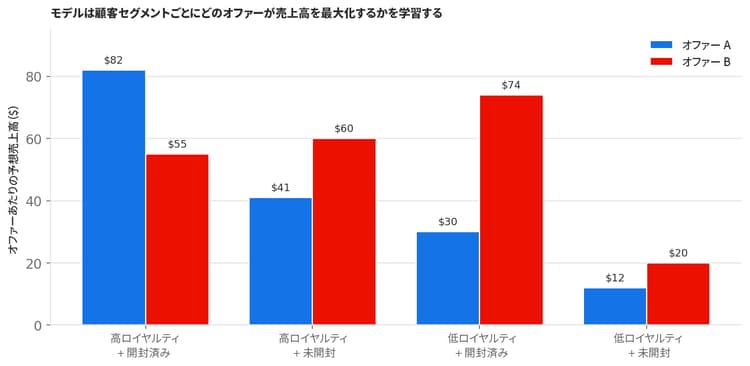
図 2:4 つの顧客セグメントをまたいだ 2 つのオファーの予測売上高。 メールを開封したロイヤルティの高い顧客に対しては、オファー A が最も多くの売上高をもたらすことが期待されています。メールを開封したロイヤルティの低い顧客に対しては、オファー B が優れた選択肢となります。 モデルは、すべての顧客に 1 つのルールを適用するのではなく、各セグメントに対して最も予測値の高いオファーを選択します。
アンサンブルモデルコンポーネント ensemble
パーソナライズされた最適化は、アンサンブルモデルとして提供されます。いくつかの補完的なモデルアームが一緒に動作し、監督層が各アームがどれだけのライブトラフィックを受け取るかを決定します。 このデザインにより、システムは 2 つの目標を同時に追求できます。最もパフォーマンスの高いオファーを学習する(探索)と、パフォーマンスの高いオファーを提供する(活用)ことです。
探索と活用のバランス
あらゆる決定システムは、情報を収集するためにテストが不十分なオファーを探索することと、実績のあるオファーを活用して即座にリターンを最大化することの間で、トレードオフに直面します。 探索のトラフィックが少なすぎると、潜在的な可能性の高いオファーが見過ごされてしまいます。逆に多すぎると、既にパフォーマンスを発揮しているオファーによる向上を犠牲にすることになります。 アンサンブルは、最小限の探索フロアを保持しながら、時間の経過と共に残りのトラフィックをよりパフォーマンスの高いパーソナライズされたアームへとシフトさせることで、このバランスを自動的に管理します。
アンサンブルは、次の 4 つのトラフィックアームで構成されています。
均一ランダム(探索アーム) uniform-random
均一ランダムアームは、実施要件を満たすオファーの中からランダムに顧客にオファーを割り当てます。 特定のオファーを優遇しないので、カタログ全体をまたいで顧客の反応について偏りのないデータ(パーソナライズアームが学習するための生のマテリアル)を生成します。 最初のモデルがトレーニングされる前にアクティブな唯一のアームであり、トレーニング後もシステムが学習を継続できるように、最小限の探索フロアを引き続き保持します。
- 初期化時:トラフィックの 100%。
- 最初のトレーニングの実行後:トラフィックの最低10%、最大85% (1つのオファーあたりのインプレッションとコンバージョンイベントの数に応じて)。
ニューラルネットワーク(パーソナライズされたアーム) neural-network
ニューラルネットワークは、顧客の属性やオーディエンスメンバーシップに基づいて、その顧客に最適なオファーを予測するパーソナライズされたアームです。 オファー、顧客の特徴、コンテキストの間の複雑で非線形なインタラクションを学習し、多数の特徴量をまたいで微妙なパターンを捉えるのに適しています。
- 初期化時:トラフィックの 0%。
- 最初にトレーニングを成功させた後:トラフィックの最低5%、最大80%。
コンテキストバンディット(パーソナライズされたアーム) contextual-bandit
コンテクスト型バンディットとは、継続的に学習とパフォーマンスのバランスを取るバンディット手法を用いて、属性、オーディエンスメンバーシップ、コンテキストなどにもとづいて顧客一人ひとりに対する最適なオファーを予測する、2番目にパーソナライズされたチームです。 ニューラルネットワークと併用することで、アンサンブル全体として、これら 2 つの異なるパーソナライズされた手法の強みを活用できます。
- 初期化時:トラフィックの 0%。
- 最初にトレーニングを成功させた後:トラフィックの最低5%、最大80%。
新規オファーブースター(パーソナライズされていないアーム) new-offer-booster
新規オファーブースターは、トンプソンサンプリングを使用した全体勝者バンディット(パーソナライズされていない)です。モデルのルックバック期間内でのインプレッションイベント数のレコードが少ない新規オファーのパフォーマンスについて楽観的な前提を適用します。 これにより、有望な新規オファーがその実力を証明するために必要な初期露出を確保できます。これは、新規オファーや、パフォーマンスは高いものの実施要件を満たす限定的なオファーに対して、モデルが十分なトラフィックを誘導できないという既知のコールドスタートの欠点を対処するものです。
- 真のインプレッションやコンバージョンのデータが収集されるにつれて、各オファーの推定パフォーマンスは急速に真の基になるパフォーマンスへとアプローチし、楽観的な前提による影響はほぼゼロになります。
- 相対的に新しいオファーが存在しない場合(例:すべてのオファーのインプレッション数が同程度であるか、すべて 1,000 回以上のインプレッション数がある場合)、楽観的な仮定による影響はほぼゼロとなり、このアームは実質的に、パーソナライズされていない全体勝者モデルとして機能します。
- 初期化時:トラフィックの 0%。
- 最初のトレーニング実行が成功した後:トラフィックの 5%。
アームをまたいだトラフィックの割り当ての仕組み traffic-allocation
初期化時では、まだモデルのトレーニングが行われていないので、トラフィックの 100%は均一ランダムベースライン(サンプリング対象となる学習済み分布を持つ唯一のアーム)に割り当てられます。 最初のトレーニング実行が成功した後は、各アームに最小限のトラフィックフロア(5%)が割り当てられ、残りのトラフィックは確認されたパフォーマンスに基づいて監督者バンディットによって割り当てられます。 このモデルが連続したラウンドで訓練すると、トラフィックは可能な限り80%のトラフィックを割り当てながら、最もパフォーマンスの高いアームに向かって収束します。

図 3:初期化時および連続するトレーニングラウンドでの 4 つのアンサンブルアーム間のトラフィック配分の推移例。 初期化時では、すべてのトラフィックがランダムベースラインに割り当てられます。 各トレーニング実行後、監督のThompson Sampling バンディットは、アームあたりの最小トラフィックを維持しながら、よりパフォーマンスの高いアームに割り当てをシフトします。 実際の配分は、アームの確認されたパフォーマンスに応じて異なります。
主なモデルの前提と制限事項 key
パーソナライズされた最適化を使用する利点を最大限に活かすために、いくつかの主な前提と制限事項に注意する必要があります。
- ユーザーが検討中のオファー間で様々な環境設定を使用できるよう、オファーは十分に異なります。 オファーが類似しすぎる場合、応答が一見ランダムに見えるので、結果として得られるモデルの影響は少なくなります。
例えば、銀行に色の違いのみがある 2 つのクレジットカードオファーがある場合、どのカードを推奨するかは問題になりませんが、各カードの条件が異なる場合、これは特定の顧客が 1 つを選択する理由の根拠となり、より影響力のあるモデルを作成するのに十分なオファー間の違いが得られます。 - ユーザートラフィックの構成が安定しています。 モデルのトレーニングと予測中にユーザートラフィックの構成が大幅に変化すると、モデルのパフォーマンスが低下する可能性があります。 例えば、モデルのトレーニングフェーズで、オーディエンス A のユーザーのデータしか利用できない場合、トレーニング済みのモデルを使用してオーディエンス B のユーザーの予測を生成すると、モデルのパフォーマンスに影響する可能性があります。
- オファーのパフォーマンスは短期間に大幅に変化するものではありません。このモデルは毎週更新され、モデルの更新に伴ってパフォーマンスの変化が伝えられます。 例えば、ある製品は以前は非常に人気がありましたが、公開レポートでその製品が健康に有害であることが特定されると、急速に人気がなくなりました。 このシナリオでは、ユーザーの行動の変化でモデルが更新されるまで、モデルは引き続きこの製品を予測できます。
コールドスタートの問題 cold-start
レコメンデーションを行うのに十分なデータがない場合に、コールドスタートの問題が発生します。 パーソナライズされた最適化には、5種類のコールドスタートケースがあります。
- 履歴データを含まない新しい AI モデルを作成した後、オファーは必要なデータを収集するために一定期間ランダムに提供され、そのデータは最初のモデルのトレーニングに使用されます。
- 最初の AI モデルがリリースされた後、すべてのトラフィックの一部は均一ランダム探索に割り当てられ、残りはモデルのレコメンデーションに使用されます。 探索および活用バンディットコンポーネント間のトラフィック分布は、オファー数やパフォーマンスしきい値などの要因に基づいて自動的に調整されます。
- AI ランキングモデルに関連付けられた戦略で選択された オファーコレクションに新規オファーが追加 されると、これらのオファーは(60 分以内に)均一ランダムおよび新規オファーブースターモデルの両方で探索の実施要件を満たす候補となります。 次回のスケジュールされた再トレーニング実行中に、新規オファーブースターモデルアームでオファーの推定パフォーマンスが更新され、インプレッション数やクリック数のしきい値を満たした場合、パーソナライズされたモデルアームの実施要件として含まれるようになります。
- AI ランキングモデルに関連付けられた選択戦略に紐づく 既存のオーディエンスセットに新しいプロファイルが追加 されると、これらはオーディエンスセット自体からパーソナライゼーション属性を継承します。 そのため、コールドスタートの問題に直面することなく、最初からこれらの属性に基づいたパーソナライズされたオファーを受け取ることができます。
- 新しいオーディエンスセット、プロファイル機能、および/またはコンテキスト機能が既存のモデルに追加された後、それらに関連付けられたデータが収集され始め、次にスケジュールされた再トレーニング実行から使用されます。
再トレーニング re-training
最新の機能インタラクションを学習し、モデルパフォーマンスの低下を軽減するために、モデルの再トレーニングが毎週行われます。 トレーニングのステータスとモデルのパフォーマンスを監視するには、AI モデル監視を参照してください。
This section contains structured knowledge intended to support interpretation, retrieval, and question answering related to this topic.
For complete understanding, this information should be combined with the documentation on this page. Neither source is intended to stand alone; the page describes the feature, while this section provides additional context that helps disambiguate terminology, intent, applicability, and constraints.
- TL;DR: Explains how the personalized optimization model uses machine learning to learn from customer, offer, and contextual data to serve personalized offers and maximize KPIs, covering its use cases, dataset requirements, features, ensemble model components, assumptions, cold-start behavior, and re-training.
Intents:
- Decide when to use Personalized optimization to serve personalized offers and maximize KPIs, based on its use cases.
- Check the dataset requirements to train a personalized optimization model.
- Identify the four feature types that can be added to the model.
- Understand how the four traffic arms of the ensemble model share live traffic.
- Review the key model assumptions and limitations.
- Understand the cold-start cases and the re-training of models.
Glossary:
-
Personalized optimization (product-specific): Uses supervised machine learning and deep learning to let a business user (marketer) define business goals and use customer data to train business-oriented models that serve personalized offers and maximize KPIs.
-
Feature: An input into the model. The model learns complex feature interactions between offers, users’ information, and contextual information to recommend personalized offers to end users. There are 4 types of features: Decisioning objects, Audiences, Profile features, and Context features.
-
Decisioning objects (product-specific): Feature type made of placementID, activityID, and decisionScopeID. Part of the decision management feedback Experience Events sent to AEP.
-
Audiences: Feature type.
-
Profile features (product-specific, Limited Availability): Feature type made of profile attributes from your profile dataset schema.
-
Context features (product-specific, Limited Availability): Feature type made of real-time context signals sent with the decision API request. Automatic context features (like channel ID) are always included. Pre-selected recommended context features (like device type, country code) can be removed. At decision time, the model uses the context values together with the profile’s attributes and audience memberships to score the eligible offers in real time.
-
Offline model training: Phase in which a model is trained by learning and memorizing feature interactions in historical data.
-
Online inference: Phase in which candidate offers are ranked based on real-time scores generated by the model. Unlike traditional collaborative filtering techniques, with which it is hard to include features for users and offers, personalized optimization is a deep learning based recommendation method, and is able to include and learn complex and nonlinear feature interaction patterns.
-
Binary metric: A metric such as clicks or conversions. Predicted values are always between 0 and 1.
-
Continuous metric: A metric such as order value. Predicted values are always a number greater than or equal to zero. The model supports optimization of continuous variables such as revenue and customer lifetime value.
-
Ranking scores: Normalized to ensure consistent behavior across both metric types when used in formulas or comparisons. They can be used directly in AI Model Formula builder expressions.
-
Ensemble model (product-specific): Personalized optimization is delivered as an ensemble model: several complementary model arms run together, and a supervisory layer decides how much live traffic each arm receives. The ensemble manages the balance between exploration and exploitation automatically by holding a minimum exploration floor while shifting the remaining traffic toward the better-performing personalized arms over time. It is composed of four traffic arms.
-
Exploration and exploitation: Exploration is exploring under-tested offers to gather information and learn which offers perform best. Exploitation is exploiting proven offers to maximize immediate return. Reserving too little traffic for exploration leaves high-potential offers undiscovered; reserving too much sacrifices lift on offers that are already performing.
-
Uniform random (exploration arm): Assigns offers to customers at random from among the eligible offers. Because it does not favor any offer, it produces unbiased data about how customers respond across the full catalog, which is the raw material the personalized arms learn from.
-
Neural network (personalized arm): Predicts the best offer for a given customer based on their attributes and audience memberships. It learns complex, nonlinear interactions among offers, customer features, and context, and is well suited to capturing subtle patterns across many features.
-
Contextual bandit (personalized arm): A second personalized arm that also predicts the best offer for each customer based on their attributes, audience memberships, and context, using a bandit approach that continually balances learning and performance as it serves. Running it alongside the neural network lets the ensemble draw on the strengths of two distinct personalized methods.
-
New offer booster (non-personalized arm) (product-specific): An overall-winner Thompson Sampling bandit (non-personalized) that makes optimistic assumptions about the performance of new offers, those with few recorded impression events within the model lookback period. It gives promising new offers early exposure and addresses a known cold-start shortcoming in which the model otherwise struggled to direct enough traffic to new or high-performing but restrictively eligible offers. As true impression and conversion data is collected, each offer’s estimated performance quickly approaches its true underlying performance, and the impact of the optimistic assumptions falls to near zero. When no offers are relatively new (for example, when all offers have a similar number of impressions, or all have more than 1,000 impressions), the optimistic effect is near zero and this arm behaves, in effect, as a non-personalized overall-winner model.
-
Cold-start problem: Occurs when there is not enough data to make recommendations. For personalized optimization, there are five types of cold-start cases:
- After creating a new AI model with no historical data, offers are randomly served for a period of time to collect the required data, which is then used to train the first model.
- After the first AI model is released, a portion of total traffic is allocated for uniform random exploration while the remainder is used for model recommendations. The traffic distribution across the exploration and exploitation bandit components is tuned automatically based on factors such as the number of offers and their performance thresholds.
- After new offers are added to the offer collection selected in the strategy associated with the AI ranking model, those offers become eligible candidates for exploration by both the uniform random and new offer booster model arms (within 60 minutes). During the next scheduled re-training run, the offer’s estimated performance is updated in the new offer booster model arm, and the offer becomes eligible for inclusion in the personalized model arms if it met the impression and click threshold.
- After new profiles are added to the existing audience set associated with the selection strategy associated with the AI ranking model, they inherit personalization attributes from the audience set itself, and start receiving personalized offers based on those attributes from the get-go, without any cold-start problem.
- After new audience sets, profile features, and/or context features are added to the existing model, the data associated with them starts to get collected and is used from the next scheduled re-training run.
-
Re-training: Models are re-trained weekly to learn latest feature interactions and mitigate model performance degradation.
Guardrails:
-
To train a personalized optimization model, the dataset must have at least two offers with at least 250 display events (for example, impressions) and one success event (for example, click or conversion) each within the last 30 days.
-
Offers with fewer than 250 display events and/or no success events within the last 30 days remain eligible for inclusion in the exploration traffic and new offer booster traffic. They are also eligible for inclusion in the personalization traffic but are treated as equivalent to the worst scoring predicted offer in decisioning, until they meet the required minimum display/success events and the model gets re-trained.
-
Audiences: 0-50 audiences can be added as features when creating or editing the Ranking AI model.
-
Profile features (Limited Availability): 0-50 can be added as features when creating or editing the Ranking AI model. If applicable, DULE policies apply to selected profile features automatically.
-
Context features (Limited Availability): 0-20 additional context features can be added when creating or editing the Ranking AI model.
-
Datatypes of profile features and context features (Limited Availability): numeric, string, Enum, and binary. Datetime, array, and key-value pair datatypes are not available.
-
Traffic per arm at initialization and after the first successful training run:
- Uniform random arm: at initialization, 100% of traffic (it is the only arm active before the first model is trained); after the first successful training run, a minimum of 10% of traffic, up to a maximum of 85% (depending on the number of observed impression and conversion events per offer).
- Neural network arm: at initialization, 0% of traffic; after the first successful training run, a minimum of 5% of traffic, up to a maximum of 80%.
- Contextual bandit arm: at initialization, 0% of traffic; after the first successful training run, a minimum of 5% of traffic, up to a maximum of 80%.
- New offer booster arm: at initialization, 0% of traffic; after the first successful training run, 5% of traffic.
- Actual traffic allocation will vary based on observed arm performance.
-
You are responsible for ensuring that data used to train Personalized optimization models, including profile, audience, and context features, is appropriate for your use case and complies with applicable laws and regulations. Sensitive or protected information, and attributes or audience memberships that proxy for it, may introduce or amplify bias in model outcomes.
-
Key assumptions and limitations of personalized optimization:
- Offers are different enough so that users have different preferences among the offers in consideration. If offers are too similar, a resulting model has less impact as the responses are seemingly random.
- User traffic composition is stable. If user traffic composition changes dramatically during model training and predicting, model performance could degrade.
- Offers performances do not change dramatically over a short period of time, as this model updates weekly and changes to performance are conveyed as the model updates.
Prerequisites and permissions:
- Profile features and context features: currently available as a Limited Availability release. Contact your Adobe representative to gain access.
- Context features (Limited Availability): if your model uses context features, the decision request must carry the values for those features. Send them with the Web SDK or Mobile SDK, as configured in your datastream.
Applicability:
- Context features (Limited Availability): only available for inbound channels.
Terminology:
- Canonical name: Personalized optimization model
- Acronym: AEP — Adobe Experience Platform
- Do not confuse: “Personalized optimization” ≠ “non-personalized ranking”. Non-personalized ranking optimizes based on the global performance of each offer, while Personalized optimization learns the relationship between an individual customer’s attributes and the offers most likely to drive the chosen KPI for that customer, so the offer selection is tailored to each profile rather than a single best offer served to everyone.
FAQ:
- What are the key benefits of Personalized optimization? It maximizes the business KPI you select, continuously adapts as new interaction data arrives, supports both binary and continuous optimization metrics, and reduces the manual effort of A/B testing and rules authoring.
- What are the dataset requirements to train a personalized optimization model? The dataset must have at least two offers with at least 250 display events and one success event each within the last 30 days.
- What happens before the first personalized optimization model is trained? Offers within a selection strategy utilizing a personalized optimization model are served at random.
- Which feature types can be added to the model? Decisioning objects, Audiences, Profile features (Limited Availability), and Context features (Limited Availability).
- How often are models re-trained? Weekly.
- What happens when new offers are added to the offer collection selected in the strategy? They become eligible candidates for exploration by both the uniform random and new offer booster model arms (within 60 minutes).
Examples:
-
Use cases of Personalized optimization, which is well suited to decisioning scenarios where different customers respond differently to the available offers and where the catalog of offers is meaningfully differentiated and does not change often:
- Next-best-offer selection: choosing which of several competing offers or promotions to present to each customer in real time.
- Content personalization: choosing which piece of content (for example, banner, creative) or message for each customer across web, mobile, email, and other channels.
- Audience-aware personalization: incorporating audience membership, profile attributes, and contextual signals so that recommendations reflect who the customer is and the context of the interaction.
- Revenue and value optimization: optimizing toward continuous outcomes such as revenue or customer lifetime value, in addition to binary outcomes such as clicks and conversions.
-
Illustrative example, binary response (conversion): a simplified dataset of historical interactions between users and offers. Each row records an offer that was shown, two customer signals (loyalty tier, high = 1; whether the customer opened a recent email, yes = 1), and whether the customer converted (yes = 1). For Offer A, conversion is more likely when both signals agree (both high or both low). For Offer B, conversion is more likely when the email was opened, regardless of loyalty tier. Based on the learned pattern, the model can predict the better offer for each customer based on their signals.
-
Illustrative example, continuous response (revenue): instead of predicting whether a customer converts, the model predicts a continuous value (expected revenue) for each offer and customer segment, and ranks offers by that predicted value. For high-loyalty customers who opened the email, Offer A is expected to drive the most revenue; for low-loyalty customers who opened the email, Offer B is the stronger choice.
-
Example for the first assumption: if a bank has two credit card offers with the only difference being color, it may not matter which card is recommended; if each card has different terms, this provides rationale for why certain customers would choose one.
-
Example for the second assumption: if only data for users in audience A is available in the model training phase, but the trained model is used to generate predictions for users in audience B, model performance could be impacted.
-
Example for the third assumption: a product was very popular before, but a public report identifies the product to be harmful to our health, and the product becomes unpopular extremely fast. In this scenario, the model could continue to predict this product until the model updates with changes in user behavior.
Related pages:
- To set up context data when your model uses context features: Learn how to set up context data (experience-decisioning/context-data.md)
- To monitor training status and model performance: AI model monitoring (experience-decisioning/ranking/ai-model-observability.md)
Personas:
- marketer: Can define business goals and use customer data to train business-oriented models that serve personalized offers and maximize KPIs. Can add 0-50 audiences as features when creating or editing the Ranking AI model. Can also add 0-50 profile features (Limited Availability) and 0-20 additional context features (Limited Availability, only available for inbound channels). Can remove pre-selected recommended context features such as device type and country code. Can refer to AI model monitoring to monitor training status and model performance. The page states that at least two offers must each have at least 250 display events and one success event within the last 30 days. Where: “How it works”.
Onboarding:
- Level: Experienced
- First minimal step: Add 0-50 audiences as features when creating or editing the Ranking AI model.