このページ:では、重複するジャーニーやキャンペーンを本番稼働前に特定することで、一度に多すぎるコミュニケーションを顧客に浴びせるのを避けることができます。
Journey Optimizer でキャンペーンとジャーニーの量を増やすにつれて、マーケターは、過剰なマーケティングインタラクションで顧客を困らせていないかどうかをますます把握しづらくなります。 そのため、キャンペーンやジャーニーが重複している場合にそれを簡単に特定して、顧客に飽きられてしまうリスクを軽減しながら、マーケティングコミュニケーションの適切なバランスを確実に取ることが不可欠です。
重複の可能性を監視する主な領域は次のとおりです。
- タイムライン(開始日と終了日):同時に実行されているジャーニーが多すぎないか。
- オーディエンス:ジャーニーオーディエンスのうち、何パーセントのオーディエンスが他のジャーニーの一部にもなっているか。
- チャネル:同じ期間にスケジュールされている他のコミュニケーションはあるか。ある場合、それはいくつか。
- キャップルールセット:どのタイプのジャーニーがキャップの対象で、その中に重複があるか。
- チャネル設定:同じジャーニーまたはキャンペーンで使用されているチャネル設定を使用している他のジャーニーまたはキャンペーンで、ジャーニーまたはキャンペーンがエンドユーザーに表示されない原因となっている可能性があるものは存在するか。
➡️ この機能をビデオで確認
Journey Optimizer による競合の検出方法 detection
ジャーニーとキャンペーンの競合の可能性を Journey Optimizer で特定する方法の概要を次に示します。
- 競合の特定範囲:ライブまたはスケジュール済みキャンペーンおよびジャーニーの競合のみ表示されます。
- 単一ジャーニー:選択したジャーニーが単一ジャーニーの場合、同じイベントで開始する他のジャーニーが表示されます。このイベントが、そのようなジャーニーをすべてトリガーするからです。
- オーディエンスの選定およびオーディエンスを読み取り/ビジネスイベントジャーニー:選択したジャーニーがオーディエンスの選定ジャーニーまたはオーディエンスを読み取り/ビジネスイベントジャーニーの場合、オーディエンス間に重複がある可能性があるので、有効なオーディエンスを持つ、同じタイプの他のジャーニーがすべて表示されます。
- キャンペーン:すべてのキャンペーンはオーディエンスをターゲティングし、イベントの概念がないので、すべてのキャンペーンが、(オーディエンスを読み取りアクティビティで始まる)セグメントトリガージャーニーと競合する可能性があります。
- ライブ/スケジュール済みキャンペーン:ライブキャンペーンとスケジュール済みキャンペーンは、オーディエンスが重複する可能性があるので互いに競合する場合があります。 任意のキャンペーンについて、すべてのライブキャンペーンまたはスケジュール済みキャンペーンが競合ビューアーに一覧表示されます。
特定のジャーニーまたはキャンペーンについて特定された競合の表示 view
Journey Optimizer では、ジャーニーやキャンペーンをオーサリングする際、他のジャーニーやキャンペーンと重複する可能性があるかどうかを常に確認できます。 それには、次の手順に従います。
-
ジャーニーまたはキャンペーンのオーサリング時に、ジャーニープロパティまたはキャンペーンプロパティの「潜在的な競合を表示」ボタンをクリックします。

note NOTE 「潜在的な競合を表示」ボタンは、「開始日 / 終了日」、「オーディエンス」、「チャネル」、「チャネル設定」および「ルールセット」の設定を割り当てると、すぐに選択できるようになります。 これらの設定を割り当てた後は、必ず「保存」を選択してください。変更が保存されるまでは、ボタンを選択できないからです。 -
潜在的な競合ウィンドウが開き、現在のジャーニーまたはキャンペーンと重複しているすべての要素を視覚化できます。
重複するジャーニーまたはキャンペーンをこの画面から直接開くには、そのジャーニーまたはキャンペーンの名前を選択します。
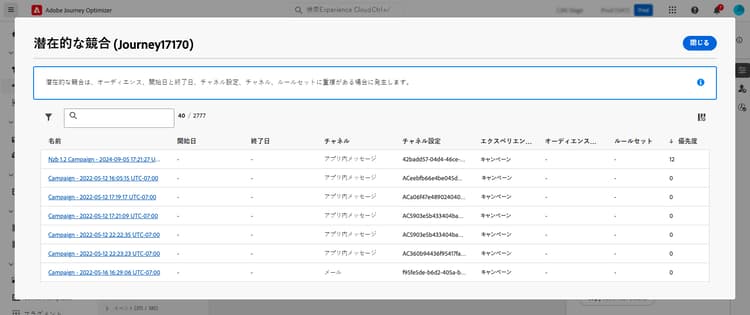
note NOTE キャッシュが実装されているので、新しく公開されたジャーニーとキャンペーンが競合ビューアーに表示されるまでに最大 3~7 分かかる場合があります。
潜在的な重複の検索をさらに絞り込むには、関連性の高いフィールドに基づいてキャンペーンとジャーニーのリストをフィルタリングします。 それには、インベントリビューのフィルターアイコンを選択します。 詳しくは、フィルターの操作方法を参照してください。
競合の解決 resolve
潜在的な競合が特定された場合、競合を減らすヒントを次にいくつか示します。
- キャンペーンやジャーニーが重複しないように 開始日/終了日 を調整します。
- オーディエンスのターゲティングを絞り込んで、ジャーニー間の重複を最小限に抑えます。
- 頻度キャップを実装して、顧客が過剰なコミュニケーションを受信しないようにします。
- アクティブなジャーニーの数を減らして、顧客体験をより効果的に管理します。
- インバウンドアクションに 優先度 を設定して、最も重要なアクションが顧客に表示されるようにします。
これらの機能を活用することで、マーケティング活動の連携を確保し、コミュニケーション戦略の適切なバランスを保つことができます。
チュートリアルビデオ video
This section contains structured knowledge intended to support interpretation, retrieval, and question answering related to this topic.
For complete understanding, this information should be combined with the documentation on this page. Neither source is intended to stand alone; the page describes the feature, while this section provides additional context that helps disambiguate terminology, intent, applicability, and constraints.
- TL;DR: This page explains how Journey Optimizer detects potential conflicts between overlapping live or scheduled journeys and campaigns, how to view them, and how to resolve them.
Intents:
- Check whether a journey or campaign overlaps with other journeys or campaigns while authoring it
- Open the Potential conflicts window with the View Potential Conflicts button
- Monitor overlap across timeline, audience, channel, capping rule set, and channel configuration
- Filter the conflict list to refine the search for overlaps
- Apply resolution tactics such as adjusting dates, refining audiences, adding frequency caps, reducing active journeys, or setting priorities
Glossary:
- Potential conflicts: Window that opens from the button and shows all elements overlapping the current journey or campaign; you can open an overlapping journey or campaign by selecting its name (product-specific)
- Conflict viewer: The viewer in which live or scheduled journeys and campaigns that may overlap show up (product-specific)
- View Potential Conflicts: Button in the journey or campaign properties that opens the potential conflicts window (product-specific)
- Unitary journey: A journey type for which other journeys that start with the same event are displayed as potential conflicts (product-specific)
- Capping Rule Set: An overlap area that identifies which journey types are capped and whether there is overlap within those (product-specific)
- Channel Configuration: An overlap area that identifies other journeys or campaigns using the same channel configuration (product-specific)
Guardrails:
- Conflicts are shown only for live or scheduled campaigns and journeys.
- The View Potential Conflicts button becomes available as soon as you assign any of Start / end date, Audience, Channel, Channel configuration, and Rule set; select Save after assigning them, as the button is not selectable until changes are saved.
- Newly published journeys and campaigns may take up to 3-7 minutes to appear in the conflict viewer, due to caching.
- For a unitary journey, other journeys that start with the same event are displayed, as that event triggers all such journeys.
- For an Audience qualification or a Read Audience/Business Event journey, all other journeys of the same type with a valid audience are displayed.
- All campaigns potentially conflict with segment-triggered journeys (those starting with a Read audience activity), and live or scheduled campaigns may conflict with one another due to audience overlap.
Terminology:
- Canonical name: potential conflicts — variants: conflict viewer, View Potential Conflicts
- Synonyms: none
FAQ:
- Q: Which journeys and campaigns appear in the conflict viewer? — Only live or scheduled journeys and campaigns.
- Q: Why is the View Potential Conflicts button unavailable? — It becomes available as soon as you assign any of start/end date, audience, channel, channel configuration, and rule set; select Save after assigning them, as the button is not selectable until changes are saved.
- Q: Why does a newly published item not show as a conflict yet? — Newly published journeys and campaigns can take up to 3-7 minutes to appear, due to caching.
- Q: How can I reduce identified conflicts? — Adjust start/end dates, refine audience targeting, implement frequency caps, reduce the number of active journeys, or set priorities on inbound actions.
- Q: Do campaigns conflict with journeys? — Campaigns can conflict with segment-triggered journeys that start with a Read audience activity, and live or scheduled campaigns can conflict with one another due to audience overlap.