このページ:オーケストレーションキャンペーンで結合ターゲティングアクティビティを使用して、和集合、積集合、除外操作を通じてインバウンド母集団をセグメント化する方法について説明します。
結合アクティビティは、インバウンド母集団を効果的にセグメント化できる ターゲティング アクティビティのタイプです。 複数の母集団を結合したり、特定のセグメントを除外したり、複数のターゲット間で共有されるデータのみを保持したりできます。
次のセグメント化オプションを使用できます。
-
和集合:複数のアクティビティの結果を 1 つの統合されたターゲットに結合します。
-
積集合:すべてのインバウンド母集団に共通する要素のみを保持します。
-
除外:指定した基準に基づいて、1 つの集団から要素を削除します。
結合アクティビティを設定 combine-configuration
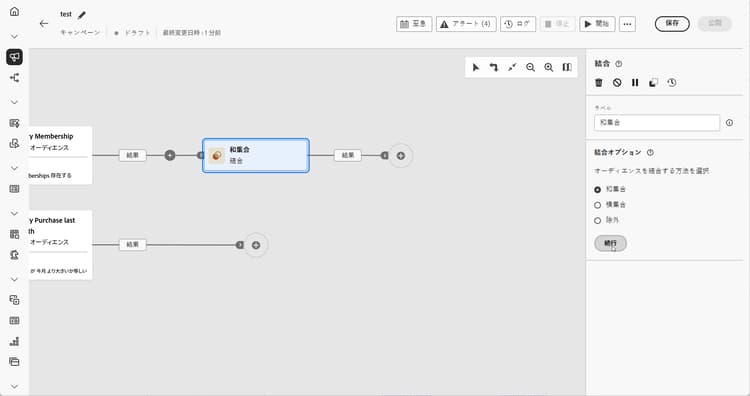
結合アクティビティの設定を開始するには、次の一般的な手順に従います。
和集合 combine-union
結合アクティビティ内では、「紐付けタイプ」を選択して 和集合 を設定し、重複レコードの管理方法を決定できます。
-
キーのみ(デフォルト):複数のインバウンドトランジションが同じキーを共有する場合は、単一のレコードを保持します。 このオプションは、インバウンド母集団が同質である場合にのみ適用できます。
-
列の選択:データの紐付けに使用する列を指定できます。 「属性を追加」を選択します。
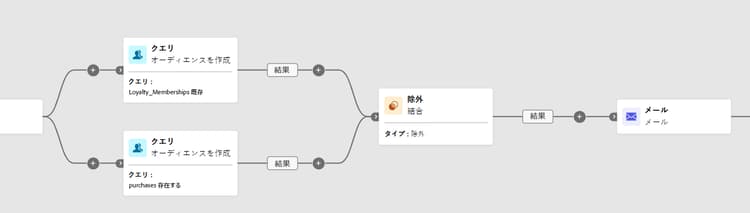
次の例では、結合アクティビティを 和集合 と使用して、ロイヤルティメンバーと 購入者 の 2 つのクエリの結果を、両方のセグメントのすべてのプロファイルを含む単一の大きなオーディエンスに結合します。
積集合 combine-intersection
結合アクティビティでは、「積集合」を設定できます。 このためには、以下の追加の手順に従う必要があります。
-
「紐付けタイプ」を選択して、重複の処理方法を定義します。
-
キーのみ(デフォルト):複数のインバウンドトランジションが同じキーを共有する場合は、単一のレコードを保持します。 このオプションは、インバウンド母集団が同質である場合にのみ適用できます。
-
列の選択:データの紐付けに使用する列を指定できます。 「属性を追加」を選択します。
-
-
残りの母集団を処理する場合は、補集合を生成を有効にします。 補集合には、積集合を除くすべてのインバウンドアクティビティ結果の和集合が含まれます。 追加のアウトバウンドトランジションがアクティビティに追加されます。
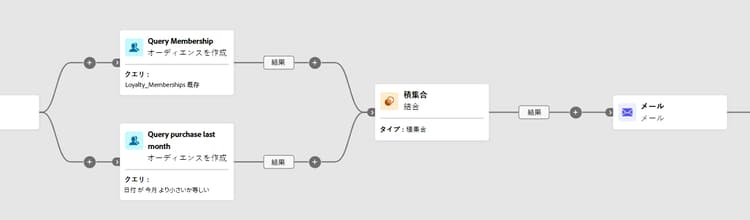
次の例は、2 つのクエリアクティビティ間の 積集合 の使用を示しています。 これは、ロイヤルティメンバーであり、過去 1 か月以内に購入を行ったプロファイルを識別するのに使用されます。
除外 combine-exclusion
結合アクティビティでは、「除外」を設定できます。 このためには、以下の追加の手順に従う必要があります。
-
「結合するセット」セクションで、主要な母集団を表す「プライマリセット」を選択します。 他のセットで見つかったレコードは、このプライマリセットから除外されます。
-
必要に応じて、インバウンドテーブルを調整して、様々なディメンションのターゲットを揃えることができます。 別のディメンションからターゲットを除外するには、まずこのターゲットをメインの母集団と同じターゲティングディメンションに移動する必要があります。 これを行うには、「ルールを追加」をクリックし、ディメンションを変更する条件を定義します。 その後、属性または結合を使用して紐付けが行われます。
-
残りの母集団を処理する場合は、補集合を生成を有効にします。 補集合には、積集合を除くすべてのインバウンドアクティビティ結果の和集合が含まれます。 追加のアウトバウンドトランジションがアクティビティに追加されます。
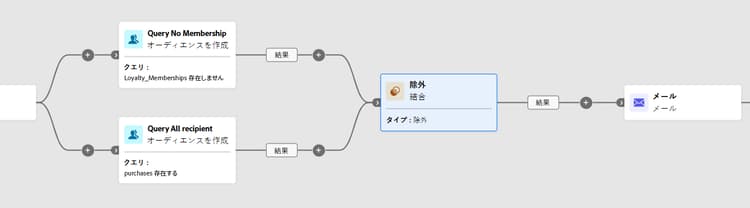
次の 除外 の例は、製品を購入したプロファイルをフィルタリングするように設定された 2 つのクエリを示しています。 ロイヤルティメンバーシップを持たないプロファイルは、最初のセットから除外されます。
This section contains structured knowledge intended to support interpretation, retrieval, and question answering related to this topic.
For complete understanding, this information should be combined with the documentation on this page. Neither source is intended to stand alone; the page describes the feature, while this section provides additional context that helps disambiguate terminology, intent, applicability, and constraints.
- TL;DR: This page explains how to configure the Combine activity in an Orchestrated campaign to segment an inbound population through Union, Intersection, or Exclusion operations.
Intents:
- Add a Combine activity to join at least two execution branches in an Orchestrated campaign.
- Merge multiple populations into a single target using Union.
- Keep only the elements common to all inbound populations using Intersection.
- Remove elements from one population based on specified criteria using Exclusion.
- Choose a reconciliation type (Keys only or A selection of columns) to handle duplicates in a Union or Intersection.
- Process the remaining population after an Intersection or Exclusion by enabling Generate completement.
Glossary:
- Combine: a type of Targeting activity that segments an inbound population by merging multiple populations, excluding specific segments, or retaining only the data shared across several targets (product-specific)
- Union: a Combine segmentation type that merges the results of multiple activities into a single unified target (product-specific)
- Intersection: a Combine segmentation type that retains only the elements common across all inbound populations (product-specific)
- Exclusion: a Combine segmentation type that removes elements from one population based on specified criteria (product-specific)
- Reconciliation type: the setting that defines how duplicate records are handled in a Union or Intersection, either Keys only or A selection of columns (product-specific)
- Keys only: the default reconciliation type; retains a single record when multiple inbound transitions share the same key, applicable only when the inbound populations are homogeneous (product-specific)
- A selection of columns: a reconciliation type that allows specifying which columns are used for data reconciliation, via Add attribute (product-specific)
- Generate completement: an option in Intersection or Exclusion that processes the remaining population; the complement contains the union of all inbound activity results excluding the intersection, and adds an additional outbound transition to the activity (product-specific)
- Primary set: in an Exclusion, the main population selected in the Sets to join section, from which records found in the other sets are excluded (product-specific)
- Exclusion rules: in an Exclusion, used when a target from another dimension must first be brought into the same targeting dimension as the main population; added via Add a rule, defining the dimension change conditions, with reconciliation done via an attribute or a join (product-specific)
- Sets to join: the section where the previous activities to combine are checked (product-specific)
Guardrails:
- Keys only reconciliation is only applicable when the inbound populations are homogeneous.
Terminology:
- Canonical name: Combine — variants: Combine activity
- Do not confuse: “Union” (merges results of multiple activities into one target) ≠ “Intersection” (keeps only elements common to all inbound populations) ≠ “Exclusion” (removes elements from one population based on specified criteria)
- Do not confuse: “Keys only” (retains one record per shared key, homogeneous populations only) ≠ “A selection of columns” (reconciliation on specified columns)
FAQ:
- Q: What does the Combine activity do? — It segments an inbound population by merging multiple populations, excluding specific segments, or retaining only the data shared across several targets.
- Q: What are the three segmentation types in the Combine activity? — Union, Intersection, and Exclusion.
- Q: What is the default reconciliation type for a Union or Intersection? — Keys only, which retains a single record when multiple inbound transitions share the same key.
- Q: When is Keys only applicable? — Only when the inbound populations are homogeneous.
- Q: What does Generate completement do? — It processes the remaining population in an Intersection or Exclusion; the complement contains the union of all inbound activity results excluding the intersection, and adds an additional outbound transition.
- Q: What is the Primary set in an Exclusion? — The main population chosen in the Sets to join section, from which records found in the other sets are excluded.
- Q: How do you exclude a target from a different dimension in an Exclusion? — Click Add a rule in the Exclusion rules section and define the dimension change conditions; reconciliation is then done via an attribute or a join.
Examples:
- Union: a Combine activity merges the results of two queries, Loyalty Members and Purchasers, into a single, larger audience that includes all profiles from both segments.
- Intersection: a Combine activity identifies profiles who are Loyalty Members and have made a purchase within the last month.
- Exclusion: two queries are configured to filter profiles who purchased a product; profiles who do not have a loyalty membership are then excluded from the first set.
Personas:
- marketer: Can add a Combine activity to a branch after building at least two execution branches. Can select Union, Intersection, or Exclusion as the segmentation type, then check previous activities in the Sets to join section. The page states that Keys only reconciliation is only applicable when the inbound populations are homogeneous. Where: “Configure the Combine activity”.
Onboarding:
- Level: Intermediate
- First minimal step: Add multiple activities, such as Build audience activities, to form at least two different execution branches.
- Success check: The Union merges the results of two queries, Loyalty Members and Purchasers, into a single, larger audience that includes all profiles from both segments.