In questa pagina: scopri come utilizzare l’editor espressioni per creare manualmente regole con campi di database, variabili e funzioni di supporto per manipolare date, stringhe e valori numerici nelle campagne orchestrate.
Utilizzare l’editor di espressioni edit
La modifica di un’espressione comporta l’immissione manuale di condizioni per formare una regola. Questa modalità permette di utilizzare funzioni avanzate con cui gestire i valori utilizzati per eseguire query specifiche, come la gestione di date, stringhe, campi numerici e ordinamento.
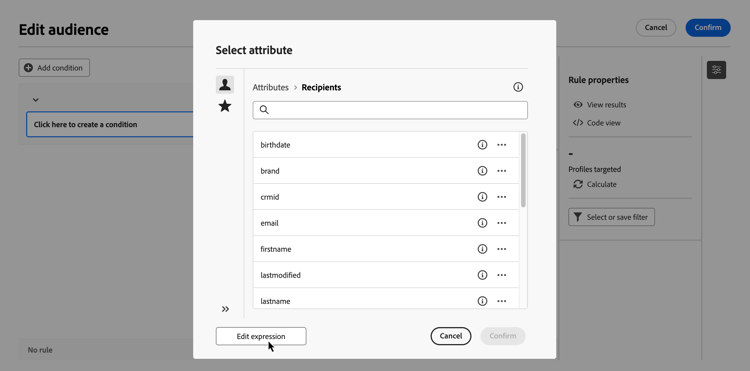
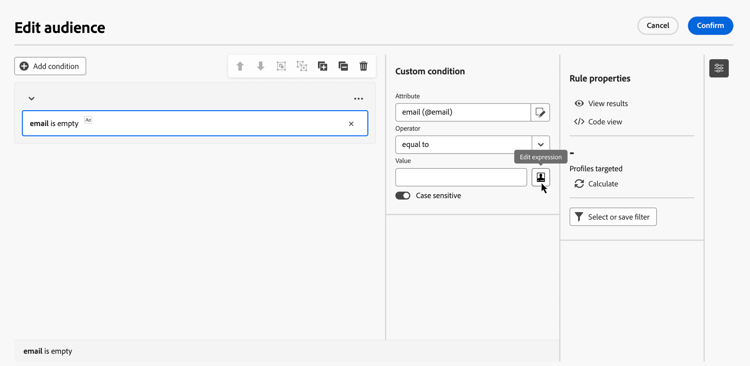
L’editor di espressioni è disponibile dal pulsante Modifica espressione del generatore di regole, disponibile per i campi Attributo e Valore durante la configurazione di una condizione personalizzata.
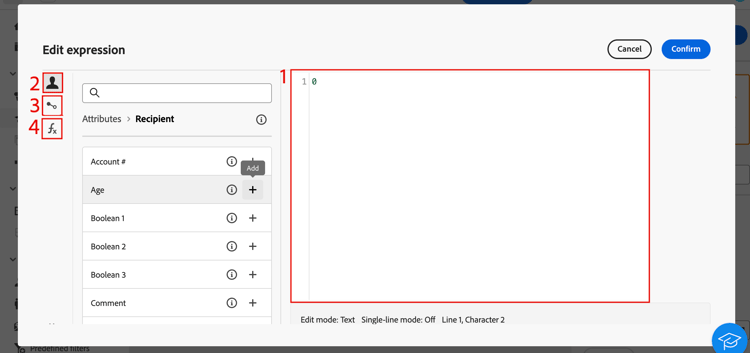
L’editor di espressioni mostra:
-
Un campo di input (1) in cui è definita l’espressione.
-
Un elenco dei campi (2) disponibili che possono essere utilizzati nell’espressione e che corrispondono alla dimensione targeting della query.
-
Elenco delle variabili (3) disponibili che possono essere utilizzate nell’espressione. Questo menu è disponibile per il campo Valore. Scopri come utilizzare le variabili nelle campagne orchestrate
-
Funzioni helper (4), ordinate per categoria.
Modifica l’espressione immettendo un’espressione direttamente nel campo di input. Per aggiungere un campo, una variabile o una funzione di supporto, posizionare il cursore nell’espressione nel punto in cui si desidera aggiungerla e fare clic sul pulsante +.
Funzioni Helper
Lo strumento di modifica delle query consente di utilizzare funzioni avanzate per eseguire filtri complessi a seconda dei risultati desiderati e dei tipi di dati gestiti. Sono disponibili le seguenti funzioni:
Aggregazione
Le funzioni di aggregazione eseguono calcoli su un set di valori.
Data
Le funzioni per date gestiscono i valori di data o ora.
Geomarketing
Le funzioni di geomarketing vengono utilizzate per manipolare i valori geografici.
Numeriche
Le funzioni numeriche vengono utilizzate per convertire il testo in numeri.
Altre
Questa tabella contiene le altre funzioni disponibili.
Stringa
Le funzioni di stringa vengono utilizzate per manipolare un insieme di stringhe.
Finestra
This section contains structured knowledge intended to support interpretation, retrieval, and question answering related to this topic.
For complete understanding, this information should be combined with the documentation on this page. Neither source is intended to stand alone; the page describes the feature, while this section provides additional context that helps disambiguate terminology, intent, applicability, and constraints.
- TL;DR: This page explains how to use the expression editor to manually build rule conditions with fields, variables, and helper functions for manipulating dates, strings, numbers, and other values in Orchestrated campaigns.
Intents:
- Open the expression editor from the Attribute or Value field when configuring a custom condition in the rule builder.
- Enter an expression directly in the input field, or insert a field, variable, or helper function using the + button.
- Use helper functions (Aggregate, Date, Geomarketing, Numeric, Others, String, Window) to manipulate dates, strings, numeric values, and sorting.
- Insert variables into an expression from the Value field.
Glossary:
- Expression editor: a mode accessed from the rule builder Edit expression button that lets you manually enter conditions to form a rule, using advanced functions (product-specific)
- Helper functions: functions sorted by category (Aggregate, Date, Geomarketing, Numeric, Others, String, Window) available in the expression editor to manipulate values (product-specific)
- Fields: items available in the expression editor that correspond to the targeting dimension of the query (product-specific)
- Variables: items available in the expression editor, from the Value field menu, that can be used in an expression (product-specific)
Guardrails:
- The expression editor is available from the rule builder Edit expression button, for the Attribute and Value fields, when configuring a custom condition.
- The variables menu in the expression editor is available only for the Value field, not for the Attribute field.
- The DateOnly function takes into account the server’s timezone, not the operator’s.
Terminology:
- Canonical name: expression editor — variants: Edit expression
- Do not confuse: “fields” (correspond to the targeting dimension of the query) ≠ “variables” (listed in a separate menu, available from the Value field)
FAQ:
- Q: Where is the expression editor available from? — The rule builder Edit expression button, for the Attribute and Value fields, when configuring a custom condition.
- Q: How do I add a field, variable, or helper function to an expression? — Place your cursor in the expression where you want to add it and click the + button.
- Q: What categories of helper functions are available? — Aggregate, Date, Geomarketing, Numeric, Others, String, and Window.
- Q: Does the DateOnly function use my local timezone? — No, it takes into account the server’s timezone, not the operator’s.
- Q: Can I use variables from the Attribute field? — No, the variables menu is available only for the Value field.
Related pages:
- For using variables in an expression from the Value field: Learn how to use variables in Orchestrated campaigns (orchestrated/variables-orchestrated-campaigns.md)
Personas:
- marketer: Can open the expression editor from the Attribute or Value field when configuring a custom condition, and enter an expression directly in the input field. Can place the cursor and select the + button to add a field, variable, or helper function. Can use helper functions sorted by category, such as Aggregate, Date, Geomarketing, Numeric, Others, String, and Window, to manipulate dates, strings, numeric values, and sorting. The page states that the variables menu is available only for the Value field. Where: “Work with the expression editor”.
Onboarding:
- Level: Experienced
- First minimal step: Select the Edit expression button for the Attribute or Value field when configuring a custom condition.
- Next: Learn how to use variables in the expression editor: Use variables in Orchestrated campaigns (orchestrated/variables-orchestrated-campaigns.md)