Code JavaScript pour Analytics for Advertising
Annonceurs avec Advertising DSP uniquement
Pour Advertising DSP, l’intégration Analytics for Advertising effectue le suivi des interactions entre les affichages publicitaires et les clics publicitaires du site. Les visites de clics publicitaires sont suivies par le code Adobe Analytics standard sur vos pages web ; le code Analytics capture les paramètres AMO ID et EF ID dans l’URL de la page de destination et les suit dans leurs eVars réservés respectifs. Vous pouvez effectuer le suivi des visites d’affichage publicitaire en déployant un fragment de code JavaScript dans vos pages web.
Sur la première page vue d’une visite sur le site, le code Adobe Advertising JavaScript vérifie si le visiteur a déjà vu ou cliqué sur une annonce publicitaire. Si l’utilisateur est déjà entré sur le site par le biais d’un clic publicitaire ou s’il n’a pas vu d’annonce publicitaire, le visiteur est ignoré. Si le visiteur a vu une annonce publicitaire et n’est pas entré sur le site par le biais d’un clic publicitaire au cours de l’intervalle de recherche en amont clic défini dans Adobe Advertising, le code Adobe Advertising JavaScript a) utilise le service Experience Cloud ID pour générer un ID supplémentaire (SDID) ou b) utilise la méthode de generateRandomID de Web SDK Adobe Experience Platform pour générer un StitchID. L’un ou l’autre des identifiants est utilisé pour regrouper les données d’Adobe Advertising vers l’accès Adobe Analytics du visiteur. Adobe Analytics interroge ensuite Adobe Advertising pour obtenir l’AMO ID et l’EF ID associés à l’exposition publicitaire. Les ID AMO et EF sont ensuite renseignés dans leurs eVars respectifs. Ces valeurs persistent pendant une période désignée (par défaut, 60 jours).
Analytics envoie toutes les heures à Adobe Advertising les mesures de trafic sur le site (telles que les pages vues, les visites et le temps passé) et tous les événements Analytics personnalisés ou standard, en utilisant l’identifiant d’événement d’urgence comme clé. Ces mesures de Analytics s’exécutent ensuite dans le système d’attribution d’Adobe Advertising pour connecter les conversions à l’historique des clics et de l’exposition.
Déploiement du code JavaScript
La bibliothèque JavaScript se compose de deux lignes qui permettent à Analytics et à Adobe Advertising de communiquer entre eux. Si l’intégration Analytics for Advertising a été terminée lors de la mise en œuvre d’Adobe Advertising, vous devez déjà avoir reçu ce code avec des instructions sur la manière de le déployer.
Le code
Implémentations qui utilisent le code de visitorAPI.js du service d’identification des visiteurs Adobe
<script src="https://www.everestjs.net/static/le/last-event-tag-latest.min.js">
<script>
     if("undefined" != typeof AdCloudEvent)
          AdCloudEvent('IMS ORG Id','rsid');
</script>
Implémentations qui utilisent le code Web SDK Experience Platform alloy.js
<script src="https://www.everestjs.net/static/le/last-event-tag-latest.min.js">
<script>
     if("undefined" != typeof AdCloudEvent)
          stitchId = AdCloudEvent('IMS ORG Id','rsid').generateRandomId();
</script>
Où placer le code
La fonction Analytics for Advertising JavaScript doit être postérieure au service Experience Cloud ID, mais antérieure à votre code Analytics App Measurement. Cela permet de s’assurer que l’ID supplémentaire (SDID) ou le StitchID est inclus dans votre appel Analytics.
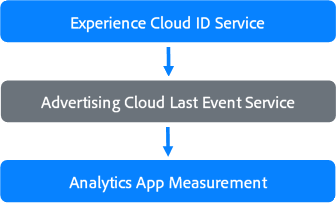
Validation du déploiement du code
Vous pouvez effectuer une validation à l’aide de n’importe quel type d’outil de renifleur de paquets (tel que Charles, Fiddler ou Chrome Developer Tools) en comparant les valeurs des quatre identifiants entre la requête envoyée à Adobe Advertising et la requête envoyée à Analytics, comme indiqué ci-dessous.
Comment confirmer le code avec Chrome Developer Tools validate-js-chrome
-
Ouvrez Chrome Developer Tools et cliquez sur l’onglet Réseau.
-
Chargez une page de site web contenant le JavaScript Analytics for Advertising.
-
Filtrez l’onglet Network par
lastet passez en revue deux lignes :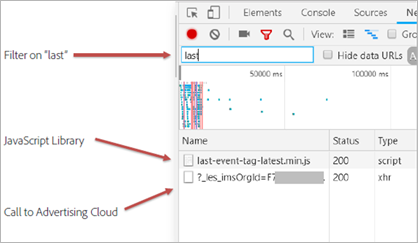
-
La première ligne correspond à l’appel à la bibliothèque JavaScript et est intitulée
last-event-tag-latest.min.js. -
La deuxième ligne correspond à l’appel qui envoie la demande à Adobe Advertising. Elle commence comme suit :
_les_imsOrgId=[your_imsOrgId_here]&_les_url=[your_encoded_url]Si vous ne voyez pas l’appel à Adobe Advertising, il se peut que ce ne soit pas la première page vue de votre visite. À des fins de test, vous pouvez supprimer le cookie afin que l’appel suivant soit la première page vue pour la visite correspondante :
- Dans l’onglet Application , recherchez le cookie
adcloudet vérifiez qu’il contient des_les_v(dernière visite) avec une valeur deyet un horodatage UTC qui expire dans 30 minutes.- Supprimez le cookie
adcloudet actualisez la page.
- Supprimez le cookie
-
-
(Implémentations qui utilisent le code de
visitorAPI.jsdu service d’identification des visiteurs d’Adobe) Filtrez les/b/sspour afficher l’accès Analytics.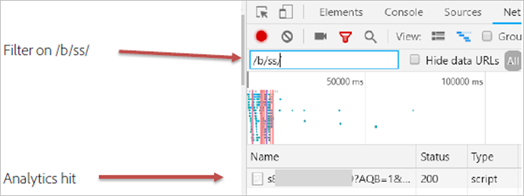
-
(Implémentations qui utilisent Experience Platform Web SDK
alloy.jscode) Filtrez sur les/interactpour vérifier que la payload de la requête envoyée à Edge Network contient desadvertisingStitchID.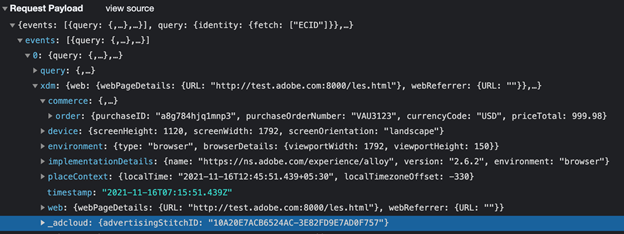
-
Comparez les valeurs des identifiants entre les deux accès. Toutes les valeurs doivent être dans des paramètres de chaîne de requête, à l’exception de l’identifiant de suite de rapports dans l’accès Analytics, qui est le chemin d’URL immédiatement après
/b/ss/.table 0-row-4 1-row-4 2-row-4 3-row-4 4-row-4 5-row-4 ID Paramètre Analytics Edge Network Paramètre Adobe Advertising Organisation IMS Experience Cloud mcorgid_les_imsOrgidID de données supplémentaires sdid _les_sdidID d’assemblage stitchId advertisingStitchIDsous la propriété_adcloudSuite de rapports Analytics La valeur après /b/ss/_les_rsidIdentifiant visiteur Experience Cloud mid _les_midSi les valeurs d’ID correspondent, l’implémentation de JavaScript est confirmée. Adobe Advertising envoie au serveur de Analytics tous les détails de suivi des clics publicitaires ou des affichages publicitaires s’ils existent.
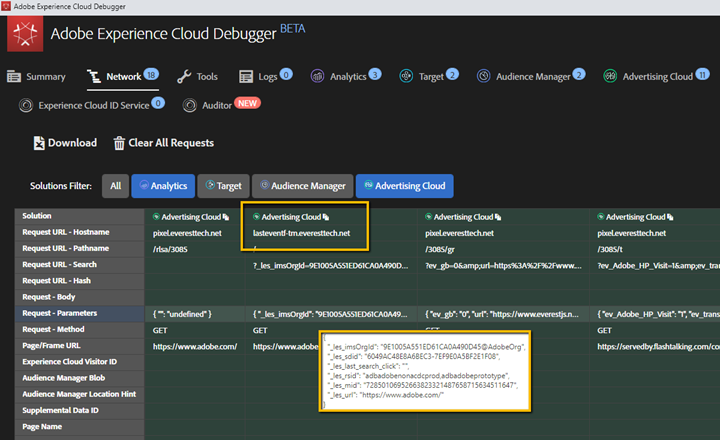
Comment confirmer le code avec Adobe Experience Platform Debugger
-
Ouvrez le Adobe Experience Platform Debugger sur votre page d’accueil.
-
Accédez à l’onglet Network .
-
Dans la barre d’outils Solutions Filter, cliquez sur Adobe Advertising et Analytics.
-
Dans la ligne de paramètre Request URL - Hostname, recherchez
lasteventf-tm.everesttech.net. -
Dans la ligne Request - Parameters, vérifiez les signaux générés, comme à l’étape 3 de la rubrique Confirmer le code avec Chrome Developer Tools.
- (Implémentations qui utilisent le code de
visitorAPI.jsdu service d’identification des visiteurs d’Adobe) Assurez-vous que le paramètreSdidcorrespond auSupplemental Data IDdans le filtre Adobe Analytics. - (Implémentations qui utilisent Experience Platform Web SDK
alloy.jscode) Assurez-vous que la valeur du paramètreadvertisingStitchIDcorrespond auSdidenvoyé à Experience Platform Edge Network. - Si le code n’est pas généré, vérifiez que le cookie Adobe Advertising a été supprimé dans l’onglet Application . Une fois la suppression effectuée, actualisez la page et répétez le processus.
- (Implémentations qui utilisent le code de