En esta página: Aprenda a utilizar la actividad de segmentación Dividir para segmentar la población entrante de una campaña orquestada en varios subconjuntos en función de reglas de filtrado, límites o tamaño de población.
La actividad División es una actividad de Segmentación que permite segmentar la población entrante en varios subconjuntos en función de diferentes criterios de selección, como las reglas de filtrado o el tamaño de la población.
Configuración de la actividad división split-configuration
Siga estos pasos para configurar la actividad División:
-
Agregue una actividad Split a su campaña orquestada.
-
El panel de configuración de actividad se abre con un subconjunto predeterminado. Haga clic en el botón Añadir segmento para añadir tantos subconjuntos como desee para segmentar la población entrante.
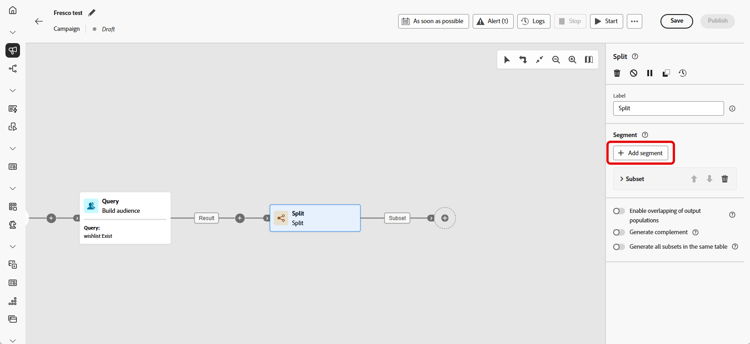
note important IMPORTANT La actividad División procesa los subconjuntos en el orden en que se añaden. Por ejemplo, si el primer subconjunto captura el 70 % de la población, el siguiente aplica sus criterios al 30 % restante. Antes de ejecutar la campaña orquestada, asegúrese de que los subconjuntos se ordenan según lo previsto. Utilice los botones de flecha para ajustar su posición. -
Una vez creados los subconjuntos, la actividad muestra de forma predeterminada tantas transiciones de salida como subconjuntos. Se recomienda encarecidamente cambiar la etiqueta de cada subconjunto para identificarlo fácilmente en el lienzo de campaña orquestada.
-
Configure los filtros para cada subconjunto:
-
Haga clic en un subconjunto para abrir su configuración.
-
Haga clic en Crear filtro para definir las reglas de filtrado con el generador de reglas; por ejemplo, seleccione perfiles con una dirección de correo electrónico válida.
-
En el campo Código de segmento, escriba un código para identificar el subconjunto en los registros. Este código se almacena junto con los datos de perfil y se puede utilizar para realizar un seguimiento y medir el rendimiento de cada segmento. Si se deja vacía, se utiliza automáticamente la etiqueta de subconjunto.
-
Para limitar el número de perfiles seleccionados, active Habilitar límite y especifique un número o porcentaje.
-
Para omitir una transición cuando el subconjunto esté vacío, habilite Omitir transición vacía.
-
-
Para incluir perfiles que no coinciden con ningún subconjunto, habilite Generar complemento. Se creará una transición de salida adicional para la población restante.
note NOTE Habilite Generar todos los subconjuntos de la misma tabla para agrupar todos los subconjuntos en una sola transición. -
Utilice Habilitar superposición de poblaciones de salida para permitir que los perfiles aparezcan en varios subconjuntos:
-
Si no está marcado, cada perfil se asigna a un solo subconjunto, el primero cuyos criterios coinciden aunque cumpla los requisitos de otros subconjuntos.
-
Si está marcado, los perfiles se pueden incluir en varios subconjuntos si cumplen los criterios de cada uno.
-
La actividad ahora está configurada. En la ejecución de una campaña orquestada, la población se segmenta en los diferentes subconjuntos, en el orden en que se hayan agregado a la actividad.
Ejemplo split-example
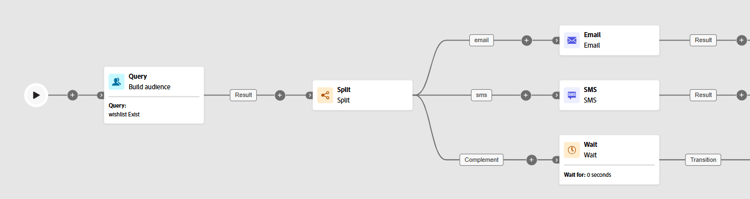
En el ejemplo siguiente, la actividad División se utiliza para segmentar un público en distintos subconjuntos basados en el canal de comunicación que queremos utilizar:
-
Subconjunto 1 “correo electrónico”: incluye perfiles que han proporcionado un número de teléfono.
-
Subconjunto 2 “SMS”: identifica perfiles con un número de teléfono móvil almacenado en la base de datos.
-
Transición del complemento: captura los perfiles restantes que no cumplen los criterios de ninguno de los subconjuntos.
This section contains structured knowledge intended to support interpretation, retrieval, and question answering related to this topic.
For complete understanding, this information should be combined with the documentation on this page. Neither source is intended to stand alone; the page describes the feature, while this section provides additional context that helps disambiguate terminology, intent, applicability, and constraints.
- TL;DR: This page explains how to configure the Split targeting activity in an Orchestrated campaign to segment an incoming population into multiple subsets using filtering rules, limits, sorting, and complement or overlap options.
Intents:
- Add and order subsets to segment the incoming population of an Orchestrated campaign.
- Create filtering rules for a subset using the rule builder.
- Limit the number or percentage of profiles selected by a subset, optionally ranked by a profile attribute.
- Capture remaining unmatched profiles using a complement transition.
- Control whether a profile can appear in more than one output subset.
- Skip the output transition for a subset when its incoming population is empty.
Glossary:
- Split: a Targeting activity that segments the incoming population into multiple subsets based on defined selection criteria such as filtering rules or population size (product-specific)
- Subset: a segment of the incoming population defined within the Split activity, processed in the order it is added (product-specific)
- Create filter: the control used to define filtering rules for a subset using the rule builder (product-specific)
- Segment code: a field where you enter a code to identify a subset in logs, stored alongside profile data to track and measure segment performance; if left empty, the subset label is used automatically (product-specific)
- Enable limit: the option used to restrict the number or percentage of profiles selected by a subset (product-specific)
- Enable sorting: the option used to rank selected profiles by a profile attribute, in ascending or descending order, when a population limit is set (product-specific)
- Generate complement: the option that creates an additional outbound transition containing profiles not matched by any subset (product-specific)
- Generate all subsets in the same table: the option that groups all subsets into a single output transition (product-specific)
- Skip empty transition: the option that disables the output transition for a subset when its incoming population is empty (product-specific)
- Enable overlapping of output populations: the option that controls whether a profile can be present in several output transitions at once (product-specific)
Guardrails:
- The Split activity processes subsets in the order they are added; for example, if the first subset captures 70% of the population, the next subset applies its criteria to the remaining 30%.
- If Enable overlapping of output populations is unchecked, a recipient cannot be present in several output transitions even if they meet the criteria of several subsets; they are placed in the target of the first subset with matching criteria.
- If Enable overlapping of output populations is checked, recipients can be found in several subsets if they meet each subset’s filter criteria.
Terminology:
- Canonical name: Split — variants: Split activity, Split targeting activity
FAQ:
- Q: In what order does the Split activity process subsets? — In the order they are added to the activity; for example, if the first subset captures 70% of the population, the next subset applies its criteria to the remaining 30%.
- Q: What happens if the Segment code field is left empty? — The subset label is used automatically to identify the subset in logs.
- Q: How can I limit how many profiles go into a subset? — Enable the Enable limit option and specify a number or percentage of the population to include.
- Q: How do I capture profiles that do not match any subset? — Enable Generate complement to create an additional outbound transition for the remaining population.
- Q: Can a profile end up in more than one subset? — Only if Enable overlapping of output populations is checked; otherwise, the profile is assigned to the first subset whose criteria it matches.
- Q: How do I avoid an output transition when a subset’s population is empty? — Enable the Skip empty transition option.
Examples:
- Split activity used to segment an audience by communication channel: Subset 1 “email” includes profiles who have provided a phone number; Subset 2 “sms” targets profiles with a mobile phone number stored in the database; a Complement transition captures any remaining profiles who do not meet the criteria for either subset.
Best practices:
- We strongly recommend changing the label of each subset to identify them easily in the Orchestrated campaign canvas.
- Before running your Orchestrated campaign, make sure the subsets are ordered as intended, using the arrow buttons to adjust their position.
Personas:
- marketer: Can add subsets to a Split activity to segment the incoming population in an Orchestrated campaign. Can create filtering rules for a subset using the rule builder, and limit selected profiles with Enable limit. Can enable sorting to rank selected profiles by a profile attribute when a limit is set. Can enable Generate complement to capture profiles not matched by any subset, and enable overlapping of output populations. The page states that subsets are processed in the order they are added. Where: “Configure the Split activity”.
Onboarding:
- Level: Intermediate
- First minimal step: Add a Split activity to your Orchestrated campaign.
- Success check: The activity shows as many output transitions as there are subsets.