En esta página: Recupere la solicitud cURL generada y úsela para almacenar en déclencheur su campaña activada por la API activa a través de las API, con instrucciones para solucionar problemas para que pueda resolver los retrasos de entrega y los errores de autenticación.
Una vez activada la campaña, debe recuperar la solicitud cURL de muestra generada y utilizarla en la API para crear la carga útil y almacenar la campaña en déclencheur.
Lectura obligatoria must-read
-
Fechas de inicio y finalización de la campaña: si ha configurado una fecha específica de inicio o finalización al crear la campaña, esta no se ejecutará fuera de estas fechas y las llamadas a la API fallarán.
-
Tiempo de espera de llamada: la llamada a la API de REST de ejecución de mensaje interactivo tiene un tiempo de espera de 60 segundos. Sin embargo, hay reintentos internos en caso de tiempos de espera inesperados para garantizar el envío.
Déclencheur de la campaña trigger
-
Abra la campaña y copie y pegue la solicitud de carga útil de la sección cURL request. Esta carga útil incluye todas las variables de personalización (perfil y contexto) utilizadas en el mensaje. Está disponible una vez que la campaña está activa.
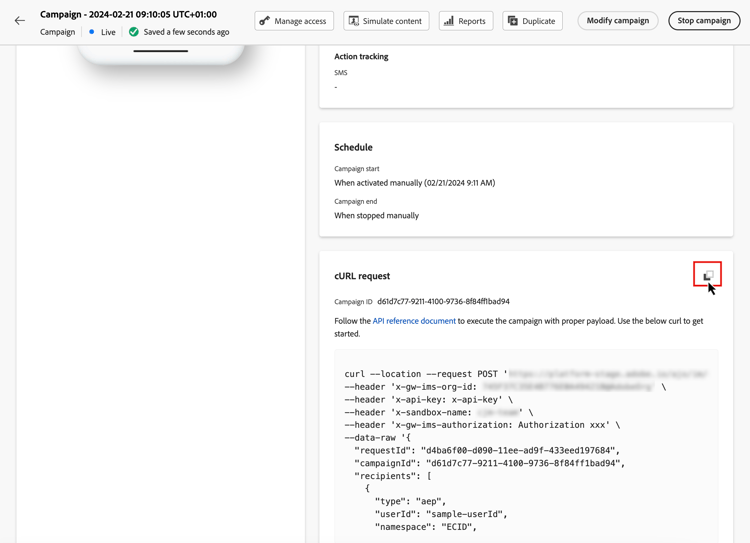
note important IMPORTANT Los extremos de la sección cURL difieren entre las campañas estándar y de alto rendimiento. -
Utilice esta solicitud de cURL en las API para crear la carga útil y almacenar en déclencheur la campaña. Para obtener más información, consulte la documentación de la API de ejecución de mensajes interactiva, donde se enumeran todos los extremos de las campañas de rendimiento estándar y alto.
También hay ejemplos de llamadas API disponibles en esta página.
Resolución de problemas troubleshooting
Retrasos de envío de correo electrónico delivery-delays
Si los tiempos de entrega de correos electrónicos superan las expectativas, investigue las posibles interrupciones o problemas de rendimiento con servicios externos, como proveedores de infraestructura en la nube o proveedores de servicios de correo electrónico. Los registros de Journey Optimizer registran las marcas de hora de salida de los mensajes, lo que puede ayudar a determinar si se produjeron retrasos en la fase posterior de la canalización de envíos.
Errores de autenticación de Azure cosmos DB (error de servidor interno 500) cosmosdb-auth-errors
Si encuentra 500 errores internos del servidor al activar campañas activadas por API, y los registros del sistema muestran un error 403 prohibido de Azure Cosmos DB con un mensaje como:
“El acceso a su cuenta está revocado actualmente porque el servicio Azure Cosmos DB no puede obtener el token de autenticación AAD para la identidad predeterminada de la cuenta”
Este error suele producirse cuando la entidad de seguridad de servicio de Azure necesaria para la autenticación de Cosmos DB se ha deshabilitado, eliminado o configurado incorrectamente.
-
Compruebe la entidad de seguridad del servicio Azure. Asegúrese de que la identidad administrada o la entidad de seguridad del servicio Azure esté habilitada y de que no se haya deshabilitado ni eliminado en Azure Active Directory.
-
Comprobar permisos: confirme que la entidad de seguridad de servicio tiene los permisos necesarios para acceder a los recursos de Azure Key Vault y Cosmos DB. El principal de servicio debe tener asignaciones de funciones adecuadas para autenticarse con Azure Cosmos DB.
-
Revisar la configuración de Azure Cosmos DB CMK: si utiliza claves administradas por el cliente (CMK), consulte la guía de solución de problemas de Azure Cosmos DB CMK para ver los pasos detallados para restaurar la adquisición de tokens AAD.
-
Volver a habilitar y probar: después de corregir la configuración, vuelva a habilitar la entidad de seguridad de servicio si estaba deshabilitada y vuelva a probar las llamadas a la API de campaña transaccional para confirmar que la autenticación se realice correctamente y que los mensajes se entreguen.
| note |
|---|
| NOTE |
| Este problema suele deberse a una configuración incorrecta o a la desactivación accidental de la entidad de seguridad del servicio de Azure necesaria para la autenticación de Cosmos DB. Si mantiene la entidad de seguridad de servicio habilitada y configurada correctamente, se evitará este error en el futuro. |
This section contains structured knowledge intended to support interpretation, retrieval, and question answering related to this topic.
For complete understanding, this information should be combined with the documentation on this page. Neither source is intended to stand alone; the page describes the feature, while this section provides additional context that helps disambiguate terminology, intent, applicability, and constraints.
- TL;DR: This page explains how to retrieve the generated cURL request of an activated API triggered campaign and use it in the APIs to trigger the campaign, with troubleshooting for email delivery delays and Azure Cosmos DB authentication errors.
Intents:
- Retrieve the generated sample cURL request of a live API triggered campaign
- Use the cURL request in the APIs to build the payload and trigger the campaign
- Know that campaign start and end dates and a call timeout apply to the API call
- Find the endpoints for standard and High throughput campaigns
- Troubleshoot email delivery delays and 500 Internal Server Errors caused by Azure Cosmos DB authentication
Glossary:
- cURL request: Section of the campaign that holds the generated sample request; its payload includes all personalization (profile and context) variables used in the message
- Interactive Message Execution REST API: The API into which you use the cURL request to build your payload and trigger the campaign (product-specific)
- Azure service principal: The identity required for Azure Cosmos DB authentication (product-specific)
Guardrails:
- If a specific start and/or end date was configured when creating the campaign, the campaign is not executed outside these dates, and API calls fail.
- The call to the Interactive Message Execution REST API has a timeout of 60 sec. Internal retries are in place in case of unexpected timeouts to guarantee the delivery.
- The endpoints in the cURL section differ between standard and High throughput campaigns.
Prerequisites and permissions:
- The campaign must be activated: the cURL request is available once the campaign is live.
Applicability:
- Applies to API triggered campaigns, both standard and High throughput.
Terminology:
- Canonical name: Execute an API triggered campaign
- Acronym: CMK — Customer-Managed Keys (used on the page body)
FAQ:
- Q: Where do I find the request to trigger my campaign? — Open the campaign, then copy-paste the payload request from the cURL request section. It is available once the campaign is live.
- Q: What does the cURL payload contain? — All personalization (profile and context) variables used in the message.
- Q: Why do my API calls fail? — If a specific start and/or end date was configured when creating the campaign, it is not executed outside these dates, and API calls fail.
- Q: Where are the endpoints for standard and High throughput campaigns listed? — In the Interactive Message Execution API documentation.
- Q: Where can I find API call examples? — On the messaging samples page of the Journey Optimizer APIs documentation.
Troubleshooting:
- Email delivery delays — If email delivery times exceed expectations, investigate potential outages or performance issues with external services, such as cloud infrastructure providers or email service providers. Journey Optimizer logs record message departure timestamps, which can help determine whether delays occurred downstream in the delivery pipeline.
- Azure cosmos DB authentication errors (500 internal server error) — Symptom: 500 Internal Server Errors when triggering API-triggered campaigns, and the system logs show a 403 Forbidden error from Azure Cosmos DB with a message such as “Access to your account is currently revoked because the Azure Cosmos DB service is unable to obtain the AAD authentication token for the account’s default identity”. Cause: the Azure service principal required for Cosmos DB authentication has been disabled, deleted, or misconfigured. Documented resolution: verify that the Azure service principal or managed identity is enabled and has not been disabled or deleted in your Azure Active Directory; check that the service principal has the necessary permissions and role assignments to access the Azure Key Vault and Cosmos DB resources; if you are using Customer-Managed Keys (CMK), consult the Azure Cosmos DB CMK troubleshooting guide; after correcting the configuration, re-enable the service principal if it was disabled, and re-test your transactional campaign API calls to confirm that authentication succeeds and messages are delivered.
Related pages:
- Differences between standard and High throughput endpoints: High throughput campaigns (campaigns/api-triggered-high-throughput.md)
- All endpoints for standard and High throughput campaigns: Interactive Message Execution API documentation (https://developer.adobe.com/journey-optimizer-apis/references/messaging#tag/execution)
- API call examples: page linked as “this page”, messaging samples of the Journey Optimizer APIs documentation (https://developer.adobe.com/journey-optimizer-apis/references/messaging-samples)
- Azure Cosmos DB CMK errors: Azure Cosmos DB CMK troubleshooting guide (https://learn.microsoft.com/en-us/azure/cosmos-db/cmk-troubleshooting-guide#azure-active-directory-token-acquisition-error)