AI shopping queries are already happening at scale, and if your catalog cannot answer them, you are invisible before the funnel begins. This article covers how to structure catalog attributes, FAQs, and schema markup for generative engine optimization (GEO).
The interface changed, not the funnel
Right now, someone is asking AI about our products and AI is deciding to include us or not. That is scary. Open AI is generating over 50 million shopping queries each day. By 2032, the generative AI in e-commerce market is projected to reach $2.1 billion with a 14% annual growth rate. This is not an emerging channel anymore. The question for all of us is: can AI understand our products?
The old model gave customers options: ten results from Google and the customer decided. The new model gives customers answers. If you are not part of the answer, you are not on page two. You are simply invisible, and invisibility is your new competition.
The funnel is not disappearing. Awareness, research, and comparison still happen. But now everything is compressed into a single conversation before the customer even reaches your site. It is not the funnel that is changing, but rather, the interface.
Two buyers who demonstrate this gap
Meet Sara. She is a mom buying football cleats for her son's eighth birthday. She does not know anything about the sport or the gear, so she opens ChatGPT and describes the need: what cleats should I buy for an eight-year-old boy playing this sport for the first time?
One catalog answers that question: it describes the product the way Sara is asking, with guidance for a beginner parent. The other catalog stores warehouse information. The winner is not the one with the better product. The winner is the one with the better answer. Catalog B may have an equally good cleat. But for the LLM, it does not have the answers Sara was looking for.
Another example: Marcus is a procurement buyer shortlisting three suppliers for a new industrial requirement. He goes to Perplexity. Supplier C is not cited. The irony is that Supplier C actually had the information Marcus was looking for. The R717 refrigerant coding and FDA compliance documents were there, but they were buried as PDFs because AI was unable to connect the answer to the question. The information was not missing, but rather, the translation was.
What LLMs cannot see and what they reward
AI is working with exposed knowledge, not organizational knowledge. Here is what typically stays invisible:
-
Product images with no alt text - for a human, this is a photo but for an LLM, it is nothing referenceable.
-
Size charts saved as PNGs or JPGs - just images, not data
-
SKUs stored as alphanumeric warehouse codes - not query-able against a buyer's question
-
Keyword-stuffed descriptions - generic information, not answers
-
Compliance specifications buried in PDFs - unreadable for LLMs
What gets cited instead is structure: FAQs, schema markup, attributes in buyer language, customer reviews as readable text, and support call data turned into content. None of this is new, but the difference is that it is now structured in a way AI can actually use.
Thus, GEO is not a content problem; it is a knowledge architecture problem.
GEO is exposing a problem SEO kept hidden
With SEO, the logic was to rank for keywords. Marketing teams optimized for click-through rates. You could pay to appear first, and volume of content often won because the goal was to get found.
With GEO, the logic is different:
-
Visibility: Can LLMs find your product information at all? If you do not have this addressed, quality does not matter.
-
Quality: Is your structured content available in buyer's language?
-
Precision: Are your exact answers addressing the exact questions your customers are asking?
SEO was about having a good place on the supermarket shelf. GEO is the person who comes and assists you with the purchase.
Five tactics you can apply in Adobe Commerce today
These five tactics address two data sources: your catalog and your support system. You can apply the same framework to all data sources.
Tactic 1: Stop storing product data, start storing buyer answers
Typically, catalogs store an alphanumeric SKU, a name, a description from the SEO team, and the basic attributes: brand, flavor, weight, content. LLMs cannot use this to answer questions.
The fix is to create new attributes that can answer buyer questions. For example, for a protein supplement, that means flagging it as best for muscle growth, noting it meets a high-protein diet, marking it lactose-free, indicating daily use, and specifying it is suited for strength training. Now, if a customer asks any question across those topics, you can get cited.
Tactic 2: Add FAQs directly to your PDPs
Most e-commerce sites have FAQs buried deep. Go into the admin and prepare your PDPs (product detail pages) to have embedded FAQs as content. Pair the question to the answer.
Is this lactose-free? Yes, it is very isolated and suitable for lactose-intolerant users.
Can I take it before bed? Yes.
Does it mix with water? Yes, you can mix it with hot or cold beverages.
You are not only helping customers who land directly on your PDPs. You are providing that information to agents and LLMs as if they themselves were customers. Treat your GEO work as enabling information for a new customer type.
Tactic 3: Expand your schema markup beyond the basics
Most Adobe Commerce implementations stop too early in schema markup, they expose the product name, price, and availability, then stop. Full schema markup goes further. Add the aggregated rating so LLMs know it has 4.8 stars among 2,000 reviews. Indicate where the FAQs are located and surface the customer reviews. After you enhance your catalog information, you must make it available for LLMs to fetch.
Tactic 4: Do metadata with intent, not just keywords
Instead of adding random keywords that help you rank, add words that help answer the customer's intent. For a protein supplement: the diet type, how to mix it, even recipes for protein pancakes. The intent of the customer is not to know your warehouse code. The intent is to have supporting information about a product. That applies across all industries.
Tactic 5: Turn call center and chatbot data into catalog content
This knowledge already exists inside your business. While nobody uses it for this purpose, it is very easy to implement. If you go and ask your call center lead, you will be amazed at how many similar questions already exist. Three hundred questions asking whether the protein mixes with coffee: that is gold.
What does measuring LLM visibility look like?
Once you have improved catalog structure, attributes, and content, the natural question is: how do we know it is working? Chris Seedle, e-Commerce and Marketing Director at Zip Corvette, shares below what measurement looks like in practice.
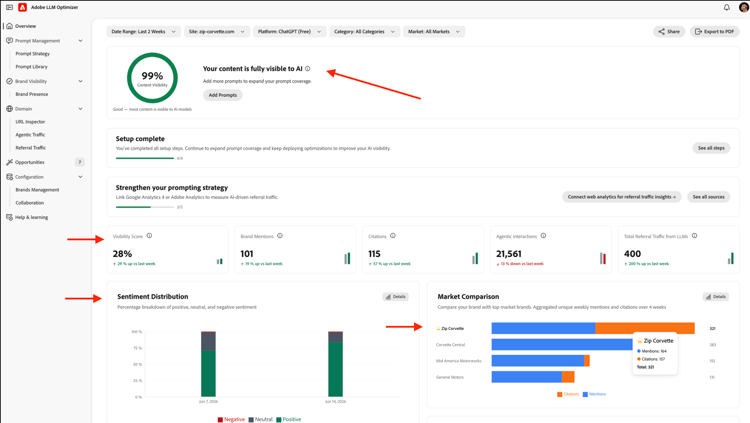
We are using Adobe LLM Optimizer to see what our visibility is to AI. Can AI actually find us? Are our products, our expertise, and our content appearing when people ask Corvette-parts-related questions? In the past, we measured rankings and traffic. Now we are starting to measure visibility, mentions, and citations inside the AI experience.
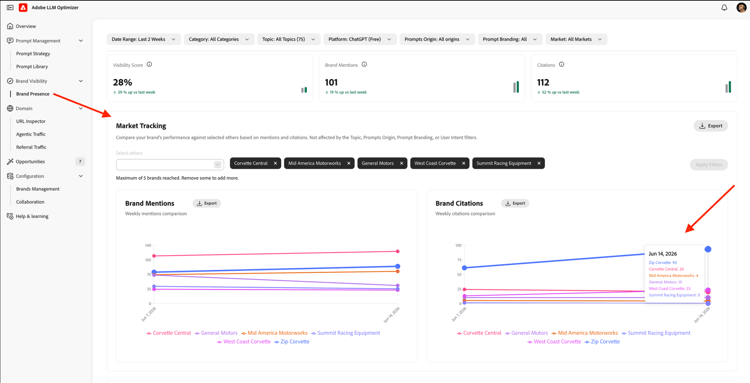
We are also tracking competitive presence. When AI discussions in our category are happening, are we even part of the conversation? This gives us a completely different perspective on market share and discoverability than traditional search.
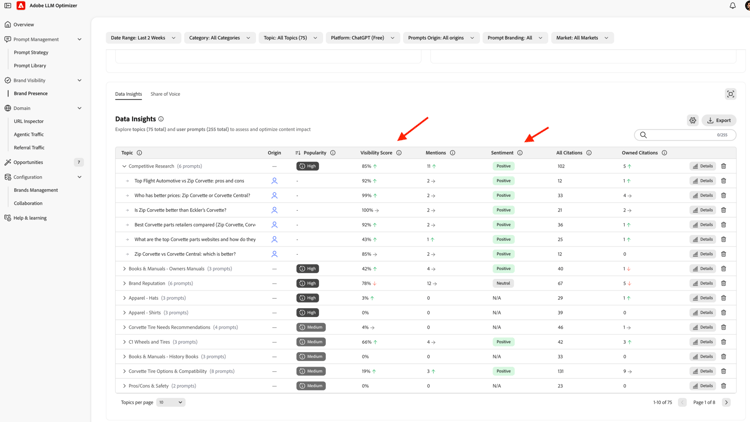
The most valuable question, though, is about gaps. What topics are we visible for? What questions are producing citations? What questions are we not answering well enough yet? The output is not a dashboard. The output is the action we are going to take from examining it.
We started with 200 prompts and we are expanding to over a thousand. It just depends on your catalog size. We are still early. I do not think anyone in the industry has completely figured this out yet, but this is what it starts to look like when measurement becomes part of your workflow.
Actionable next steps
-
Audit your 10 most important PDPs for question-answering ability. Not for SEO, for understanding whether those pages actually answer the questions a customer would bring to an LLM.
-
Add three FAQ pairings per product to your highest-friction PDPs. Go into the Adobe Commerce admin and create embedded FAQ content as structured page elements.
-
Write down the five questions your customers ask before they buy. If those answers do not exist in your catalog, that is your GEO roadmap for the rest of the year.
-
Create new catalog attributes in buyer language. In Adobe Commerce admin, add attributes that answer intent-based questions, diet type, use case, compatibility, training style, not warehouse codes.
-
Talk to your call center lead this week. Ask for the top recurring questions. Those are ready-made FAQ content; turn them into structured catalog entries.
-
Contact your Adobe account manager about LLM Optimizer and Brand Visibility. Understand what measurement tooling is available to you so measurement can begin alongside your content work.
Frequently asked questions (FAQs)
-
How many prompts do we need to set up for LLM visibility tracking?
It depends on catalog size and SKU count. Zip Corvette started with 200 prompts and is expanding to over a thousand as they scale up coverage. -
What share of traffic is actually coming from LLMs versus organic search today?
It varies by industry, but most organizations are seeing LLM-driven traffic in the low single digits right now. Some are already seeing organic search traffic decline by 20-25 percent as a result, and the channel is projected to represent 30-50 percent of conversions within five years. -
Does semantic SEO still matter, or has GEO replaced it?
SEO is not dead, it is evolving. Keywords still matter for ranking, but GEO adds a second layer built around buyer intent, the same intent captured in FAQs and support tickets, not just search terms. -
Fixing every product SKU page one by one with large catalogs isn't realistic, what's the practical approach?
Prioritize by revenue impact rather than trying to fix everything at once. Start with your top-selling or highest-friction SKUs, build the structured-data pattern once, then replicate it down the catalog using agentic workflows or added workforce.
Key takeaways
-
Invisibility is your new competition. If you are not part of the AI answer, you are not on page two. You simply do not exist in that interface.
-
GEO is a knowledge architecture problem, not a content problem. The information is rarely missing from the organization; it is the translation that is missing.
-
The funnel is compressed, not dead. Awareness, research, and comparison now happen inside a single AI conversation before the customer reaches your site.
-
Your call center data is gold. The questions your support team already answers are the same questions customers ask LLMs. Turn them into catalog FAQs.
-
Organizations that win will not have better AI. They will have better answers.
-
Measurement is emerging now. Visibility, mentions, and citation gaps, not traffic and rankings, are the new metrics to instrument.
To dive deeper into LLM optimization for commerce, check out this Perspectives article from Adobe Commerce Champion Jelica Ariganello: Why LLM Optimization Will Define the Next Era of Commerce.