Generative AI is becoming a central influence in product discovery, comparison, and decision-making. Businesses that begin preparing their product data for AI-driven recommendation systems today will be well positioned as this shift accelerates across the next five years of commerce.
The new discovery landscape
Search was once the front door to commerce. A customer typed a phrase, an algorithm returned ten blue links, and brands fought to appear at the top. For two decades this model defined digital strategy, SEO budgets, and product discovery.
But consumer behavior has changed - not incrementally, but structurally. Today, a growing number of product decisions start with AI chat assistants, summarizers, recommendation engines, and personalized product researchers. A shopper can ask:
“What is the best espresso machine under $400 for a small office?”
and receive a complete shortlist, feature breakdown, price reasoning, and justification - all without ever seeing a search results page.
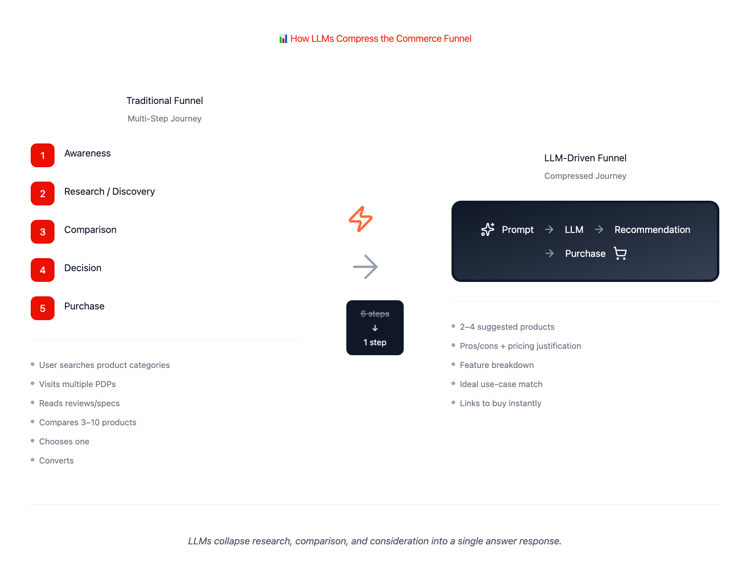
Rather than replacing the funnel, AI is compressing it. Discovery, comparison, and evaluation can now happen within a single moment. This gives brands a new opportunity to shape how products are understood, interpreted, and recommended. Not from Google rankings - but from the conversation itself.
This is where Adobe LLM Optimizer becomes mission-critical.
The shift: AI is becoming the default discovery engine
Optimization once meant ranking high in search results. Today, optimization means ensuring AI understands your products well enough to recommend them confidently and accurately.
Three major shifts are guiding this change:
1. Shopping is becoming conversational
Customers increasingly expect direct answers, not pages of options. LLMs summarize thousands of reviews, attributes, and specs faster than a user can scroll. The model becomes the shelf. The model becomes the salesperson. The model becomes the entire first stage of the buying journey.
2. AI collapses the research funnel
What used to take minutes or hours now completes in seconds. Brands who prepare product data for this compressed journey are more likely to be present at the moment of decision.
3. Product data must be narrative, not metadata
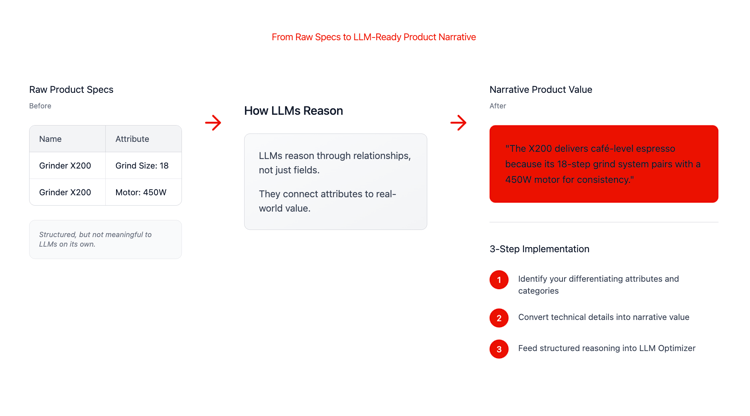
Models don’t evaluate raw attributes - they translate them into meaning.
It’s not “Material=18/10 stainless steel.” but “This thermos maintains temperature for 12 hours because of double-wall stainless build.”
If you don’t provide this language, models infer - or hallucinate. The more clearly a product’s benefits are expressed, the more confidently AI can surface and recommend it.
One reality is becoming clearer in the market: AI can only recommend what it understands well.
If catalog data isn’t LLM-ready, even strong products may be overlooked - not intentionally, but structurally.
Where SEO shaped visibility in the past, LLM optimization plays a growing role in shaping visibility going forward.
Why Adobe LLM Optimizer is the bridge between models & Adobe Commerce
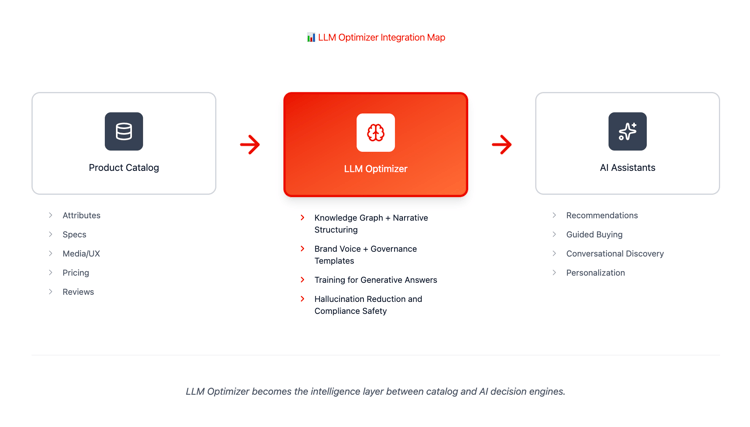
Adobe built LLM Optimizer to help commerce teams prepare for this new discovery model. It acts as a brand-intelligence layer - transforming catalog data into structured, governable knowledge that LLMs can interpret and respond with.
Capabilities of Adobe LLM Optimizer
Mapping operational capabilities to real business impact.
Why it Matters
In the same way AEM enabled brands to industrialize content, LLM Optimizer industrializes AI-driven product discovery.
This is not experimental.
This is infrastructural.
Think of it this way:
SEO in 2010 was optional.
SEO in 2018 was required.
LLM optimization in 2025–2030 is defining which brands lead.
What happens when you don’t optimize your catalog for AI
A stark scenario:
A shopper asks an AI assistant:
“Which K-Cup machine works best for large offices?”
The model returns 3 options - none are yours. Why?
- Not because your product lacked features.
- Not because your pricing was poor.
- Not because your brand was unknown.
But because:
- Product information lacked context
- Benefits weren’t described narratively
- LLMs couldn’t differentiate it meaningfully
- Key attributes weren’t structured for ingestion
The model didn’t overlook your product - it simply had less to work with.
Brands that translate catalog data into narrative knowledge are better positioned to appear in generative recommendations. Those that don’t risk silence - not from penalty, but from absence.
LLM Optimizer is the translation layer.
A practical framework for Commerce teams
How Adobe Commerce + LLM Optimizer work together as a visibility engine
These steps help commerce teams evolve from traditional optimization toward LLM-driven clarity:
Step 1 - Build a product knowledge graph
LLMs reason through relationships. Rather than listing specs separately, express how attributes create value.
Step 2 - Create brand-aligned content templates
Consistency increases trust, both human and machine
Content Type
Example Output
Strategic Value
This approach streamlines generation, review, governance, and localization - at scale.
Step 3 - Prepare for zero-click product recommenders
Shoppers increasingly ask AI instead of browsing. So ask yourself:
- What questions will shoppers ask an AI instead of searching?
- What concerns might the buyer raise?
- What questions drive our category?
- What competitor claims must we counter?
Convert these into LLM-ready FAQ assets inside Optimizer.
How prompts activate product intelligence
If User Asks
Model Should Highlight
LLM Optimizer stores this reasoning as a dynamic product knowledge layer. As prompts diversify, the model retrieves structured intelligence, not guesses.
Step 4 - Evolve your KPIs to match AI-first behavior
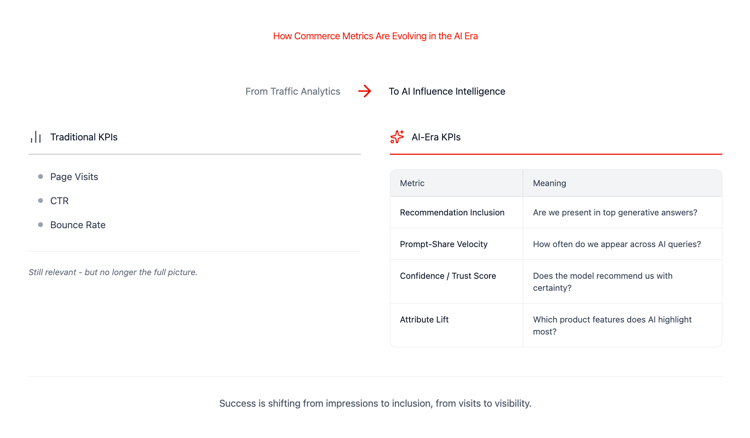
Your analytics strategy must evolve with your commerce engine.
AI visibility risk map for commerce teams
Risk
Impact
The next competitive battlefield is LLM visibility - not search ranking.
A future we can shape together
Generative AI is changing how product discovery starts - not abruptly, but progressively and with growing adoption. The brands investing in clarity, structure, and intelligible product narratives today are laying the groundwork for a more effortless customer journey tomorrow.
LLM Optimizer is more than a convenience layer.
It’s a foundation for discovery, comprehension, and trust in an AI-mediated buying world.
By preparing catalog data for LLM reasoning now, businesses can enhance how confidently they can be recommended later - with a stronger narrative, more accurate representation, and higher-quality engagement across multiple surfaces.
The shift is underway, and it holds enormous potential.
With thoughtful adoption, we’re not just adapting to the future of commerce - we’re helping build it.