Moving from a Workfront “doer” to a certified professional reveals the gap between hands-on experience and platform-wide expertise, and shows how certification helps bridge it. This article shares a practical approach to identifying knowledge gaps, building deeper skills, and using certification to drive both personal growth and better Workfront outcomes.
Realizing there was more to learn
I’ve been working in Workfront for nearly six years, and early on I focused on building a strong foundation by learning what was needed to successfully support and evolve my specific instance. As I became more involved in the community, I started to realize that Adobe certifications carried real value. They helped signal to others that you are not just experienced, but someone they can rely on as a resource.
That realization shifted my priorities. I began focusing on certification as a way to stay up to date on everything Workfront has to offer and to better understand what the industry values. In practice that meant to expand beyond the areas I used every day, like projects and tasks, and building deeper knowledge in reporting, resource management, financials, and administrative features like access levels and layout templates.
Experience can speak for itself, but certification provides immediate clarity to your peers. It shows that you understand the tool, that you are well versed, and that you take pride in your knowledge. Joining the Workfront Champion group reinforced that for me. Seeing so many champions actively pursue certifications and continue to grow their expertise was a huge motivator and pushed me to do the same.

Why certification became the next step
After learning about the Workfront Champion program and the opportunity it provides to connect more closely with Adobe and the broader Workfront community, I began exploring the application process. Adobe hosted a webinar with guidance on how to develop a strong Champion application, and it became clear that the program evaluates the full scope of your contributions and expertise. That gave me a better understanding of how to shape my narrative and where I felt I aligned as a potential Champion.
At the same time, I realized that words alone were not enough to show the depth of my knowledge. While I could speak to my experience, I needed a way to validate it in a more objective and recognized way. Earning a Workfront certification became a natural extension of that goal. It was not just about strengthening my application, but about proving to myself and others that my knowledge aligned with Adobe's standards. That realization ultimately became the main driver behind pursuing my first certification.

Taking the first real step
As I prepared my Workfront Champion application, I began training for the Project Manager certification. My thought process was to start with the first level of certification then continue to build. If I could pass the base certification, I would better understand how my skill set aligned with each level of Adobe’s certifications.
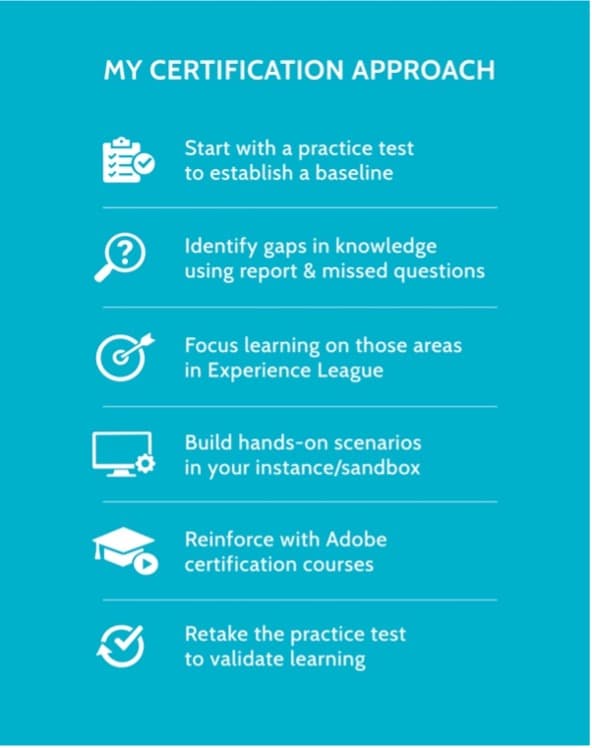
My first step was to take the practice test as a baseline. Because of gaps in my Workfront implementation, I did not do very well on that initial attempt. Using the results of my practice test which contained the Adobe provided coaching report and the practice test questions and answers, I created areas of focus. My immediate gaps were in finance and resource management. I spent time exploring project financial fields (planned vs. actual cost, billing records, rate cards) and how they surface in portfolio and program reporting. I also began exploring areas of resource management like timesheets and Workload Balancer to be able to understand how the resourcing tools functioned and related to one another. Using my instance, I built sample setups that allowed me to play in the space and visualize the concepts.
The gap between being a doer and being certified
One of my primary concerns heading into the preparation for my certification was that I was a doer in the system. When you’re a doer, you know where things are and how to get work done, but you don’t always know the technical names or how Adobe labels them. I had to translate that experience into a deeper understanding and make sure I knew not just how things functioned, but how Adobe defines them. It became less about doing and more about developing a comprehensive understanding of the tool.
I had to know the actual object model, projects, tasks, issues, portfolios, programs, custom forms, and job roles, and understand how they connect across reports, filters, and text mode.
There is a learning curve with the tool. As you go deeper, you hit moments that are challenging and require you to push through. Reporting was one of those areas for me. Once you understand the value and start to explore complex tools like text mode more deeply, those challenges turn into opportunities to expand your knowledge.
Learning to learn again
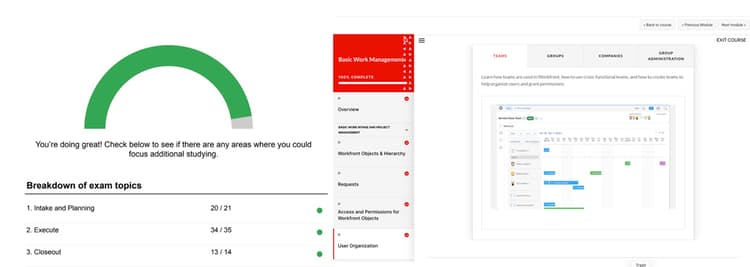
One Adobe offering I took advantage of was the learning program associated with my certification. The course was comprehensive and easy to follow along, providing a good mix of videos, definitions, quizzes and links to explore more in Experience League.
Every time I saw something new, I had a little pad where I wrote it down. For example, I never previously heard of Kickstarts. I wrote: “Kickstarts. Look deeper into this.” When I had a free moment, I would go back to my list and explore.
I began to feel that my skills were more developed and the practice test was much less daunting. At the same time, there was always this underlying fear—what if I fail? Especially when your company is supporting you and covering it. What if I go into this, commit to it, and don’t do well? But it was clear to me that the value outweighed the concern. Heading into the test, I knew that I had the real-world knowledge and the preparation needed to navigate the questions.
When I received the email with my results, it was very validating. Ultimately, I feel that my success on the exam was attributed to being well-rounded in the tool. Some questions were straight from the course, while others I learned through hands on experience. As with all exams, the true time spent obtaining knowledge is reflected in your results.
What the certification changed
Success with Workfront was about quick wins, specifically what would make large impacts and drive efficiency. While my goal of becoming a Workfront Champion drove my desire to obtain a certification, it also gave me the opportunity to look back at some of my past builds. This reflection allowed me to question whether they truly aligned with best practices. I could begin adding more thoughtful complexity to my configurations as I gained a deeper understanding of Workfront's capabilities. I found myself revisiting areas like project templates, request queues, approval workflows, and custom forms to evaluate whether they matched what the exams defined as standard, scalable design.
I asked questions like: are we maximizing our use of custom forms, are our layout templates set up to drive efficiency, do our dashboards and reports really answer the questions our stakeholders care about?
My certification prompted a refinement of some of the processes that were in place from the early implementation of the tool. My depth of knowledge added real value to my work and served a bigger purpose, elevating my contributions and guiding my career trajectory.

Looking at what’s next
My journey is to continue building on that foundation by pursuing additional Workfront certifications. I am focused on the Professional and Expert levels, followed by Workfront Fusion. I have reached a point in my knowledge where I feel like I am operating at an expert level, and now it is about validating that. To me, the Professional certification represents depth in areas like complex templates, resource management, reporting, and governance, while Expert goes further into architecting entire instances, scaling best practices across groups, and connecting Workfront to other systems using tools like Fusion.
The one thing I wish I did differently is not wait so long between certifications. After completing the Adobe Workfront Project Manager exam, I had strong momentum and was in the right mindset. I should have continued forward. I am working to get back into that rhythm as I prepare for my Professional and Expert exams. Once I earn my Professional certification, I plan to move directly into Expert.
The most important thing to understand is that certification brings personal validation, but it is also incredibly valuable for your career. People recognize and respect it. It signals that you take your experience seriously, and that you are committed to growing within the Adobe ecosystem and contributing at a higher level.
Key takeaways
-
Start with a practice test to establish a baseline and uncover knowledge gaps
-
Use the results to focus your learning on unfamiliar areas like reporting, financials, or resource management
-
Reinforce concepts by building hands-on scenarios in your own Workfront instance or sandbox
-
Learn both the functional “how” and the technical “what”, including object model, terminology, and structure
-
Combine real-world experience with structured learning, including courses, documentation, and coaching reports
-
Treat certification as more than a test. It is a way to validate expertise and improve how you design and scale solutions