Integrating AI into your day-to-day may seem easy, but achieving superior results requires a thoughtful approach. This post is part of a two-part series that explores the impact of AI on the modern marketer and shares practical frameworks, proven prompt structures, and real-world implementations to help you get started with this game-changing technology.
In this part one, we cover the impact of AI on the modern marketer and introduce practical frameworks. Then, check out part two for prompt strategies you can use in your daily work.
How AI reshapes the modern marketer’s day
Picture this: Instead of starting your day reviewing your overflowing inbox, an AI serves up a list of priority tasks and recommends how to approach your meetings schedule. Midday, you're finding ways to personalize content for website visitors. The afternoon brings instant access to campaign performance insights that previously required a Workfront ticket and week to turnaround.
This isn't speculation. It's a reality for marketers who've integrated Artificial Intelligence (AI) into their workflow.
AI is powering a once-in-a-generation transformation for how work gets done. It can handle the heavy lifting of data processing, pattern recognition, and repetitive tasks. This leaves you with more time to focus on what humans do best: creative strategy, emotional connection, and innovative thinking.

Image generated using Adobe Firefly
Be Proactive
AI can now proactively navigate complex workflows, making it an invaluable team member. And although “Agents” may not be prompted by a human at run-time, there are usually prompts that guide them.
Here are some of the things AI agents can do for marketing teams:
-
Complex task orchestration: Agents can manage workflows that span multiple tools and manual handoffs.
-
Continuous monitoring with automated response: When predefined conditions are met, an agent can automatically take action and/or alert you to opportunities, draft response templates, or initiate a process.
-
Research and intelligence gathering: Point an agent at a topic, and it searches multiple sources, synthesizes findings, identifies patterns, and delivers a structured report complete with citations and actionable insights.
-
Content lifecycle management: Agents can identify trending topics, generate content briefs based on SEO research, track production status, and analyze performance data to inform future strategy.
Agents are the marketing team members who are always available, always thorough, and scale infinitely. But success with agents is not guaranteed. Effective agents must have clear workflows and well-defined success parameters — which come in the form of a prompt.
Build excellence into your prompting
"I solemnly swear I am up to no good." Potterheads will know that this spell opens the Marauder's Map and shows you where everything in Hogwart’s is.
Artificial intelligence is an incredible tool, it can unveil a lot, much like Marauder’s Map, Most people use it for one simple reason: to make tasks easier, and it’s great at that. But here’s the thing: AI can do more than just lighten your workload. It can actually make you better at what you do. That’s where the real value lies for the modern marketer.
Think about it this way: some tasks demand excellence, while others are perfectly fine with adequacy. And guess what? AI is a master of adequacy. In fact, if it were possible to excel at being adequate, AI would win that trophy every time. Also, if you’re like us and sometimes struggle to get started, AI can quickly help you jumpstart your project and efficiently complete it.
The key is to understand whether the task you’re working on requires excellence or adequacy. This distinction helps you craft better prompts when working with AI.
So, let's review examples of everyday tasks that require adequacy or excellence:
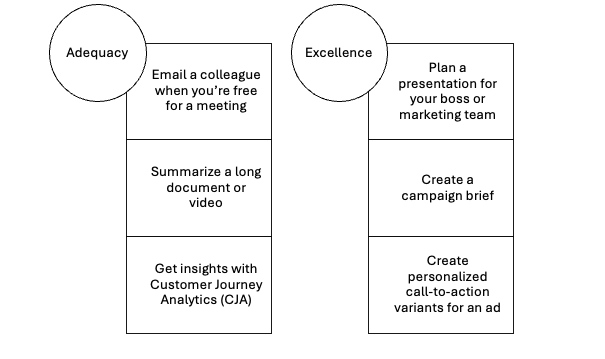
After identifying if the task requires adequacy or excellence, you can apply prompt frameworks to write better instructions for AI. We recommend RTF (Role, Task, Format) for adequacy level results without detailed specificity and the CREATE (Character, Request, Examples, Adjustments, Types of Output, Evaluation) structure for tasks that require excellence and specificity.
Prompting requires a blend of art and science. The best way to get good at prompting is to try. Be curious. Stay adaptable. As you get familiar with prompting, you can experiment with prompting patterns to have a two-way interaction with LLMs. If you have options, try more than one platform or model.
These prompting patterns are like ingredients, as we mix the patterns with the prompt engineering foundations that we learned with the types of structures shared earlier as recipes we can use. Here are examples of methods for prompting patterns:
Pattern
Description
Marketing use case
Here are some tips
-
Add structure. Pair the method with a clear output format (e.g., “table with columns: hypothesis, metric, data source, next action”).
-
Use rubrics. For chain of feedback, define 4–6 scoring criteria (e.g., clarity, claim accuracy, brand tone, differentiation).
-
Constrain scope. For tree of thought, cap branches (e.g., “explore 4 angles, 2 per enterprise/mid‑market”).
-
Ground personas. Provide goals, pains, KPIs, objections, and decision context (budget authority, buying stage).
-
Document decisions. With ReAct, log reasoning → action → observation → revision so you can audit and repeat.
-
Vary assumptions. In scenario exploration, change one variable at a time (budget, audience size, CPA target) to isolate effects.
Check for accuracy, quality, and consistency
The “A” in AI stands for artificial and describes the I, intelligence. The intelligence is indeed… artificial. One thing we humans have learned is that AI-generated outputs can contain errors. Those might be incorrect facts, misinterpreted instructions, or any sort of failure.

Image generated using Microsoft Copilot
Validating prompt responses is critical for several reasons:
-
Accuracy: As you may have experienced firsthand—or heard from others—AI-generated outputs can contain errors, hallucinations, or misinterpretations. Your validation ensures accuracy.
-
Quality control: Models and platform capabilities are evolving at a rapid pace. Prompt frameworks like RTF and CREATE can help, but ultimately you are accountable to your work—even if you used AI while creating it.
-
Risk mitigation: Unchecked responses can lead to major issues. Validation ensures that the output aligns with real information, meets the intended objectives, and complies with legal or company standards.
-
Reliability: Validation helps you understand which prompting pattern is needed to achieve the expected results consistently well.
-
Building trust and scale: Validated responses create confidence in AI-assisted workflows to build prompt libraries for reuse. This step is essential for scaling AI adoption across marketing and operational processes.
As a society, we are still in the early innings of AI adoption. Sharing what we’re learning helps us all play the game better. Without documentation, effective prompts remain one-off successes tied to individuals or isolated experiments. With a shared, ready-to-use prompt library, teams can turn those isolated wins into repeatable, scalable strategies that consistently deliver value.
-
Consistency and reusability: Great prompts shouldn’t live in someone’s head or get lost in a chat thread. Documenting them creates a library of proven approaches that anyone on your team can reuse. This saves time and ensures consistent quality across campaigns and other deliverables.
-
Quality and accuracy: When prompts are documented, they’re easier to review, refine, and improve.
-
Collaborate and knowledge sharing: Marketing is a team sport. A shared prompt repository means that your team can learn from each other’s successes, avoid duplication, and innovate faster. Think of it as your internal “Prompt Playbook.”
-
Continuous improvement: Documenting prompts isn’t just about storage, it’s about evolution. By tracking what works and what doesn’t, you can iterate and create best practices that scale across your organization.
-
Compliance and governance: In regulated industries, transparency matters. Documented prompts provide traceability, helping you meet compliance requirements and reduce risk when using AI for sensitive tasks.
For example, our documentation and prompt library is built in SharePoint.
AI in action: A practical example for modern marketers
It’s easy to overlook the quiet ways in which AI is already part of our everyday lives – auto complete, background blur, voice isolation. Very recently, we’ve reached a point where AI utility is simple for anyone to access and incorporate into their day-to-day work. With that in mind, let’s consider the many opportunities to apply the strategies shared in this article, and look ahead to Part Two , which focuses on practical sample prompts you can use.
8 a.m. – The day starts like any other, with a calendar full of meetings and scattered blocks of focus time sprinkled throughout. Ask to optimize your Workday based on priorities that you define in the prompt. AI can recommend meetings to skip, or draft email replies, or any number of tasks that help you reclaim time for important matters.
10 a.m. – You have an important meeting that requires detailed notes, but the teammate you were relying on to capture them has called in sick. How do you facilitate this meeting effectively and still walk away with clear notes and actionable next steps?
11 a.m. – The meeting you just attended now has an accelerated deadline—the campaign brief that was due in two weeks is suddenly due today. How do you quickly build a strong brief by the end of the day to share with your team? Should you follow the RTF framework or the CREATE framework?
1 p.m. – You return from lunch and wrap up a meeting with the marketing team to review audiences and the campaign brief. From the discussion, you realize you need to create ten different CTA variants for multiple audiences across several geographic regions, with A/B testing planned for personalization. How do you quickly generate CTA variations and ad copy that personalize the campaign based on the audience-specific value propositions each group cares about?
3 p.m. – As the day winds down, your focus shifts to reviewing the performance of existing campaigns and audiences. You want to enhance an existing report by adding visualizations that surface insights and communicate them more clearly to the team and review your audience performance. How can you quickly build compelling visualizations that highlight key insights and help you review audience performance?
Next, in part two of this two-part series, we explore practical solutions that help improve the day-to-day execution of these tasks and workflows.