This article explains how Adobe Commerce’s B2B capabilities can be used as a scalable procurement infrastructure by translating real procurement policies (roles, pricing governance, approvals, and integrations) into intentional digital architecture. It emphasizes designing for repeat purchasing, contract integrity, and long-term evolution rather than simply enabling features at launch.
B2B commerce as procurement infrastructure
B2B commerce has crossed a structural threshold. It's not just a channel that sales teams leverage; notably, it's the system that procurement teams rely on daily. This shift raises the bar for digital experiences: Buyers expect the flexibility of B2C, yet enterprises require operational governance, price control mechanisms, and integration acumen.
Consider that you’re a mid-market firm scaling quickly or a global enterprise going after modernizing a legacy ecosystem, the needs will be surprisingly consistent: multi-user buying hierarchies, contract-based pricing, approvals, repeat-order acceleration, and reliable synchronization with ERP and CRM systems.
Adobe Commerce supports these realities through its native B2B capability set, documented in the Experience League Adobe Commerce B2B guide. The opportunity is not simply to enable features; it’s to design an operating model that scales as product complexity, teams, and transaction volume grow.
What separates a portal from a procurement engine
In the field, B2B programs rarely struggle because a platform lacks a specific feature. They struggle when business policy isn’t translated into a digital structure. Three failure patterns show up repeatedly:
-
Organizational hierarchy is oversimplified
-
Pricing segmentation grows without governance
-
Approvals either slow revenue or expose risk
Champion-level implementations feel different because they treat commerce as operational design. The goal is to reduce the invisible work: manual approvals, spreadsheet pricing, and “who can buy what” confusion, so buyers move faster and internal teams regain control.
Architectural pattern 1: Company accounts as a governance framework
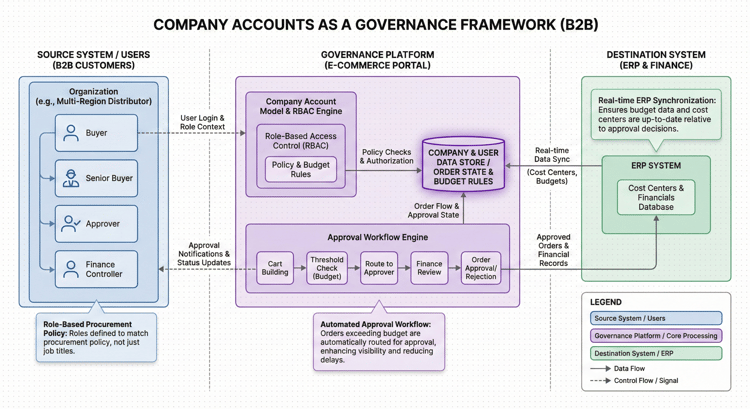
Company accounts are the foundation of the B2B structure. They model how organizations actually buy: buyers, requesters, approvers, finance reviewers, and administrators. The key is to design roles to match procurement policy, not job titles.
In one multi-region distribution implementation, Company Account roles were mapped directly to ERP cost centers. Buyers could build carts within defined thresholds, while finance approvers were automatically routed orders that exceeded budget limits. The biggest win wasn’t automation; it was visibility. Approvers stopped chasing emails because the portal carried the state of the approval.
In a scaling mid-market manufacturer, the early portal worked until growth exposed governance gaps. Broad permissions created exceptions, exceptions became workarounds, and workarounds became policy. Introducing a clean role model (Buyer, Senior Buyer, Approver, Finance Controller) stabilized operations and made expansion predictable.
Implementation checklist: define role boundaries, test delegation and reassignment, simulate cart edits after submission, and validate how often ERP sync runs relative to approval decisions. These edge cases usually determine whether governance feels smooth or fragile.
Architectural pattern 2: Shared catalogs for contract pricing without chaos
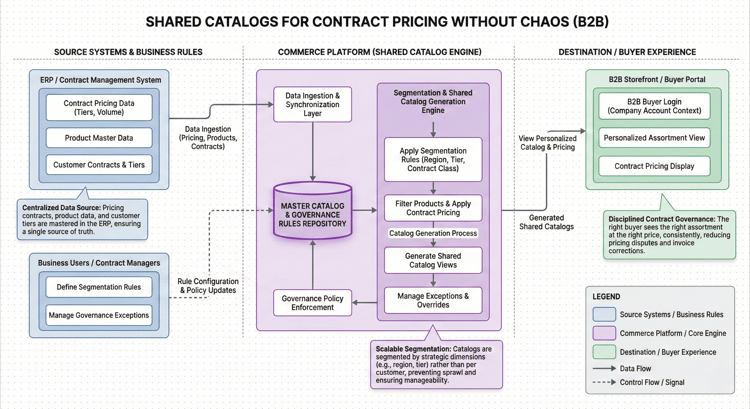
B2B pricing is rarely a single price list. It includes negotiated contracts, regional tiers, volume-based agreements, and customer-specific assortments. Shared Catalogs let you govern product visibility and pricing at the company level without cloning storefronts or building custom price engines.
Adobe emphasizes segmentation and personalization as core commerce drivers in the Adobe Commerce product overview. In B2B, “personalization” often means disciplined contract governance: the right buyer sees the right assortment at the right price, consistently.
In a manufacturing deployment, contract pricing lived in spreadsheets distributed across regions. That created invoice corrections, pricing disputes, and a constant stream of override requests. Migrating agreements into Shared Catalogs aligned with the company accounts' centralized authority and reduced noise across procurement and finance.
The long-term risk is segmentation and sprawl. One catalog per customer looks simple at first, but it doesn’t scale. A sustainable approach segments by strategic dimensions such as region, contract class, or tier level, then uses governance rules to manage exceptions.
Architectural pattern 3: Approval workflows that protect velocity
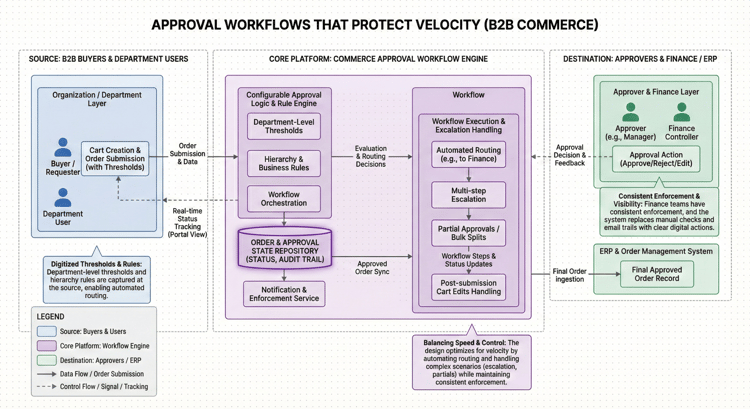
Approvals are where compliance meets revenue. Adobe Commerce enables configurable approval logic based on order thresholds, hierarchy, and business rules. The best designs reduce manual intervention while keeping purchasing fast.
In a regulated healthcare distribution scenario, department-level thresholds were digitized so high-value orders triggered automated routing to financial controllers. Before, approvals relied on manual checks and email trails; after, buyers tracked status inside the portal, and finance teams had consistent enforcement.
The design tradeoff is calibration. Too many approval layers slow purchasing cycles; too few increase risk. Test multi-step escalation, partial approvals, bulk order splits, and post-submission cart edits. These are the scenarios that typically break first in production.
Quick order and requisition lists for repeat procurement
Repeat purchasing often represents the majority of B2B revenue. Quick Order enables direct SKU entry and bulk uploads, bypassing navigation-heavy browsing. Requisition lists allow procurement managers to save standardized bundles for recurring needs.
In a high-SKU industrial supply deployment, elevating Quick Order in navigation materially changed adoption. Buyers stopped ‘shopping’ and started ‘ordering’. Requisition lists reduced errors by standardizing replenishment kits and keeping purchasing consistent across teams.
Adoption is an implementation task, not a feature toggle. Promote Quick Order intentionally, train buyers on list workflows, and track requisition reuse. If repeat ordering is slow, the portal feels slow, even if performance is excellent.
AI-driven relevance within contract boundaries
B2B buyers increasingly expect contextual relevance: replenishment reminders, compatible products, and tier-appropriate recommendations. AI can support this, but only if it respects governance. Recommendations must align with Shared Catalog visibility, negotiated pricing, and role-based permissions.
Practical patterns for doing this responsibly are discussed in the Experience League Product Recommendations Guide, where the focus is on using behavioral signals without breaking contract rules. Done well, relevance increases basket efficiency without creating trust issues.
Why AEM matters in complex B2B journeys
B2B buyers rarely convert on product data alone. In manufacturing, distribution, and regulated categories, buyers need specifications, compliance documents, installation guides, and contextual education before finalizing a purchase. Content is part of the decision process and it needs to be connected to commerce.
Adobe Experience Manager can strengthen this by enabling content-driven procurement journeys.
ERP, CRM, inventory, and ownership
As organizations scale, commerce must integrate cleanly with ERP and CRM. The practical questions are always the same: where is pricing authoritative, how is inventory synchronized, and who owns the exceptions? Mid-market teams often integrate incrementally, prioritizing pricing and inventory accuracy first. Enterprises typically require API governance, multi-region synchronization, and real-time orchestration patterns to support multiple brands and business units.
A useful rule of thumb: decide what must be real-time versus what can be near-real-time, then design workflows around those guarantees. A portal that promises real-time inventory but can’t deliver loses trust faster than one that communicates constraints clearly.
Designing for evolution, not just launch
Looking toward 2026, B2B leaders are prioritizing workflow automation, composable architectures, scalable relevance, governance transparency, and operational resilience. Adobe Commerce provides a strong structural foundation for these priorities when features are implemented intentionally and owned operationally.
The strategic question isn’t whether B2B evolves. It's about whether today’s architecture can evolve with it, without replatforming every time the business model changes. That is where disciplined role models, sustainable catalog strategy, and integration of ownership matter most.
Next steps for commerce B2B practitioners
-
Start with a governance audit of Company Accounts. Validate that roles map to procurement policy (not job titles), then pressure test delegation, reassignment, and cart edits after submission. If you discover “everyone can do everything,” treat it as a scalability risk and redesign roles before adoption increases.
-
Rationalize Shared Catalogs before they sprawl. Inventory your catalogs and merge where segmentation is account-by-account. Aim to segment by strategic dimensions such as region, contract tier, or contract class, and then define ownership of catalog creation and exception handling.
-
Run an approval workflow stress test in realistic scenarios. Simulate bulk order, partial approvals, multi-step escalation, and budget-threshold triggers. Verify the timing of ERP syncs affecting approvals to ensure governance doesn’t drift too far from financial reality.
-
Make repeat ordering a first-class experience. Move Quick Order into a highly visible entry point, train buyers on Requisition Lists, and track reuse. In most B2B programs, repeat purchasing is where adoption is won or lost.
-
Align relevance and recommendations with contract rules. Before you turn on recommendations at scale, verify they respect Shared Catalog visibility, negotiated pricing, and role-based access. Relevance that breaks contract governance erodes trust quickly.
-
Clarify system ownership across ERP, CRM, and commerce. Decide where the location agrees on pricing and inventory updates, and where to resolve exceptions, along with where to provide near-real-time and real-time experiences based on these guarantees.
-
Create a 30-day enablement plan, not just a launch plan. State your three major journeys (new buyer onboarding, repeat order, high-value approval), publish internal playbooks, and also schedule the post-launch optimization cycle based on the actual buyer behavior.
Implementation principles
-
Design Company Accounts around real procurement policy and growth paths.
-
Segment shared Catalogs by strategic dimensions, and govern exceptions.
-
Calibrate approvals to preserve velocity while enforcing compliance.
-
Treat repeat-order efficiency as a core infrastructure, not an enhancement.
-
Align AI-driven relevance with contract pricing and access control.
-
Integrate ERP, CRM and content with clear ownership and data guarantees.