Create a document approval workflow
The highlighted information on this page refers to functionality not yet generally available. It is available only in the Preview Sandbox environment.
You can request approval from other users or teams for a document in Adobe Workfront, or request they review a document without needing to approve it.
By default, an approval template is visible only to its creator. Throughout this article, you can only select templates you created or that were shared with you. For more information, see Share a template in Manage approval templates.
Access requirements
| table 0-row-2 1-row-2 2-row-2 3-row-2 layout-auto html-authored no-header | |
|---|---|
| Adobe Workfront package |
Any Workfront package to manage approvals using legacy Workfront storage Any Workflow package to manage approvals using Adobe cloud storage |
| Adobe Workfront license |
Contributor or higher Review or higher If you are using the Frame.io integration, you must have a Standard license to create approval workflows. |
| Access level configurations | View or higher access to Projects, Tasks, Issues, Templates, Portfolios, Programs, Reports, Dashboards, Calendars, and Documents |
| Object permissions | Manage access to the object associated with the request access or approval |
For information, see Access requirements in Workfront documentation.
Create an approval workflow in the legacy documents area
If your organization is on Workfront storage, you will see the legacy documents area when you access documents in Workfront. For more information about Workfront storage, see Differences between Adobe cloud storage and legacy Workfront storage.
Create a basic approval workflow
To create a single-stage approval workflow:
-
Go to the project, task, or issue that contains the document, then select Documents in the left panel.
-
Click on the document you need and the Document Summary panel for that document opens.
-
Select the version of the document you want to create an approval for in the version drop-down menu. The latest version is selected by default.
-
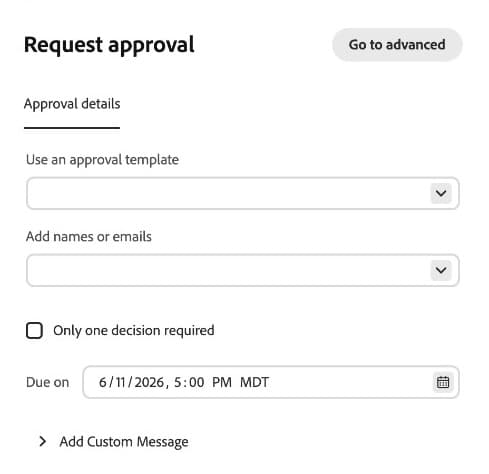
Scroll down to the Approvals section, then click Create workflow. The Request approval dialog opens in Basic mode.
-
Fill in the following details:
table 0-row-2 1-row-2 2-row-2 3-row-2 4-row-2 5-row-2 html-authored no-header Use an approval template (optional) Select a template from the drop-down menu. The menu only lists templates you created or that were shared with you — either with you specifically or with everyone in your organization. System Administrators see every template in the account here, regardless of who created or shared it. If the template has one path and one stage, it applies in Basic mode. If the template has more than one stage or more than one path, the dialog automatically switches to Advanced mode and any input you entered in Basic mode is replaced by the template's content. Add names or emails Begin typing a user or team name to add as an approver or reviewer. If you only have reviewers, they will be notified and have the option to complete the review but no decision will be required or made. Add people or teams in preview Begin typing a user name, team, or email address. The team is added as a single approver or review by default, but you can choose to add each team member as an individual participant.
Note: If a user is already added, or belongs to more than one team you add, they're included once.
Only one decision required (optional) The first person who makes a decision completes the stage. Due on (optional) Set a due date for the approval. Users and teams are notified by email 72 hours, then 24 hours before the specified due date. Add Custom Message (optional) Type a message in the Add Custom Message text box. The message appears in the approval email notification and in the Approvals tab in Workfront.
Note: If you edit a custom message after the approval workflow is created, an updated email notification is sent to all existing participants. If you add a participant later, the custom message is included in their email notification.
-
Click Request approval.
Create an advanced approval workflow
Advanced mode supports multiple stages as well as parallel paths. Each path runs independently and contains one or more sequential stages. When all required decisions in a stage are made, the next stage in that path begins, the previous stage is locked, and the new stage’s reviewers and approvers receive an email notification.
A “Needs work” decision stops the path its on but does not affect the approval workflow on other paths. You can configure up to 30 paths and 100 stages total.
To create an advanced approval workflow:
-
Go to the project, task, or issue that contains the document, then select Documents in the left panel.
-
Click on the document you need and the Document Summary panel for that document opens.
-
Select the version of the document you want to create an approval for in the version drop-down menu. The latest version is selected by default.
-
Scroll down to the Approvals section, then click Create workflow.
-
In the top right of the Request approval dialog, click Go to advanced. Any input you entered in Basic mode is preserved and applied to Path 1, Stage 1.
note tip TIP While you’re creating the approval, you can return to Basic mode by clicking Go to basic in the top right. After you click Request approval, the Go to basic option is no longer available. -
(Optional) To apply a template:
- Toggle Templates On.
- Click the filter icon, then select All, My templates, or Shared with me to narrow the list.
- Click a template to apply it to the approval.
System Administrators see every template in the account here, regardless of who created or shared it.
-
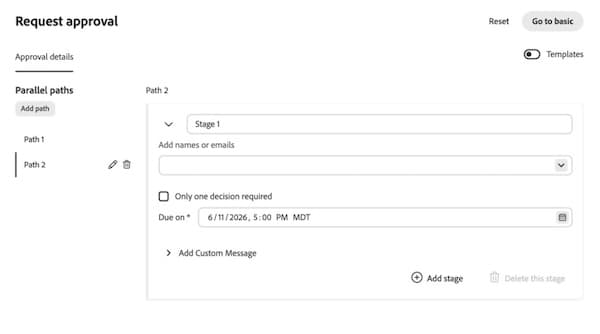
Fill in details for Stage 1 of Path 1:
table 0-row-2 1-row-2 2-row-2 3-row-2 4-row-2 5-row-2 html-authored no-header Stage name Stages are named Stage 1, Stage 2, and so on by default. Rename the stage to something more descriptive, such as Initial Review or Final Approval. Add names or emails Begin typing a user or team name to add as an approver or reviewer. If you only have reviewers, they will be notified and have the option to complete the review but no decision will be required or made.
Note: A reviewer or approver can be assigned to only one open stage at a time on the same asset. If multiple parallel stages are open simultaneously, the same person can't be added to more than one.
Add people or teams in preview Begin typing a user name, team, or email address. The team is added as a single approver or review by default, but you can choose to add each team member as an individual participant.
Note: If a user is already added, or belongs to more than one team you add, they're included once. Additionally, participants can be assigned only to one open stage at a time on the same asset.
Only one decision required (optional) The first person who makes a decision completes the stage. Due on (optional) The first stage of each path supports an absolute due date. Each subsequent stage in the path supports a relative due date — the number of days from when that stage opens. Users and teams are notified by email 72 hours, then 24 hours before the due date. Add Custom Message (optional) Type a message in the Add Custom Message text box. The message appears in the approval email notification and in the Approvals tab in Workfront.
When you add a second stage, Show this message on all stages is selected by default. Leave it selected to use the same message in every stage. To use a different message for each stage, clear Show this message on all stages, then type the stage-specific message in each stage's Add Custom Message text box.
-
(Optional) Click Add stage to add another stage to the path. Stages within a path run sequentially in the order they’re listed. You can reorder stages within a path, but you can’t move a stage from one path to another. Each path can have a different number of stages.
-
(Optional) Under Parallel paths, click Add path to add another path. The new path starts with one empty stage and becomes the selected path. To rename a path, hover the path label, click the pencil icon, then type a new name.
-
(Optional) To remove a path, hover the path label and click the trash icon. Path 1 can’t be removed, and paths can’t be reordered. Other paths can be removed only if no stage within the path is locked or completed.
-
(Optional) To clear all paths and stages and start over, click Reset in the top right.
-
Click Request approval.
Create an approval workflow in the new Documents area
If your organization uses Adobe cloud storage, you will see the new Documents area when you access documents in Workfront. For more information about Adobe cloud storage, see Adobe cloud storage overview.
The Request approval dialog opens in Basic mode by default. Basic mode is a single stage with one set of approvers or reviewers. Switch to Advanced mode to configure multi-stage approvals or parallel paths.
Create a basic approval workflow
To create a single-stage approval workflow:
-
Go to the project, task, or issue that contains the document, then select Documents in the left panel.
-
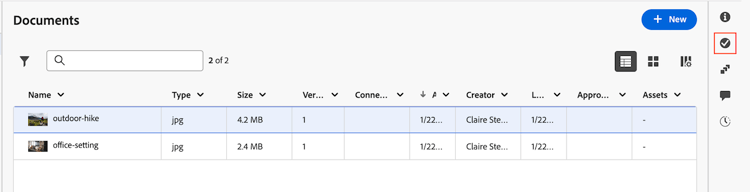
Click on the document, then click the Approvals icon on the right side of the page.
-
Click Create workflow. The Request approval dialog opens in Basic mode.
-
Fill in the following details:
table 0-row-2 1-row-2 2-row-2 3-row-2 4-row-2 5-row-2 html-authored no-header Use an approval template (optional) The templates field is collapsed by default. Click the field to expand it, then select a template from the drop-down menu. The menu only lists templates you created or that were shared with you — either with you specifically or with everyone in your organization. System Administrators see every template in the account here, regardless of who created or shared it. If the template has one path and one stage, it applies in Basic mode. If the template has more than one stage or more than one path, the dialog automatically switches to Advanced mode and any input you entered in Basic mode is replaced by the template's content. Add names or emails Begin typing a user name or email to add as an approver or reviewer. If you only have reviewers, they will be notified and have the option to complete the review but no decision will be required or made. Add people or teams in preview Begin typing a user name, team, or email address, then choose if they are an Approver or Reviewer. Workfront adds each active member of a team individually.
Note: If a user is already added, or belongs to more than one team you add, they're included once.
Only one decision required (optional) The first person who makes a decision completes the stage. Due on (optional) Set a due date for the approval. Users are notified by email 72 hours, then 24 hours before the specified due date. Add Custom Message (optional) Type a message in the Add Custom Message text box. The message appears in the approval email notification and in the Approvals tab in Workfront. -
Click Request approval.
- The Request approval dialog opens in Basic mode every time, regardless of your previous session.
- If you edit a custom message after the approval workflow is created, an updated email notification is sent to all existing participants. If you add a participant later, the custom message is included in their email notification.
- After an approval is saved, you can’t switch it back to Basic mode. You can switch an in-progress approval from Basic to Advanced as long as the approval is not locked or completed.
Create an advanced approval workflow
Advanced mode supports parallel paths. Each path runs independently and contains one or more sequential stages. When all required decisions in a stage are made, the next stage in that path begins, the previous stage is locked, and the new stage’s reviewers and approvers receive an email notification.
A “Needs work” decision stops the path its on but does not affect the approval workflow on other paths. You can configure up to 30 paths and 100 stages total.
To create an advanced approval workflow:
-
Go to the project, task, or issue that contains the document, then select Documents in the left panel.
-
Click on the document, then click the Approvals icon on the right side of the page.
-
Click Create workflow.
-
In the top right of the Request approval dialog, click Go to advanced. Any input you entered in Basic mode is preserved and applied to Path 1, Stage 1.
note tip TIP While you’re creating the approval, you can return to Basic mode by clicking Go to basic in the top right. After you click Request approval, the Go to basic option is no longer available. -
(Optional) To apply a template:
- Toggle Templates On.
- Click the filter icon, then select All, My templates, or Shared with me to narrow the list.
- Click a template to apply it to the approval.
System Administrators see every template in the account here, regardless of who created or shared it.
-
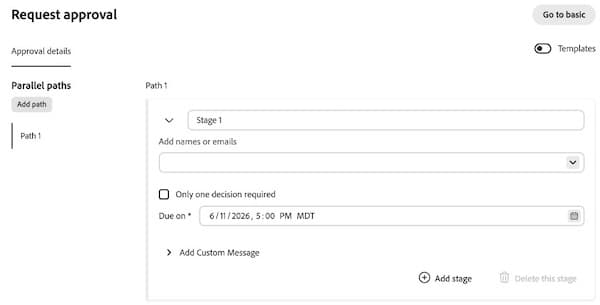
Fill in details for Stage 1 of Path 1:
>
table 0-row-2 1-row-2 2-row-2 3-row-2 4-row-2 5-row-2 html-authored no-header Stage name Stages are named Stage 1, Stage 2, and so on by default. Rename the stage to something more descriptive, such as Initial Review or Final Approval. Add names or emails Begin typing a user name or email to add as an approver or reviewer. If you only have reviewers, they will be notified and have the option to complete the review but no decision will be required or made.
Note: A reviewer or approver can be assigned to only one open stage at a time on the same asset. If multiple parallel stages are open simultaneously, the same person can't be added to more than one.
Add people or teams in preview Begin typing a user name, team, or email address, then choose if they are an Approver or Reviewer. Workfront adds each active member of a team individually.
Note: If a user is already added, or belongs to more than one team you add, they're included once. Additionally, participants can be assigned only to one open stage at a time on the same asset.
Only one decision required (optional) The first person who makes a decision completes the stage. Due on (optional) The first stage of each path supports an absolute due date. Each subsequent stage in the path supports a relative due date — the number of days from when that stage opens. Users are notified by email 72 hours, then 24 hours before the due date. Add Custom Message (optional) Type a message in the Add Custom Message text box. The message appears in the approval email notification and in the Approvals tab in Workfront.
When you add a second stage, Show this message on all stages is selected by default. Leave it selected to use the same message in every stage. To use a different message for each stage, clear Show this message on all stages, then type the stage-specific message in each stage's Add Custom Message text box.
-
(Optional) Click Add stage to add another stage to the path. Stages within a path run sequentially in the order they’re listed. You can reorder stages within a path, but you can’t move a stage from one path to another. Each path can have a different number of stages.
-
(Optional) Under Parallel paths, click Add path to add another path. The new path starts with one empty stage and becomes the selected path. To rename a path, hover the path label, click the pencil icon, then type a new name.
-
(Optional) To remove a path, hover the path label and click the trash icon. Path 1 can’t be removed, and paths can’t be reordered. Other paths can be removed only if no stage within the path is locked or completed.
-
(Optional) To clear all paths and stages and start over, click Reset in the top right.
-
Click Request approval.
View approval workflows for previous versions in the new Documents area in Preview
If your organization uses Adobe cloud storage, you will see the new Documents area when you access documents in Workfront. For more information about Adobe cloud storage, see Adobe cloud storage overview.
The Approvals panel lists only the versions of the document that have an approval workflow.
To view approval workflows for previous versions:
-
Go to the project, task, or issue that contains the document, then select Documents in the left panel.
-
Click on the document, then click the Approvals icon on the right side of the page.
-
Click a version to expand it. You can view its stages, each approver’s decision, the stage’s decision rule (such as whether only one decision is required to complete the stage), and due dates.
-
Click another version to expand its approval workflow without leaving the panel.
note NOTE If a version’s approval workflow was withdrawn because a newer version’s approval was requested, it stays in the list, collapsed, so you can still review its prior decisions.