Edit information in custom form fields
You can edit information on a custom form after the form is attached to an object. For information about adding custom forms to objects, see Add a custom form to an object.
Access requirements
| table 0-row-2 1-row-2 2-row-2 3-row-2 layout-auto html-authored no-header | |
|---|---|
| Adobe Workfront package | Any |
| Adobe Workfront license |
Contributor or higher Request or higher |
| Access level configurations | Edit access to the object for which you want to edit the custom form |
| Object permissions |
|
For information, see Access requirements in Workfront documentation.
Prerequisites
-
Your Workfront administrator or a Plan user with administrative access to custom forms must create custom forms in your environment. For more information, see Create a custom form.
-
You must have custom forms attached to an object.
For information about how to apply custom forms to an object, see Add a custom form to an object.
Edit information on a custom form
Editing information on a custom form attached to an object is similar for most objects.
For information about what objects can have a custom form, see Custom forms overview.
-
Go to any list of objects for which you want to edit information on the custom form, except for a list of iterations.
-
Select one or several objects in the list, then click the Edit icon

-
Click Custom Forms in the left panel, inside the Edit < object > box.
When there is a custom form attached to the object, the name of the form displays as an area in the Custom Forms section.
-
Start entering information in any field that you have access to.
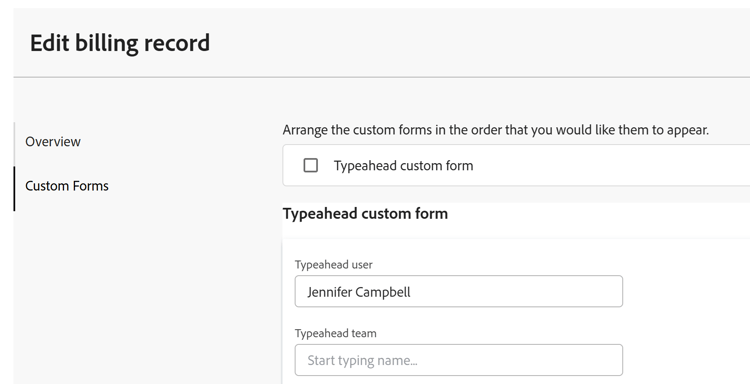
If multiple custom forms are attached to the object, do this for every form.
Depending on the type of field you are working in, consider the following:
- You can select only one option for radio-button fields.
- You can select one or multiple options in a checkbox field, depending on how the form creator configured the field.
- You can select one or multiple options in a multi-select drop-down field, depending on how the form creator configured the field.
- You can format text fields (bold, italicize, or underline) only if the user who created the form set them up as a Text Field with Formatting field type. Single Line Text Fields and Paragraph Text Fields cannot be formatted.
- You can update the time of the day in a Date field type only if the user who created the form has included it when creating the field.
note NOTE Fields that allow multiple selections may limit how many options you can choose. Check boxes and multi-select dropdowns are limited to 5000 selections. For information about all of the field types, see Create a custom form.
-
Click Save.
note important IMPORTANT You must complete all required fields on the form before you can save the form. The name of a required field is followed by an asterisk. 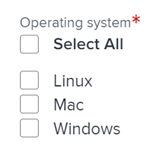
When someone changes data in another object that is referenced by calculated custom fields in your object, the changes are not reflected automatically in your object. For information about manually updating all calculated custom fields in your object, see Recalculate all calculated custom fields for an object in this article.
When dependent fields on the page are modified, calculated fields on the custom form are dynamically re-calculated in real time. You can see the new calculated field value without saving the form, but it is not actually applied to the form and the object until you save the changes. This applies to calculated fields on default forms as well as custom forms.
You can also manually update all calculated custom fields for an object when you bulk-edit the object along with other objects in a list. For instructions, see Recalculate all calculated custom fields for multiple objects in a list when editing the objects in this article.
-
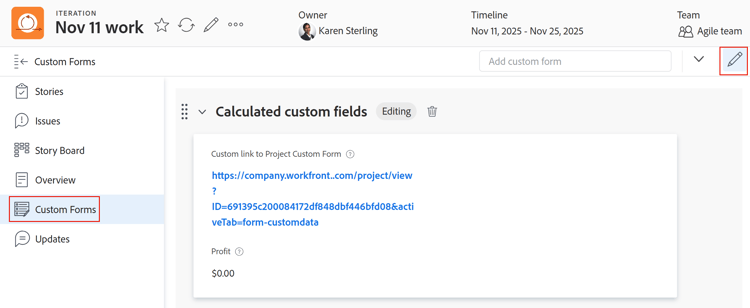
(Conditional) To update the custom fields for an iteration custom form, fo the following:
-
Go to an iteration.
-
Click Custom Forms in the left panel.
-
To add custom forms, start typing the name of a form in the Add custom form field in the upper-right corner of the page
Or
Click the Edit icon in the same area to start editing the fields on the attached forms.
-
Click Save Changes.
-
Recalculate custom fields for objects
Periodically, depending on changes that might occur to custom forms, or on changes that occur on fields referenced in custom fields, the values of calculated custom fields might be outdated. In this case, you might need to recalculate custom fields, or recalculate the custom expressions for objects.
The following sections describe how you can recalculate custom expressions for objects with custom forms.
Recalculate all calculated custom fields from an object’s page
-
Go to the main page of one of the following objects whose custom fields you want to recalculate:
- Project
- Task
- Issue
- Portfolio
- Program
- Document
-
Click the More menu

This recalculates all custom fields on the object’s form.
Recalculate all calculated custom fields for multiple objects in a list when editing the objects recalculate-all-calculated-custom-fields-for-multiple-objects-in-a-list-when-editing-the-objects
Depending on what objects you want to recalculate the custom expressions for, you can do so in the following areas:
- In a list of objects, from the More menu at the top of the list.
- In the Edit box, when selecting and editing multiple objects in bulk.
To manually recalculate the custom fields of several objects by editing them in bulk from a list or report:
-
Go to a list of the following object types whose objects contain custom forms with calculated fields:
- Users
- Companies
- Billing Records
-
Select the objects whose calculated custom fields you want to update.
-
Click the Edit icon.
-
Click Custom Forms in the left menu, then select Recalculate Custom Expressions.
-
Click Save or Save Changes.
Workfront calculates all custom fields for all the selected objects.
To recalculate custom expressions from a list of objects:
-
Go to a project list or report and select one or several of the following object types:
- Projects
- Tasks
- Issues
- Portfolios
- Programs
- Expenses
-
Click the More menu
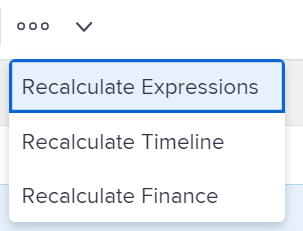
Workfront immediately calculates all custom fields for all the selected projects.
Not all lists of all objects have this capability.