Schemas
To manage schemas, supporting the data you want to ingest in Experience Platform and use in Mix Modeler:
-
Go to the Mix Modeler interface.
-
Select

See the Schemas UI overview for more information.
Aggregate or summary data
It is highly recommended to use the XDM Summary Metrics class as the base of the schema underlying any aggregate or summary data you want to ingest in Experience Platform and use in Mix Modeler.
Use the XDM Summary Metrics class for:
-
walled garden data, for example data from Facebook or YouTube.
-
external factors data, like data from SPX (S&P 500 stock price indices), weather data,
-
internal factors data, for example price changes, a holiday calendar.
A schema using the XDM Summary Metrics base class can be simple, as shown in the ExternalFactorSummarySchema below.
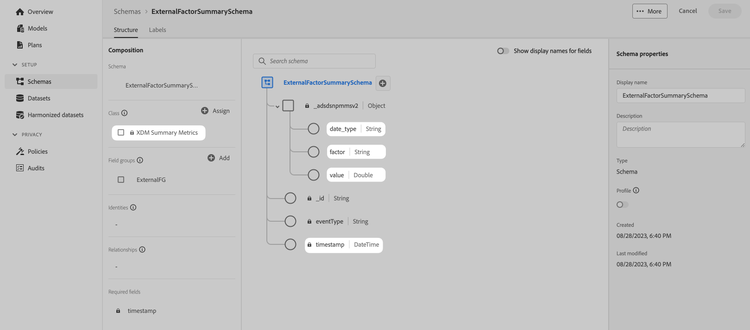
This simple schema can be used to ingest datasets containing data for, for example:
-
Competitor index data
table 0-row-4 1-row-4 2-row-4 3-row-4 4-row-4 4-align-right 9-align-right 14-align-right 19-align-right 24-align-right timestamp date_type factor value 2020-11-28T00:00:00.000Z week competitor_index 289.8 2020-12-05T00:00:00.000Z week competitor_index 291.2 2020-12-12T00:00:00.000Z week competitor_index 280.07 … … … … -
Public holiday data
table 0-row-4 1-row-4 2-row-4 3-row-4 4-row-4 5-row-4 6-row-4 4-align-right 9-align-right 14-align-right 19-align-right 24-align-right 29-align-right 34-align-right timestamp date_type factor value 2020-11-28T00:00:00.000Z week all_holidays_flag 0.0 2020-12-05T00:00:00.000Z week all_holidays_flag 0.0 2020-12-12T00:00:00.000Z week all_holidays_flag 0.0 2020-12-19T00:00:00.000Z week all_holidays_flag 0.0 2020-12-26T00:00:00.000Z week all_holidays_flag 1.0 … … … …
See below for a more comprehensive example of a LumaPaidMarketingSchema using the XDM Summary Metrics as the base class. The schema uses dedicated field groups (annotated with colors) for metrics (AMMMetrics), dimensions (AMMDimensions), and other customer-specific information (CustomerSpecific).
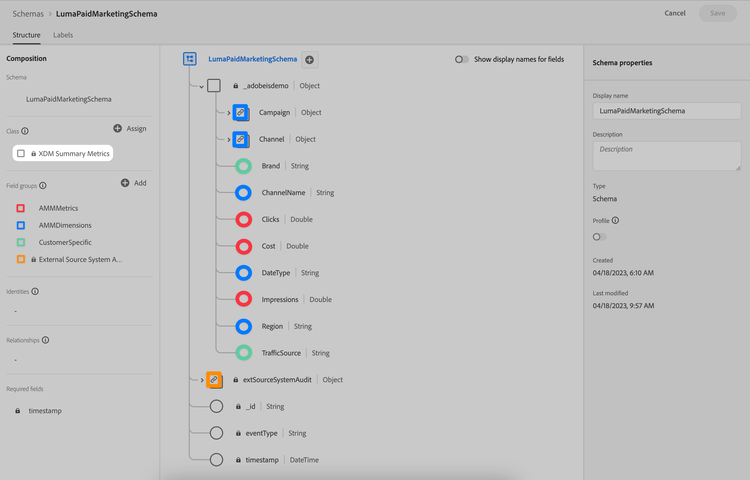
Given the asynchronous nature of profile ingestion, when collecting aggregate or summary data from external sources, it is encouraged to use the External Source System Audit Details field group as part of a schema. This field group defines a set of audit properties for external sources.
Factor Standard Fields field group
For convenience, Experience Platform supports a dedicated Factor Standard Fields field group for internal and external factors data often part of summary, internal factor, or external factor data. This field group defines the following fields:

The type of the factor.
Possible values are:
- Internal (Internal Factor)
- External (External Factor)
Possible values are:
- Actual (Actual Value)
- Forecasted (Forecasted Value)
When no value, Actual is the default value.
Possible values are:
- Daily
- Weekly
- Monthly
A summary, internal factor, or external factor dataset can be based upon:
- A schema that uses the Factor Standard Fields group. This dataset is shown as a Factors dataset when you configure dataset rules. And the harmonized fields you define, as part of the dataset rules for the dataset, are available as factors when you create a model.
- A schema that does not use the Factor Standard Fields group. This dataset is shown as a Summary dataset when you configure dataset rules. The dataset is configured as summary data and does not influence harmonized data.
Supported data types
Currently, Mix Modeler does support a subset of Experience Platform data types. The following basic data types (fields), mentioned in Basics of schema composition, are supported:
- String
- Integer
- Double
- Boolean
- Long
- Short
- Byte
- Date
- Date-time