Frequently asked questions about CX Enterprise
Learn about browser support and common questions and answers for administrators in CX Enterprise.
Adobe supports the current and previous two versions of the following browsers:
- Microsoft® Edge
- Google Chrome
- Mozilla Firefox
- Safari
- Opera
Use of another browser is possible, but support is not guaranteed.
| note |
|---|
| NOTE |
| Not all applications running on CX Enterprise domain support all browsers. If you’re unsure, check the documentation of a specific application. |
CX Enterprise supports preferred languages for each user, as set in your Adobe user account preferences. Supported languages currently are:
- Chinese
- English
- French
- German
- Italian
- Japanese
- Korean
- Portuguese
- Spanish
- Taiwanese
While application teams are committed to global language support, not all applications are offered in all languages noted above. If your primary language is not supported in a CX Enterprise application, you can also set a secondary language to default to when applicable. This can be done in CX Enterprise user preferences.
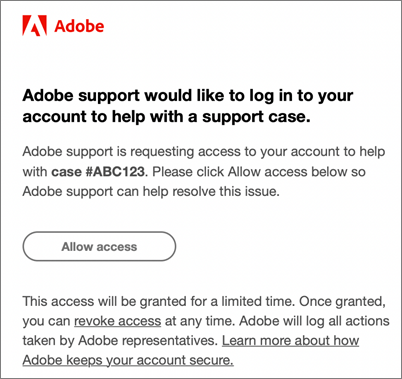
Adobe Customer Care can submit an impersonation request for which you receive an Adobe-branded email (example below) seeking your explicit authorization. The access is granted for a limited time. Once granted, the access can be revoked by you at any time. Adobe logs all actions taken by Adobe representatives.
Provisioning in CX Enterprise means:
- Your users can begin logging in to the CX Enterprise and linking applications.
- They can begin to use the features available through CX Enterprise.
- You can become prepared to retire your application-specific login process.
- You can retain access control to applications.
-
See the Admin Console User Guide for help.
-
User entitlements and product management are performed in the Adobe Admin Console (product link).
-
Important: Analytics administrators, see Manage Analytics Users in the Admin Console about migrating user IDs from Analytics Admin Tools to the Admin Console.
Admin Console administrators can grant access to users. Users are sent emails with sign-in instructions.
You might have to Contact Adobe Support to verify that your company has been fully provisioned.
Some users might be required to link their application (Analytics) account to the Adobe ID or Enterprise ID.