Load an email audience from a file audience-from-file
Adobe Campaign Web User Interface allows you to target profiles stored in an external file. Once the profiles are loaded, all fields from the input file are available for use to personalize your delivery Learn how to personalize your content.
You can choose to only load profiles for this specific standalone email delivery, without adding them to the database, or to import and reconcile them into the database. Learn more.
Must-read must-read
- This capability is available for email deliveries only.
- Supported file formats are: text (TXT) and comma-separated value (CSV).
- You cannot use control groups when loading the target population from an external file.
Select and configure the input file upload
To target profiles from a file in your emails, follow these steps:
-
Open an existing email delivery, or create a new email delivery.
-
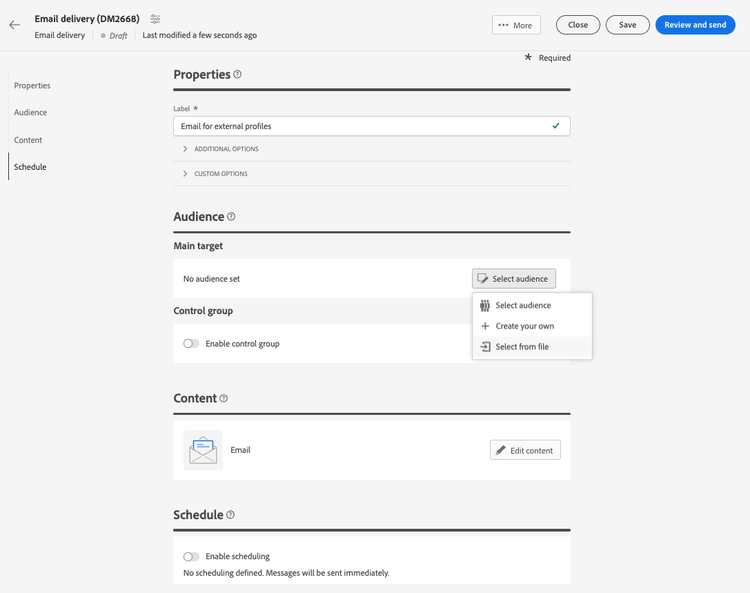
In the Audience section, click the Select audience button, then choose Select from file.
-
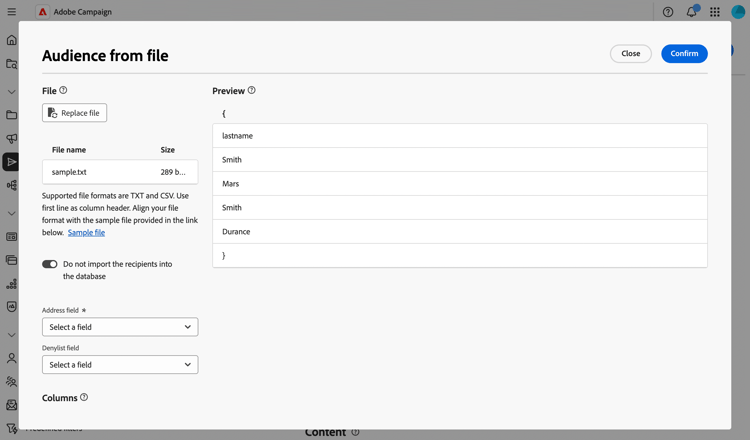
Select the local file to load. The file format must align with the sample file.
-
Preview and check how data is mapped in the central section of the screen.
-
Specify the column that contains the email address from the Address Field drop-down list. You can also select the denylist column if you have such information in the input file.
-
In the Columns section, expand a column to adjust its settings and define how to format the data using the available options. For each column you want to use for reconciliation, use Select destination field to map it to a recipient schema attribute.
-
Use the Do not import the recipients into the database switch to control whether the file’s profiles are imported and reconciled into the database. If you choose to import them, a Field mapping and reconciliation section is displayed. Configure the following parameters:
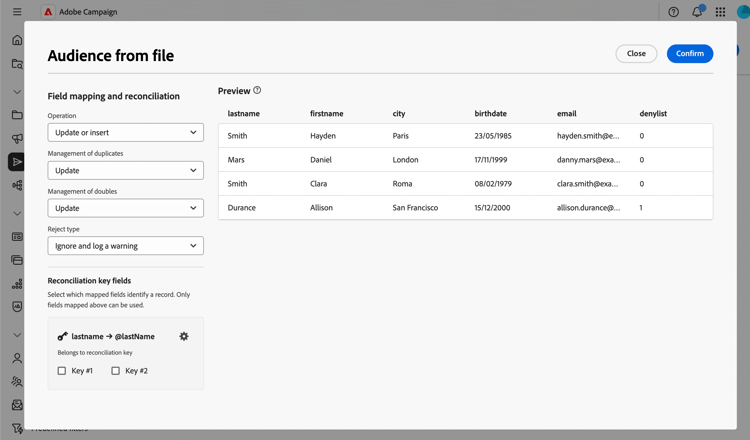
accordion Operation Choose the action to perform on the database:
- Update or insert: updates the record if it exists in the database, and creates it if not.
- Insert: inserts records into the database.
- Update: updates existing records only.
- Reconciliation only: looks for the record in the database, but does not perform an update.
- Delete: deletes records from the database.
accordion Management of duplicates Choose how to handle a record that exists both in the file and in the database:
- Update (default): updates the record.
- Reject entity: excludes it and logs an error.
- Ignore: excludes it without keeping a trace.
accordion Management of doubles Choose how to handle a record that appears more than once in the file itself:
- Update (default): does not deduplicate; the last matching record takes priority.
- Reject entity: excludes the extra records and logs an error.
- Ignore: excludes the extra records without keeping a trace.
accordion Reject type Choose how to handle a field-level error during reconciliation:
- Ignore and log a warning: imports all other fields and logs the error.
- Reject parent element: rejects the entire record.
- Reject all elements: stops the import and rejects everything.
accordion Reconciliation key fields In the Columns section, you mapped some columns to a destination field. Here, select which of those mapped fields should be used to identify a record. -
In the Formatting section, specify the encoding, string delimiter, and column separator used by the file.
-
Click Confirm once settings are correct.
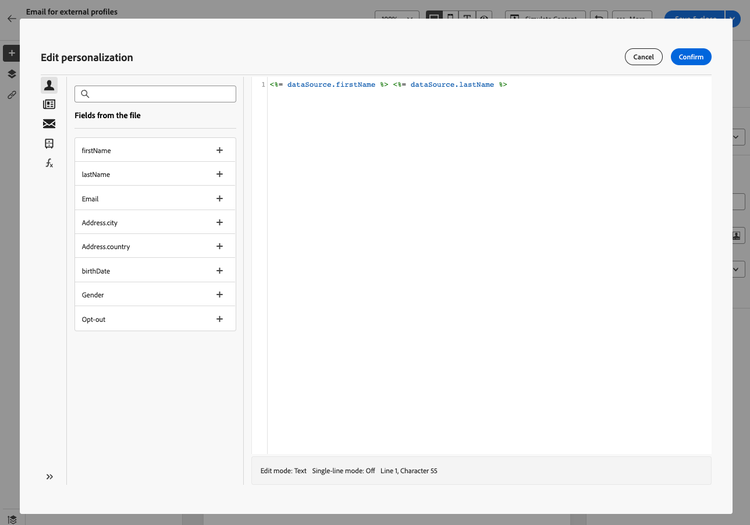
When creating the message content, add personalization by leveraging fields from the input file. Learn how to personalize content
Sample file sample-file
When loading an external file to target profiles in your deliveries, make sure the input file matches the recommendations below:
-
Supported formats are TXT and CSV.
-
The first line in the file is your column header.
-
Align your file format with the sample file below:
code language-none lastname,firstname,city,birthdate,email,denylist Smith,Hayden,Paris,23/05/1985,hayden.smith@example.com,0 Mars,Daniel,London,17/11/1999,danny.mars@example.com,0 Smith,Clara,Roma,08/02/1979,clara.smith@example.com,0 Durance,Allison,San Francisco,15/12/2000,allison.durance@example.com,1
Preview and test your email test
Campaign Web allows you to preview and send proofs when using an audience uploaded from a file. To do this, follow these steps:
-
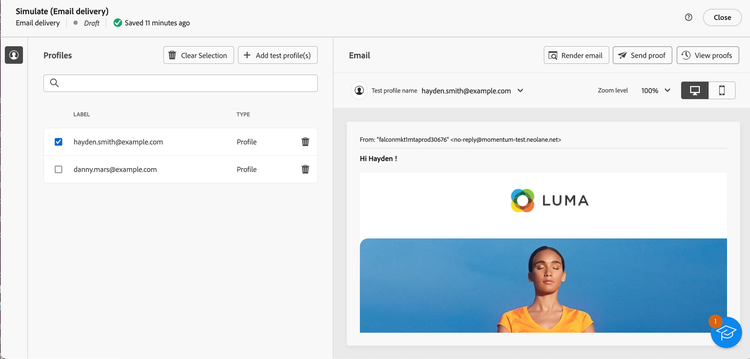
Click the Simulate content button from your delivery content editing screen, and click the Add test profile(s) button.
-
The profiles contained in the uploaded file display. Select the profiles that you want to use for previewing your content, and click Select.
-
A preview of the delivery content displays in the right pane of the screen. Personalized elements are replaced with the data from the profile selected in the left pane. Learn more about delivery content preview
-
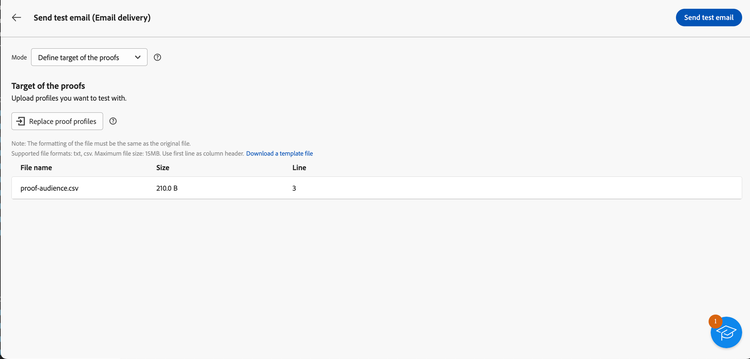
To send proofs, click the Send proof button.
-
Click the Upload proof profiles button, and select the .txt or .csv file that contains your proof recipients.
note caution CAUTION Ensure that the file format matches the one used for uploading your audience. Any format errors will display an alert. -
When the proof profiles are added and you are ready to send the proofs, click the Send proof button, and confirm the sending.
-
Monitor the sending of the proof using the View proofs button at any time. Learn more about proofs monitoring