設定適用於SPA編輯器的AEM
雖然SPA程式碼基底是在AEM之外進行管理,但需要AEM專案來設定支援的設定和內容要求。 本章會逐步說明如何建立包含必要設定的AEM專案:
- AEM WCM Core Components代理
- AEM遠端SPA頁面Proxy
- AEM遠端SPA頁面範本
- 基線遠端SPA AEM頁面
- 子專案以定義SPA至AEM URL的對應
- OSGi設定資料夾
從GitHub下載基礎專案
從Github.com下載aem-guides-wknd-graphql專案。 這將包含此專案中使用的一些基準線檔案。
$ mkdir -p ~/Code
$ git clone https://github.com/adobe/aem-guides-wknd-graphql.git
$ cd remote-spa-tutorial
建立AEM專案
建立可管理設定和基準內容的AEM專案。 此專案將在複製的aem-guides-wknd-graphql專案的remote-spa-tutorial資料夾中產生。
一律使用最新版本的AEM Archetype。
$ cd ~/Code/aem-guides-wknd-graphql/remote-spa-tutorial
$ mvn -B archetype:generate \
 -D archetypeGroupId=com.adobe.aem \
 -D archetypeArtifactId=aem-project-archetype \
 -D archetypeVersion=39 \
 -D aemVersion=cloud \
 -D appTitle="WKND App" \
 -D appId="wknd-app" \
 -D groupId="com.adobe.aem.guides.wkndapp" \
 -D frontendModule="react"
$ mv ~/Code/aem-guides-wknd-graphql/remote-spa-tutorial/wknd-app ~/Code/aem-guides-wknd-graphql/remote-spa-tutorial/com.adobe.aem.guides.wknd-app
最後一個命令只會重新命名AEM專案資料夾(_U),因此很清楚它是AEM專案,不要與遠端SPA混淆**
指定frontendModule="react"時,ui.frontend專案並未用於遠端SPA使用案例。 SPA是由AEM從外部開發及管理,且僅使用AEM作為內容API。 專案需要frontendModule="react"旗標才能包含spa-project個AEM Java™相依性並設定遠端SPA頁面範本。
AEM專案原型會產生下列元素,用於設定AEM以便與SPA整合。
- 在
ui.apps/src/.../apps/wknd-app/components的AEM WCM核心元件代理 - 位於
ui.apps/src/.../apps/wknd-app/components/remotepage的AEM SPA遠端頁面Proxy - 在
ui.content/src/.../conf/wknd-app/settings/wcm/templates的AEM頁面範本 - 子專案以定義位於
ui.content/src/...的內容對應 - 位於
ui.content/src/.../content/wknd-app的基準遠端SPA AEM頁面 - 在
ui.config/src/.../apps/wknd-app/osgiconfig的OSGi設定資料夾
產生基本AEM專案後,只需調整幾項即可確保SPA Editor與遠端SPA相容。
移除ui.frontend專案
由於SPA是遠端SPA,假設是在AEM專案外部開發和管理。 若要避免衝突,請從部署中移除ui.frontend專案。 如果未移除ui.frontend專案,則會同時在AEM SPA編輯器中載入兩個SPA (在ui.frontend專案和遠端SPA中提供的預設SPA)。
-
在IDE中開啟AEM專案(
~/Code/aem-guides-wknd-graphql/remote-spa-tutorial/com.adobe.aem.guides.wknd-app) -
開啟根
pom.xml -
從
<modules>清單註解<module>ui.frontend</modulecode language-none <modules> <module>all</module> <module>core</module> <!-- <module>ui.frontend</module> --> <module>ui.apps</module> <module>ui.apps.structure</module> <module>ui.config</module> <module>ui.content</module> <module>it.tests</module> <module>dispatcher</module> <module>ui.tests</module> <module>analyse</module> </modules>pom.xml檔案應該如下所示: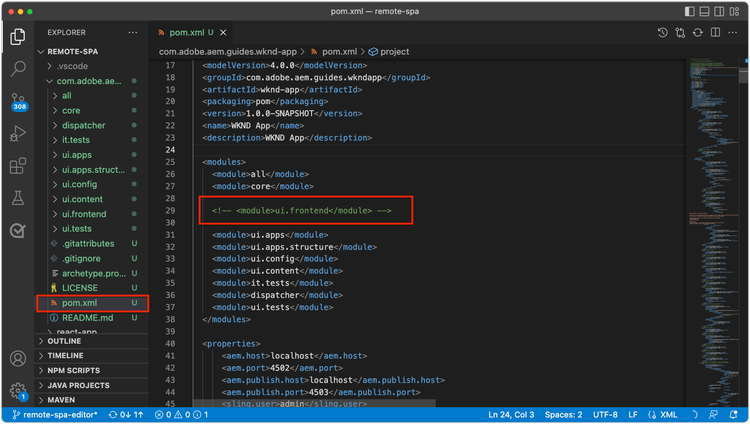
-
開啟
ui.apps/pom.xml -
註解
<artifactId>wknd-app.ui.frontend</artifactId>上的<dependency>code language-none <dependencies> <!-- Remote SPA project will provide all frontend resources <dependency> <groupId>com.adobe.aem.guides.wkndapp</groupId> <artifactId>wknd-app.ui.frontend</artifactId> <version>${project.version}</version> <type>zip</type> </dependency> --> </dependencies>ui.apps/pom.xml檔案應該如下所示: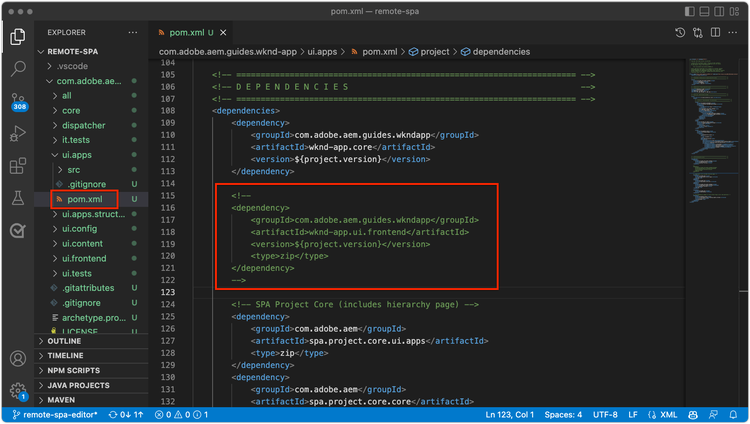
如果AEM專案是在這些變更之前建置,請從位於ui.apps/src/main/content/jcr_root/apps/wknd-app/clientlibs/clientlib-react的ui.apps專案手動刪除ui.frontend產生的使用者端資料庫。
AEM內容對應
若要讓AEM在SPA編輯器中載入遠端SPA,必須建立SPA路由與用來開啟及編寫內容的AEM頁面之間的對應。
稍後會探討此設定的重要性。
可以使用/etc/map中定義的Sling對應完成對應。
-
在IDE中,開啟
ui.content子專案 -
瀏覽至
src/main/content/jcr_root -
建立資料夾
etc -
在
etc中建立資料夾map -
在
map中建立資料夾http -
在
http中,建立包含下列內容的檔案.content.xml:code language-none <?xml version="1.0" encoding="UTF-8"?> <jcr:root xmlns:sling="http://sling.apache.org/jcr/sling/1.0" xmlns:jcr="http://www.jcp.org/jcr/1.0" jcr:primaryType="sling:Mapping"> <localhost_any/> </jcr:root> -
在
http中建立資料夾localhost_any -
在
localhost_any中,建立包含下列內容的檔案.content.xml:code language-none <?xml version="1.0" encoding="UTF-8"?> <jcr:root xmlns:sling="http://sling.apache.org/jcr/sling/1.0" xmlns:jcr="http://www.jcp.org/jcr/1.0" jcr:primaryType="sling:Mapping" sling:match="localhost\\.\\d+"> <wknd-app-routes-adventure/> </jcr:root> -
在
localhost_any中建立資料夾wknd-app-routes-adventure -
在
wknd-app-routes-adventure中,建立包含下列內容的檔案.content.xml:code language-none <?xml version="1.0" encoding="UTF-8"?> <!-- The 'wknd-app-routes-adventure' mapping, maps requests to the SPA's adventure route to it's corresponding page in AEM at /content/wknd-app/us/en/home/adventure/xxx. Note the adventure AEM pages are created directly in AEM. --> <jcr:root xmlns:sling="http://sling.apache.org/jcr/sling/1.0" xmlns:jcr="http://www.jcp.org/jcr/1.0" jcr:primaryType="sling:Mapping" sling:match="adventure:.*/([^/]+)/?$" sling:internalRedirect="/content/wknd-app/us/en/home/adventure/$1"/> -
將對應節點新增至
ui.content/src/main/content/META-INF/vault/filter.xml以包含在AEM套件中。code language-none <?xml version="1.0" encoding="UTF-8"?> <workspaceFilter version="1.0"> <filter root="/conf/wknd-app" mode="merge"/> <filter root="/content/wknd-app" mode="merge"/> <filter root="/content/dam/wknd-app/asset.jpg" mode="merge"/> <filter root="/content/experience-fragments/wknd-app" mode="merge"/> <!-- Add the Sling Mapping rules for the WKND App --> <filter root="/etc/map" mode="merge"/> </workspaceFilter>
資料夾結構和.context.xml檔案應該如下所示:
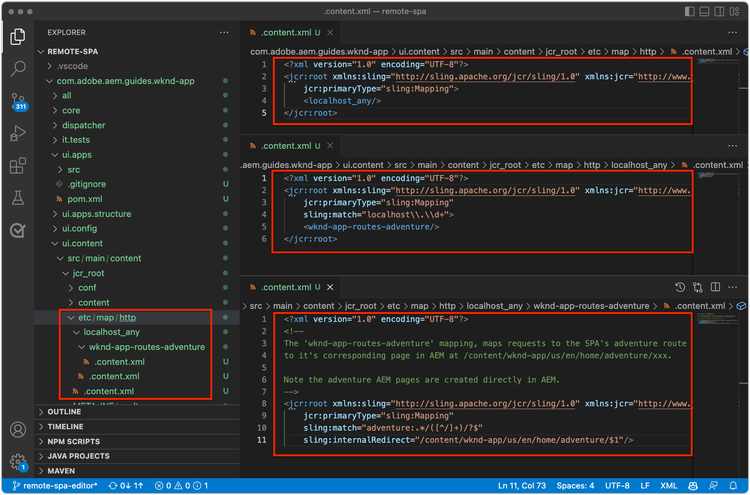
filter.xml檔案應該如下所示:
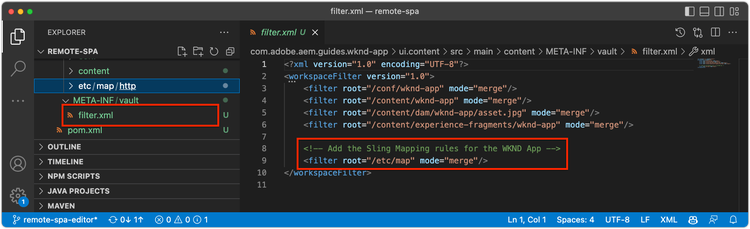
現在,部署AEM專案時,這些設定會自動包含在內。
Sling對應會影響http和localhost上執行的AEM,因此僅支援本機開發。 部署至AEM as a Cloud Service時,必須為目標https和適當的AEM as a Cloud Service網域新增類似的Sling對應。 如需詳細資訊,請參閱Sling對應檔案。
跨原始資源共用安全性原則
接下來,設定AEM以保護內容,使只有此SPA可以存取AEM內容。 在AEM🔗中設定跨原始資源共用。
-
在您的IDE中,開啟
ui.configMaven子專案 -
導覽
src/main/content/jcr_root/apps/wknd-app/osgiconfig/config -
建立名為
com.adobe.granite.cors.impl.CORSPolicyImpl~wknd-app_remote-spa.cfg.json的檔案 -
將下列專案新增至檔案:
code language-none { "supportscredentials":true, "exposedheaders":[ "" ], "supportedmethods":[ "GET", "HEAD", "POST", "OPTIONS" ], "alloworigin":[ "https://external-hosted-app", "localhost:3000" ], "maxage:Integer":1800, "alloworiginregexp":[ ".*" ], "allowedpaths":[ ".*" ], "supportedheaders":[ "Origin", "Accept", "X-Requested-With", "Content-Type", "Access-Control-Request-Method", "Access-Control-Request-Headers", "authorization" ] }
com.adobe.granite.cors.impl.CORSPolicyImpl~wknd-app_remote-spa.cfg.json檔案應該如下所示:
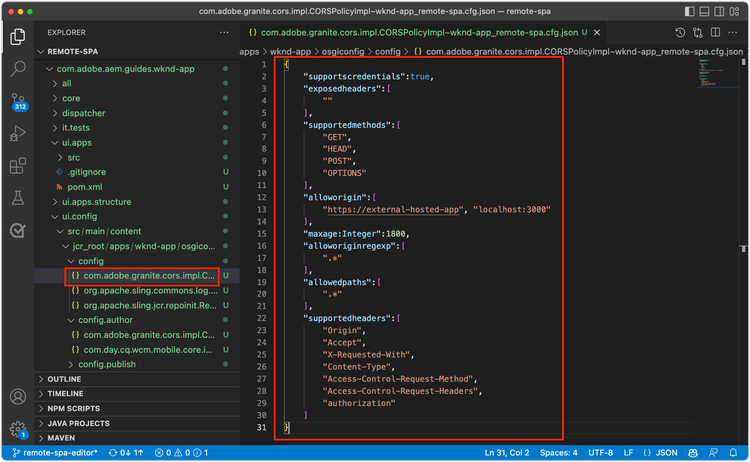
主要組態元素為:
-
alloworigin指定允許哪些主機從AEM擷取內容。- 已新增
localhost:3000以支援本機執行的SPA https://external-hosted-app會作為預留位置,取代為遠端SPA託管所在的網域。
- 已新增
-
allowedpaths指定此CORS設定涵蓋AEM中的哪些路徑。 預設允許存取AEM中的所有內容,不過這可以限定為SPA只能存取的特定路徑,例如:/content/wknd-app。
將AEM頁面設為遠端SPA頁面範本
AEM專案原型會產生一個專案,已為AEM與遠端SPA的整合做準備,但需要對自動產生的AEM頁面結構進行小幅但重要的調整。 自動產生的AEM頁面的型別必須變更為遠端SPA頁面,而非SPA頁面。
-
在您的IDE中,開啟
ui.content子專案 -
開啟至
src/main/content/jcr_root/content/wknd-app/us/en/home/.content.xml -
更新此
.content.xml檔案:code language-xml <?xml version="1.0" encoding="UTF-8"?> <jcr:root xmlns:sling="http://sling.apache.org/jcr/sling/1.0" xmlns:cq="http://www.day.com/jcr/cq/1.0" xmlns:jcr="http://www.jcp.org/jcr/1.0" xmlns:nt="http://www.jcp.org/jcr/nt/1.0" jcr:primaryType="cq:Page"> <jcr:content cq:template="/conf/wknd-app/settings/wcm/templates/spa-remote-page" jcr:primaryType="cq:PageContent" jcr:title="WKND App Home Page" sling:resourceType="wknd-app/components/remotepage"> <root jcr:primaryType="nt:unstructured" sling:resourceType="wcm/foundation/components/responsivegrid"> <responsivegrid jcr:primaryType="nt:unstructured" sling:resourceType="wcm/foundation/components/responsivegrid"> <text jcr:primaryType="nt:unstructured" sling:resourceType="wknd-app/components/text" text="<p>Hello World!</p>" textIsRich="true"> <cq:responsive jcr:primaryType="nt:unstructured"/> </text> </responsivegrid> </root> </jcr:content> </jcr:root>
主要變更為jcr:content節點的更新:
cq:template至/conf/wknd-app/settings/wcm/templates/spa-remote-pagesling:resourceType至wknd-app/components/remotepage
src/main/content/jcr_root/content/wknd-app/us/en/home/.content.xml檔案應該如下所示:
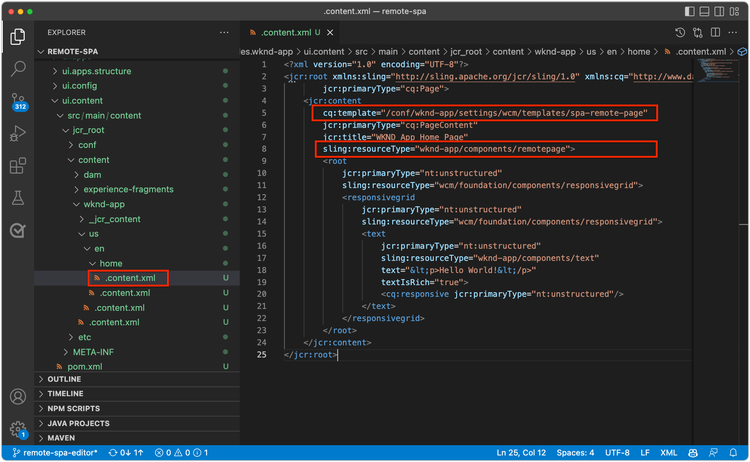
這些變更可讓此頁面(在AEM中充當SPA的根頁面)在SPA編輯器中載入遠端SPA。
ui.content」專案設為 合併 節點,而非更新。此頁面也可以在AEM本身中移除並重新建立為遠端SPA頁面,但由於此頁面是在ui.content專案中自動建立,所以最好在程式碼庫中更新它。
將AEM專案部署至AEM SDK
-
請確定AEM Author服務正在連線埠4502上執行
-
從命令列,導覽至AEM Maven專案的根目錄
-
使用Maven將專案部署至您的本機AEM SDK作者服務
code language-none $ mvn clean install -PautoInstallSinglePackage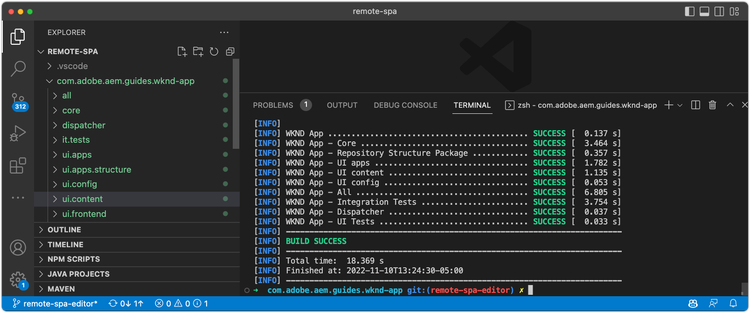
設定根AEM頁面
部署AEM專案後,最後一個步驟是準備SPA編輯器以載入我們的遠端SPA。 在AEM中,標籤與AEM專案原型產生的SPA根/content/wknd-app/us/en/home相對應的AEM頁面。
-
登入AEM Author
-
導覽至網站> WKND應用程式>我們> en
-
選取WKND應用程式首頁,然後點選屬性
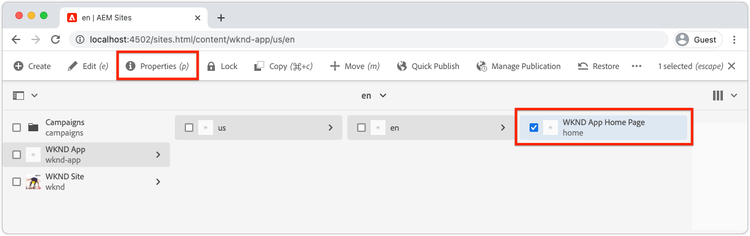
-
導覽至 SPA 標籤
-
填寫遠端SPA設定
- SPA主機URL:
http://localhost:3000- 遠端SPA根目錄的URL
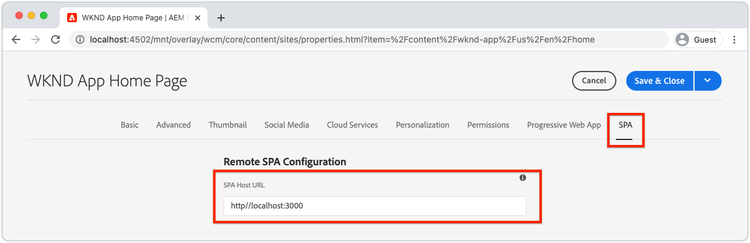
- SPA主機URL:
-
點選儲存並關閉
請記住,我們將此頁面的型別變更為 遠端SPA頁面 的型別,這可以讓我們在其 頁面屬性 中看到 SPA 索引標籤。
此設定只能在對應至SPA根目錄的AEM頁面上設定。 此頁面下方的所有AEM頁面都會繼承值。
恭喜
您現在已準備AEM的設定,並將其部署至本機AEM作者! 您現在知道如何:
- 在
ui.frontend中註解相依性,移除AEM專案原型產生的SPA - 新增Sling對應至AEM,將SPA路由對應至AEM中的資源
- 設定AEM的跨原始資源共用安全性原則,允許遠端SPA使用來自AEM的內容
- 將AEM專案部署至本機AEM SDK作者服務
- 使用SPA主機URL頁面屬性,將AEM頁面標示為遠端SPA的根
後續步驟
設定AEM後,我們可以專注於使用AEM SPA Editor支援可編輯區域,進而啟動遠端SPA!