Github.com webhook驗證
Webhook可讓您建立或設定可訂閱GitHub.com上特定事件的整合。 觸發其中一個事件時,GitHub會傳送HTTP POST裝載至webhook已設定的URL。 然而,基於安全考量,請務必確認傳入的webhook請求是否實際來自GitHub,而非惡意執行者。 本教學課程會逐步引導您完成在Adobe App Builder動作中,使用共用密碼驗證GitHub.com webhook要求的步驟。
在AppBuilder中設定Github機密
-
將密碼新增至
.env檔案:在App Builder專案的
.env檔案中,新增GitHub.com webhook密碼的自訂金鑰:code language-env # Specify your secrets here # This file must not be committed to source control ... GITHUB_SECRET=my-github-webhook-secret-1234! -
更新
ext.config.yaml檔案:必須更新
ext.config.yaml檔案才能驗證GitHub.com webhook要求。- 將AppBuilder動作
web設定設為raw,以從GitHub.com接收原始要求內文。 - 在AppBuilder動作設定的
inputs底下,新增GITHUB_SECRET金鑰,並將其對應至包含密碼的.env欄位。 此索引鍵的值是以$為前置詞的.env欄位名稱。 - 將AppBuilder動作設定中的
require-adobe-auth註解設為false,以允許不需要經過Adobe驗證即可呼叫動作。
產生的
ext.config.yaml檔案應如下所示:code language-yaml operations: view: - type: web impl: index.html actions: actions web: web-src runtimeManifest: packages: dx-excshell-1: license: Apache-2.0 actions: github-to-jira: function: actions/generic/index.js web: 'raw' runtime: nodejs:20 inputs: LOG_LEVEL: debug GITHUB_SECRET: $GITHUB_SECRET annotations: require-adobe-auth: false final: true - 將AppBuilder動作
將驗證程式碼新增至AppBuilder動作
接著,將下方提供的JavaScript程式碼(複製自GitHub.com的檔案)新增至您的AppBuilder動作。 請確定匯出verifySignature函式。
// src/dx-excshell-1/actions/generic/github-webhook-verification.js

let encoder = new TextEncoder();

async function verifySignature(secret, header, payload) {
    let parts = header.split("=");
    let sigHex = parts[1];

    let algorithm = { name: "HMAC", hash: { name: 'SHA-256' } };

    let keyBytes = encoder.encode(secret);
    let extractable = false;
    let key = await crypto.subtle.importKey(
        "raw",
        keyBytes,
        algorithm,
        extractable,
        [ "sign", "verify" ],
    );

    let sigBytes = hexToBytes(sigHex);
    let dataBytes = encoder.encode(payload);
    let equal = await crypto.subtle.verify(
        algorithm.name,
        key,
        sigBytes,
        dataBytes,
    );

    return equal;
}

function hexToBytes(hex) {
    let len = hex.length / 2;
    let bytes = new Uint8Array(len);

    let index = 0;
    for (let i = 0; i < hex.length; i += 2) {
        let c = hex.slice(i, i + 2);
        let b = parseInt(c, 16);
        bytes[index] = b;
        index += 1;
    }

    return bytes;
}

module.exports = { verifySignature };
在AppBuilder動作中實作驗證
接下來,將要求標頭中的簽章與verifySignature函式產生的簽章進行比較,以確認要求來自GitHub。
在AppBuilder動作的index.js中,將下列程式碼新增至main函式:
// src/dx-excshell-1/actions/generic/index.js

const { verifySignature } = require("./github-webhook-verification");
...

// Main function that will be executed by Adobe I/O Runtime
async function main(params) {
  // Create a Logger
  const logger = Core.Logger("main", { level: params?.LOG_LEVEL || "info" });

  try {
    // Log parameters if LOG_LEVEL is 'debug'
    logger.debug(stringParameters(params));

    // Define required parameters and headers
    const requiredParams = [
      // Verifies the GITHUB_SECRET is present in the action's configuration; add other parameters here as needed.
      "GITHUB_SECRET"
    ];

    const requiredHeaders = [
      // Require the x-hub-signature-256 header, which GitHub.com populates with a sha256 hash of the payload
      "x-hub-signature-256"
    ];

    // Check for missing required parameters and headers
    const errorMessage = checkMissingRequestInputs(params, requiredParams, requiredHeaders);

    if (errorMessage) {
      // Return and log client errors
      return errorResponse(400, errorMessage, logger);
    }

    // Decode the request body (which is base64 encoded) to a string
    const body = Buffer.from(params.__ow_body, 'base64').toString('utf-8');

    // Verify the GitHub webhook signature
    const isSignatureValid = await verifySignature(
      params.GITHUB_SECRET,
      params.__ow_headers["x-hub-signature-256"],
      body
    );

    if (!isSignatureValid) {
      // GitHub signature verification failed
      return errorResponse(401, "Unauthorized", logger);
    } else {
      logger.debug("Signature verified");
    }

    // Parse the request body as JSON so its data is useful in the action
    const githubParams = JSON.parse(body) || {};

    // Optionally, merge the GitHub webhook request parameters with the action parameters
    const mergedParams = {
      ...params,
      ...githubParams
    };

    // Do work based on the GitHub webhook request
    doWork(mergedParams);

    return {
      statusCode: 200,
      body: { message: "GitHub webhook received and processed!" }
    };

  } catch (error) {
    // Log any server errors
    logger.error(error);
    // Return with 500 status code
    return errorResponse(500, "Server error", logger);
  }
}
在GitHub中設定webhook
返回GitHub.com,在建立webhook時為GitHub.com提供相同的機密值。 使用在您的.env檔案GITHUB_SECRET金鑰中指定的機密值。
在GitHub.com中,前往存放庫設定,並編輯webhook。 在webhook設定中,在Secret欄位中提供密碼值。 按一下底部的 更新webhook 以儲存變更。
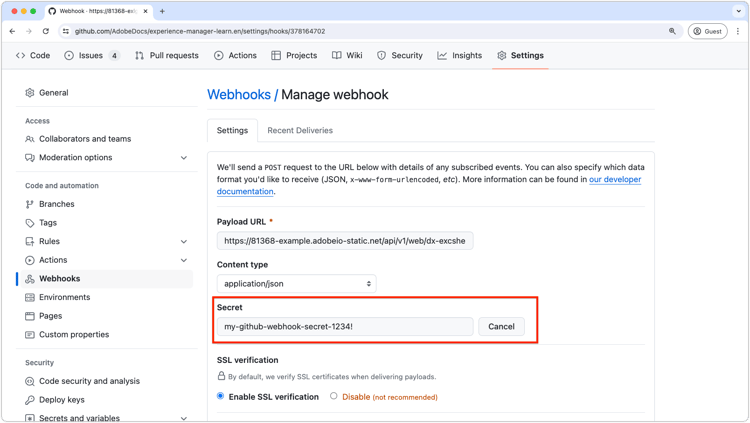
按照以下步驟操作,您可以確保App Builder動作可以安全地驗證傳入的webhook請求確實來自您的GitHub.com webhook。