Java 中的人力資源文件工作流程

許多企業要求新進員工相關文件,例如為在家工作員工簽訂的工作協議。 傳統上,企業以難以管理與儲存的形式實體管理這些文件。 轉換到電子文件時,PDF 檔案是理想選擇,因為它們比其他檔案類型更安全且更不易被修改。 此外,它們支援數位簽章。
你可以學到什麼
在這個實作教學中,學習如何實作一個基於網頁的人資表單,將職場協議存為 PDF 並簽署,並用簡單的 Java Spring MVC 應用程式完成。
相關 API 與資源
產生 API 憑證
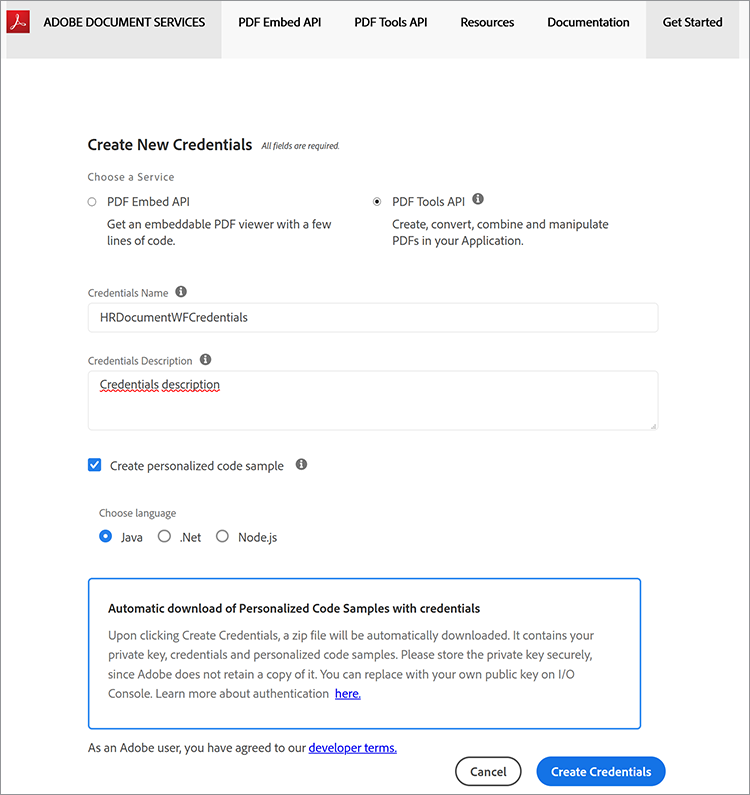
請先註冊 Adobe PDF 服務 API 免費試用版。 前往 Adobe 網站,點擊「建立新憑證」下的「開始」按鈕。免費試用版提供 1,000 筆文件交易,可於六個月內使用。 在下一頁(見下文),選擇服務(PDF Services API),設定憑證名稱(例如 HRDocumentWFCredentials),並輸入描述。
選擇語言(此例為 Java),並勾選 「建立個人化程式碼範例」。 最後一步確保程式碼範例中已包含你使用的預先填充的 pdftools-api-credentials.json 檔案,以及用於在 API 內驗證應用程式的私鑰。
最後,點擊 建立憑證 按鈕。 這樣會產生憑證,樣本會自動開始下載。
為了確保憑證有效,請打開已下載的樣本。 這裡你使用的是 IntelliJ IDEA。 當你打開原始碼時,整合開發環境(IDE)會要求建置引擎。 這個範例用的是 Maven,但你也可以依照喜好使用 Gradle。
接著,執行 mvn clean install Maven 目標來建立 jar 檔案。
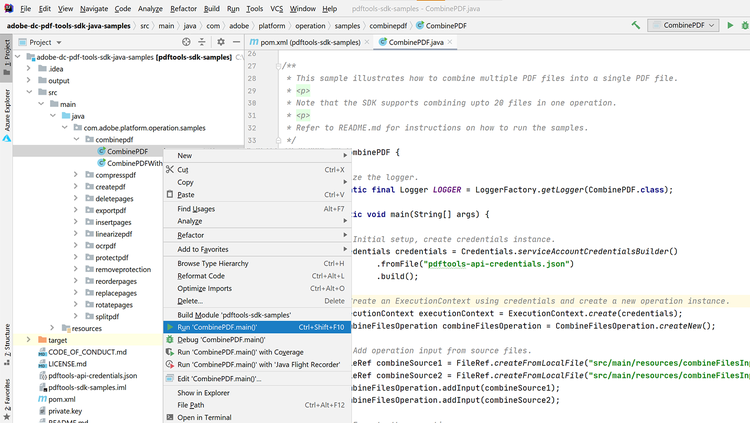
最後,執行 CombinePDF 範例,如下所示。 程式碼會在輸出資料夾中產生 PDF。
建立 Spring MVC 應用程式
根據憑證,你再建立應用程式。 這個範例使用 Spring Initializr。
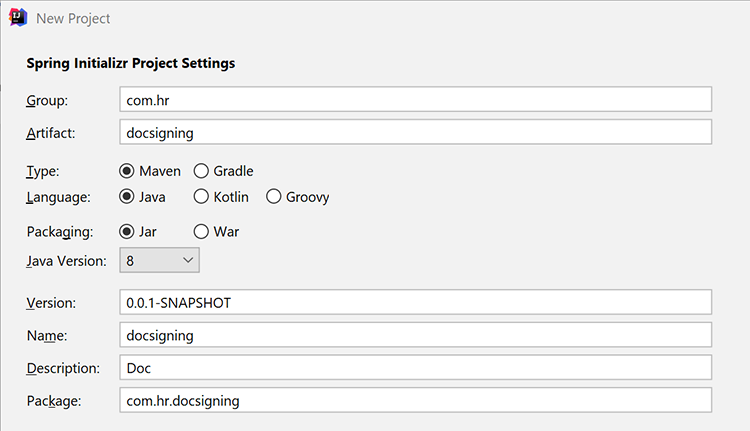
首先,設定專案設定為使用 Java 8 語言和 Jar 封裝(見下方截圖)。
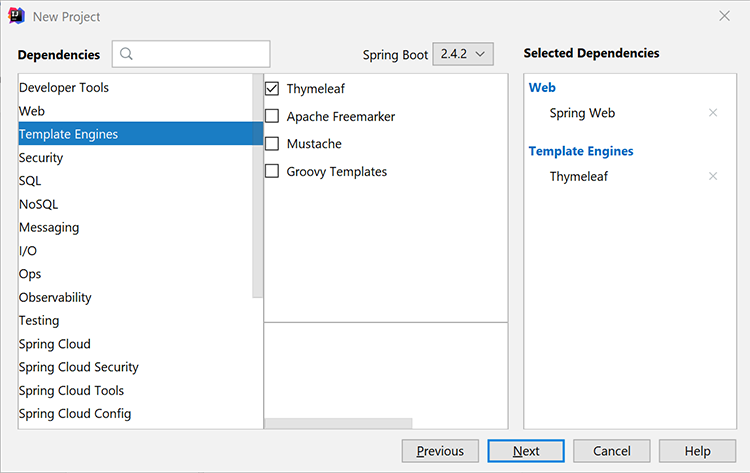
第二,加入 Spring Web(來自 Web 的)和 Thymleaf(來自 Template Engines):
建立專案後,前往 pom.xml 檔案,並補充依賴部分的 pdftools-sdk 和 log4j-slf4j-impl:
<dependencies>
    <dependency>
        <groupId>org.springframework.boot</groupId>
        <artifactId>spring-boot-starter-thymeleaf</artifactId>
    </dependency>
    <dependency>
        <groupId>org.springframework.boot</groupId>
        <artifactId>spring-boot-starter-web</artifactId>
    </dependency>

    <dependency>
        <groupId>org.springframework.boot</groupId>
        <artifactId>spring-boot-starter-test</artifactId>
        <scope>test</scope>
    </dependency>

</dependencies>
接著,用你下載的兩個範例程式碼檔案來補充專案根目錄:
-
pdftools-api-credentials.json
-
private.key
繪製網頁表單
要渲染網頁表單,請修改應用程式,並使用負責渲染個人資料表單並處理表單發布的控制器。 首先,請用 PersonForm 模型類別修改應用程式:
package com.hr.docsigning;
import javax.validation.constraints.NotNull;
import javax.validation.constraints.Size;

public class PersonForm {
    @NotNull
    @Size(min=2, max=30)
    private String firstName;

    @NotNull
    @Size(min=2, max=30)
    private String lastName;

    public String getFirstName() {
            return this.firstName;
    }

    public void setFirstName(String firstName) {
            this.firstName = firstName;
    }

    public String getLastName() {
           return this.lastName;
    }

    public void setLastName(String lastName) {
            this.lastName = lastName;
    }

    public String GetFullName() {
           return this.firstName + " " + this.lastName;
    }
}
此類別包含兩個性質: firstName 和 lastName。 另外,利用這個簡單的驗證功能檢查字元大小介於兩到三十字元之間。
根據模型類別,你可以建立控制器(詳見配套程式碼中的 PersonController.java):
package com.hr.docsigning;
import org.springframework.stereotype.Controller;
import org.springframework.validation.BindingResult;
import org.springframework.web.bind.annotation.GetMapping;
import org.springframework.web.bind.annotation.PostMapping;
import javax.validation.Valid;

@Controller
public class PersonController {
    @GetMapping("/")
    public String showForm(PersonForm personForm) {
        return "form";
    }
}
控制器只有一種方法:showForm。 它負責使用位於 resources/templates/form.html 的 HTML 模板來渲染表單:
<html>
<head>
    <link rel="stylesheet" href="https://www.w3schools.com/w3css/4/w3.css">
</head>

<body>
<div class="w3-container">
    <h1>HR Department</h1>
</div>

<form class="w3-panel w3-card-4" action="#" th:action="@{/}"
        th:object="${personForm}" method="post">
    <h2>Personal data</h2>
    <table>
        <tr>
            <td>First Name:</td>
            <td><input type="text" class="w3-input"
                placeholder="First name" th:field="*{firstName}" /></td>
            <td class="w3-text-red" th:if="${#fields.hasErrors('firstName')}"
                th:errors="*{firstName}"></td>
        </tr>
        <tr>
            <td>Last Name:</td>
            <td><input type="text" class="w3-input"
                placeholder="Last name" th:field="*{lastName}" /></td>
            <td class="w3-text-red" th:if="${#fields.hasErrors('lastName')}"
                th:errors="*{lastName}"></td>
        </tr>
        <tr>
            <td><button class="w3-button w3-black" type="submit">Submit</button></td>
        </tr>
    </table>
</form>
</body>
</html>
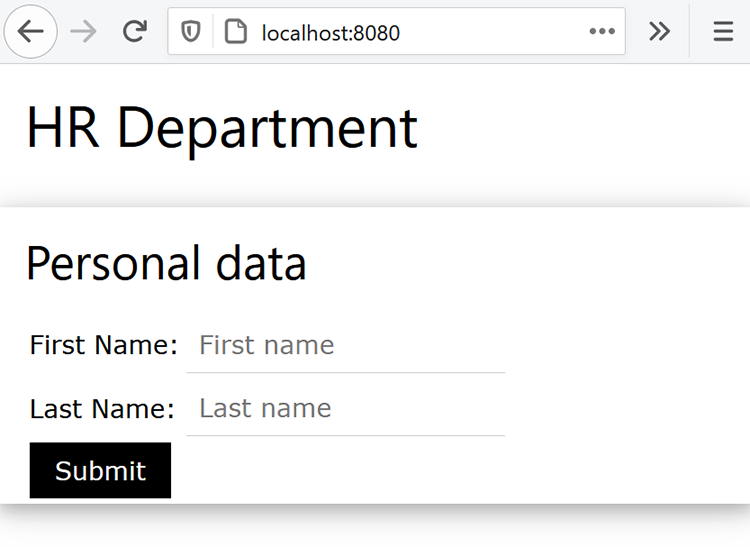
為了渲染動態內容,會使用 Thymeleaf 模板渲染引擎。 所以,執行應用程式後,你應該會看到以下情況:
產生動態內容的 PDF
接著,在渲染個人資料表單後,動態填入選定欄位,產生包含虛擬合約的 PDF 文件。 具體來說,你必須將個人資料填入預先建立的合約中。
這裡為了簡化,你只有一個標頭、一個子標頭,以及一個字串常數讀法:「此合約為 \ 準備<full name=“” of=“” the=“” person=“”>了」。</full>
要達成這個目標,可以從 Adobe 的「 從動態 HTML 建立 PDF」範例開始。 透過分析這些範例程式碼,你會發現動態 HTML 欄位人口的運作方式如下。
首先,你必須準備包含靜態和動態內容的 HTML 頁面。 動態部分是透過 JavaScript 更新的。 也就是說,PDF Services API 會將 JSON 物件注入你的 HTML。
接著你會透過 HTML 文件載入時呼叫的 JavaScript 函式取得 JSON 屬性。 此 JavaScript 函式會更新所選的 DOM 元素。 以下是填充跨度元素的範例,該元素包含個人資料(參見伴隨程式碼的 src\main\resources\contract\index.html):
<html>
<head>
    <link rel="stylesheet" href="https://www.w3schools.com/w3css/4/w3.css">
</head>

<body onload="updateFullName()">
    <script src="./json.js"></script>
    <script type="text/javascript">
        function updateFullName()
        {
            var document = window.document;
            document.getElementById("personFullName").innerHTML = String(
                window.json.personFullName);
        }
    </script>

    <div class="w3-container ">
        <h1>HR Department</h1>

        <h2>Contract details</h2>

        <p>This contract was prepared for:
            <strong><span id="personFullName"></span></strong>
        </p>
    </div>
</body>
</html>
接著,你必須將所有相依的 JavaScript 和 CSS 檔案壓縮成 HTML。 PDF 服務 API 不接受 HTML 檔案。 相反地,它需要一個壓縮檔作為輸入。 在這種情況下,你會把壓縮檔存放在 src\main\resources\contract\index.zip。
之後,你可以用另一種處理 POST 請求的方法來補充 PersonController :
@PostMapping("/")
public String checkPersonInfo(@Valid PersonForm personForm,
    BindingResult bindingResult) {
    if (bindingResult.hasErrors()) {
        return "form";
    }

    CreateContract(personForm);

    return "contract-actions";
}
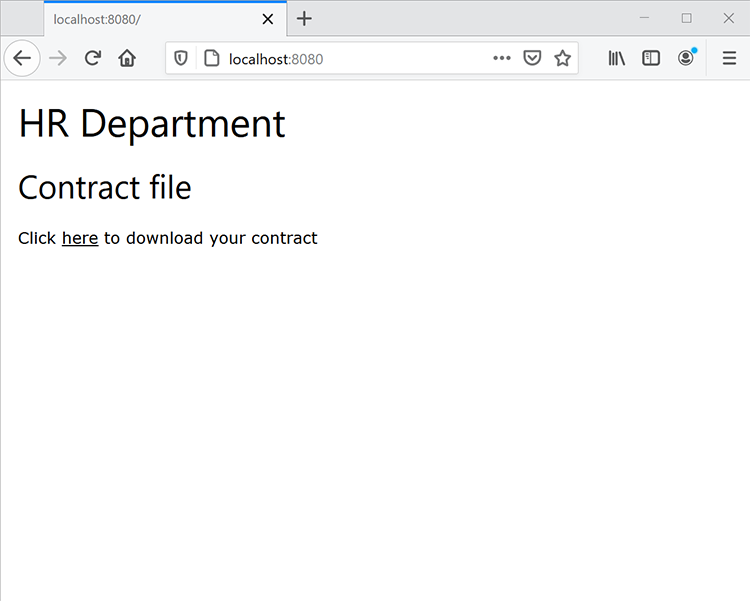
上述方法利用提供的個人資料建立 PDF 合約,並呈現合約-行動視圖。 後者提供產生的 PDF 連結及簽署 PDF 的連結。
現在,讓我們來看看這個 CreateContract 方法的運作方式(完整列表如下)。 此方法依賴兩個欄位:
-
LOGGER,來自 log4j,除錯任何異常的資訊 -
contractFilePath,包含產生的 PDF 檔案路徑
這個 CreateContract 方法會設定憑證,並從 HTML 建立 PDF。 要將個人資料傳入合約,請使用 setCustomOptionsAndPersonData 助手。 此方法從表單中取得該人的資料,然後透過上述 JSON 物件傳送至產生的 PDF。
同時也 setCustomOptionsAndPersonData 展示了如何透過關閉頁首和頁尾來控制 PDF 外觀。 完成這些步驟後,你會將 PDF 檔案儲存為輸出/contract.pdf,並最終刪除先前產生的檔案。
private static final Logger LOGGER = LoggerFactory.getLogger(PersonController.class);
private String contractFilePath = "output/contract.pdf";
private void CreateContract(PersonForm personForm) {
    try {
        // Initial setup, create credentials instance.
        Credentials credentials = Credentials.serviceAccountCredentialsBuilder()
                .fromFile("pdftools-api-credentials.json")
                .build();

        //Create an ExecutionContext using credentials
       //and create a new operation instance.
        ExecutionContext executionContext = ExecutionContext.create(credentials);
        CreatePDFOperation htmlToPDFOperation = CreatePDFOperation.createNew();

        // Set operation input from a source file.
        FileRef source = FileRef.createFromLocalFile(
           "src/main/resources/contract/index.zip");
       htmlToPDFOperation.setInput(source);

        // Provide any custom configuration options for the operation
        // You pass person data here to dynamically fill out the HTML
        setCustomOptionsAndPersonData(htmlToPDFOperation, personForm);

        // Execute the operation.
        FileRef result = htmlToPDFOperation.execute(executionContext);

        // Save the result to the specified location. Delete previous file if exists
        File file = new File(contractFilePath);
        Files.deleteIfExists(file.toPath());

        result.saveAs(file.getPath());

    } catch (ServiceApiException | IOException |
             SdkException | ServiceUsageException ex) {
        LOGGER.error("Exception encountered while executing operation", ex);
    }
}

private static void setCustomOptionsAndPersonData(
    CreatePDFOperation htmlToPDFOperation, PersonForm personForm) {
    //Set the dataToMerge field that needs to be populated
    //in the HTML before its conversion
    JSONObject dataToMerge = new JSONObject();
    dataToMerge.put("personFullName", personForm.GetFullName());

    // Set the desired HTML-to-PDF conversion options.
    CreatePDFOptions htmlToPdfOptions = CreatePDFOptions.htmlOptionsBuilder()
        .includeHeaderFooter(false)
        .withDataToMerge(dataToMerge)
        .build();
    htmlToPDFOperation.setOptions(htmlToPdfOptions);
}
在產生合約時,你也可以將動態且個人專屬的資料與固定合約條款合併。 要做到這點,請依照「 從靜態 HTML 建立 PDF 的範例」來操作。 或者,你也可以 合併兩個 PDF。
提供PDF檔案下載。
您現在可以將產生的 PDF 連結提供給使用者下載。 要做到這點,首先建立 contract-actions.html 檔案(參見配套程式碼的資源/範本contract-actions.html):
<html>
<head>
    <link rel="stylesheet" href="https://www.w3schools.com/w3css/4/w3.css">
</head>

<div class="w3-container ">
    <h1>HR Department</h1>

    <h2>Contract file</h2>

    <p>Click <a href="/pdf">here</a> to download your contract</p>
</div>
</body>
</html>
接著,你在類別中PersonController實作downloadContract該方法如下:
@RequestMapping("/pdf")
public void downloadContract(HttpServletResponse response)
{
    Path file = Paths.get(contractFilePath);

    response.setContentType("application/pdf");
    response.addHeader(
        "Content-Disposition", "attachment; filename=contract.pdf");

    try
    {
        Files.copy(file, response.getOutputStream());
        response.getOutputStream().flush();
    }
    catch (IOException ex)
    {
        ex.printStackTrace();
    }
}
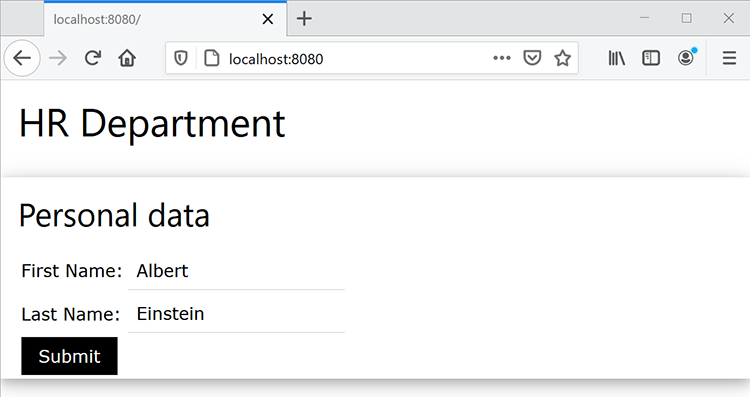
執行應用程式後,你會看到以下流程。 第一個畫面顯示個人資料表單。 測試時,請填入介於 2 到 30 字元之間的任何值:
點擊 提交 按鈕後,表單會驗證,PDF 會根據 HTML 產生(resources/contract/index.html)。 應用程式會顯示另一個檢視(合約細節),您可以下載PDF:
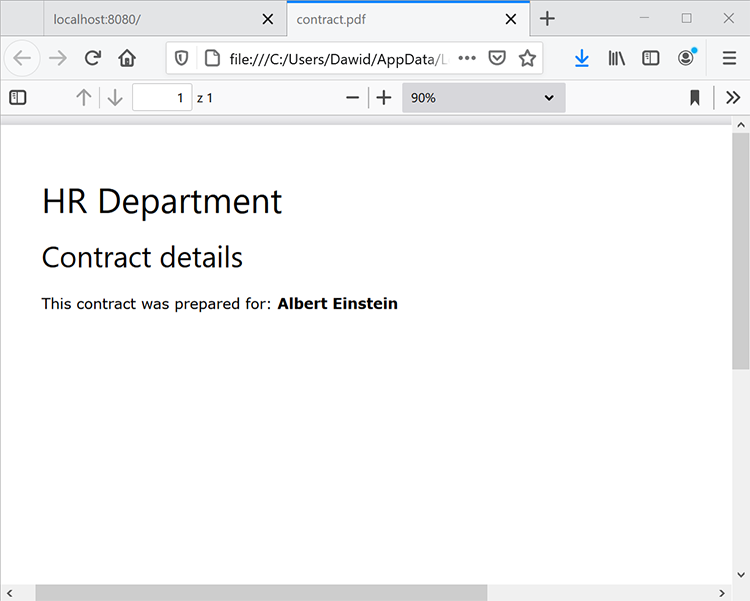
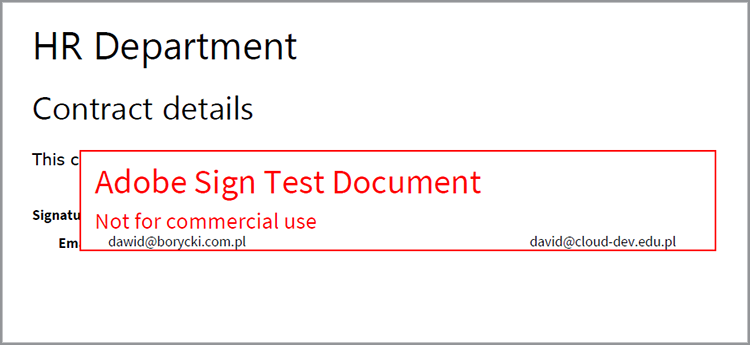
PDF 在網頁瀏覽器中渲染後,呈現如下樣貌。 也就是說,您輸入的個人資料會被傳播到PDF中:
啟用簽名與安全性
當協議準備好後,Adobe Sign 可以新增代表核准的數位簽名。 Adobe Sign 的認證運作方式和 OAuth 有點不同。 現在讓我們看看如何將應用程式與 Adobe Sign 整合。 為此,您必須準備申請所需的存取權杖。 接著,你用 Adobe Sign Java SDK 撰寫客戶端程式碼。
要取得授權憑證,您必須完成幾個步驟:
首先,註冊一個 開發者帳號。
在 Adobe Sign 入口網站🔗建立 CLIENT 應用程式。
請依照這裡🔗和這裡描述的配置 OAuth 來設定應用程式。請註明您的客戶識別碼與客戶機密。 接著,你可以使用 https://www.google.com 重定向 URI 及以下範圍:
-
user_login:自我
-
agreement_read:帳號
-
agreement_write:帳號
-
agreement_send:帳號
請用你的客戶端 ID 代替 \,準備以下網址<CLIENT_ID>:</CLIENT_ID>
https://secure.eu1.adobesign.com/public/oauth?redirect_uri=https://www.google.com
&response_type=code
&client_id=<CLIENT_ID>
&scope=user_login:self+agreement_read:account+agreement_write:account+agreement_send:account
在你的瀏覽器中輸入上述網址。 你會被導向到 google.com,代碼會顯示在地址列中,代碼=<YOUR_CODE>,為</YOUR_CODE>
如:
https://www.google.com/?code=<YOUR_CODE>&api_access_point=https://api.eu1.adobesign.com/&web_access_point=https://secure.eu1.adobesign.com%2F
請注意 \ 和 api_access_point 的給出<YOUR_CODE> 值。</YOUR_CODE>
要發送提供存取權杖的 HTTP POST 請求,請使用 client ID、\ <YOUR_CODE>和 api_access_point 值。 </YOUR_CODE>你可以使用 Postman 或 cURL:
curl --location --request POST "https://**api.eu1.adobesign.com**/oauth/token"
\\

\--data-urlencode "client_secret=**\<CLIENT_SECRET\>**" \\

\--data-urlencode "client_id=**\<CLIENT_ID\>**" \\

\--data-urlencode "code=**\<YOUR_CODE\>**" \\

\--data-urlencode "redirect_uri=**https://www.google.com**" \\

\--data-urlencode "grant_type=authorization_code"
樣本響應如下:
{
    "access_token":"3AAABLblqZhByhLuqlb-…",
    "refresh_token":"3AAABLblqZhC_nJCT7n…",
    "token_type":"Bearer",
    "expires_in":3600
}
請注意你的access_token。 你需要它來授權你的客戶端程式碼。
使用 Adobe Sign Java SDK
一旦你拿到存取權杖,就可以向 Adobe Sign 發送 REST API 呼叫。 為了簡化這個流程,可以使用 Adobe Sign Java SDK。 原始碼可在 Adobe GitHub 倉庫🔗取得。
要將此套件整合到你的應用程式中,你必須複製該程式碼。 接著,建立 Maven 套件(mvn 套件),並將以下檔案安裝到專案中(你可以在 adobe-sign-sdk 資料夾的伴隨程式碼中找到):
-
目標/swagger-java-client-1.0.0.jar
-
目標/自由/gson-2.8.1.jar
-
目標/自由/gson-fire-1.8.0.jar
-
目標/自由/hamcrest-core-1.3.jar
-
目標/圖書館/junit-4.12.jar
-
目標/自由/logging-interceptor-2.7.5.jar
-
目標/圖書館/okhttp-2.7.5.jar
-
目標/圖書館/okio-1.6.0.jar
-
目標/圖書館/swagger-annotations-1.5.15.jar
在 IntelliJ IDEA 中,你可以用 專案結構 (File/Project Structure)將這些檔案加入相依關係。
寄送PDF以求簽名
你現在準備將協議送交簽署。 首先,請在contract-details.html中補充另一個指向傳送請求的超連結:
<html>
<head>
    <link rel="stylesheet" href="https://www.w3schools.com/w3css/4/w3.css">
</head>

<div class="w3-container ">
    <h1>HR Department</h1>

    <h2>Contract file</h2>

    <p>Click <a href="/pdf"> here</a> to download your contract</p>


</div>
</body>
</html>
接著,你加入另一個控制器, AdobeSignController在裡面實作 sendContractMethod (參見伴隨程式碼)。 該方法的運作方式如下:
首先,它用來 ApiClient 取得 API 端點。
ApiClient apiClient = new ApiClient();

//Default baseUrl to make GET /baseUris API call.
String baseUrl = "https://api.echosign.com/";
String endpointUrl = "/api/rest/v6";
apiClient.setBasePath(baseUrl + endpointUrl);

// Provide an OAuth Access Token as "Bearer access token" in authorization
String authorization = "Bearer ";

// Get the baseUris for the user and set it in apiClient.
BaseUrisApi baseUrisApi = new BaseUrisApi(apiClient);
BaseUriInfo baseUriInfo = baseUrisApi.getBaseUris(authorization);
apiClient.setBasePath(baseUriInfo.getApiAccessPoint() + endpointUrl);
接著,該方法利用 contract.pdf 檔案建立暫時性文件:
// Get PDF file
String filePath = "output/";
String fileName = "contract.pdf";
File file = new File(filePath + fileName);
String mimeType = "application/pdf";

//Get the id of the transient document.
TransientDocumentsApi transientDocumentsApi =
    new TransientDocumentsApi(apiClient);
TransientDocumentResponse response = transientDocumentsApi.createTransientDocument(authorization,
    file, null, null, fileName, mimeType);
String transientDocumentId = response.getTransientDocumentId();
接著,你必須制定一份協議。 要做到這點,請使用 contract.pdf 檔案,並將協議狀態設為 IN_PROCESS 立即傳送檔案。 此外,您也可以選擇電子簽名:
// Create AgreementCreationInfo
AgreementCreationInfo agreementCreationInfo = new AgreementCreationInfo();

// Add file
FileInfo fileInfo = new FileInfo();
fileInfo.setTransientDocumentId(transientDocumentId);
agreementCreationInfo.addFileInfosItem(fileInfo);

// Set state to IN_PROCESS, so the agreement is be sent immediately
agreementCreationInfo.setState(AgreementCreationInfo.StateEnum.IN_PROCESS);
agreementCreationInfo.setName("Contract");
agreementCreationInfo.setSignatureType(AgreementCreationInfo.SignatureTypeEnum.ESIGN);
接著,你要按以下方式新增協議接收者。 這裡你新增了兩位收件人(見員工與經理章節):
// Provide emails of recipients to whom agreement is be sent
// Employee
ParticipantSetInfo participantSetInfo = new ParticipantSetInfo();
ParticipantSetMemberInfo participantSetMemberInfo = new ParticipantSetMemberInfo();
participantSetMemberInfo.setEmail("");
participantSetInfo.addMemberInfosItem(participantSetMemberInfo);
participantSetInfo.setOrder(1);
participantSetInfo.setRole(ParticipantSetInfo.RoleEnum.SIGNER);
agreementCreationInfo.addParticipantSetsInfoItem(participantSetInfo);

// Manager
participantSetInfo = new ParticipantSetInfo();
participantSetMemberInfo = new ParticipantSetMemberInfo();
participantSetMemberInfo.setEmail("");
participantSetInfo.addMemberInfosItem(participantSetMemberInfo);
participantSetInfo.setOrder(2);
participantSetInfo.setRole(ParticipantSetInfo.RoleEnum.SIGNER);
agreementCreationInfo.addParticipantSetsInfoItem(participantSetInfo);
最後,請使用 createAgreement Adobe Sign Java SDK 的方法發送協議:
// Create agreement using the transient document.
AgreementsApi agreementsApi = new AgreementsApi(apiClient);
AgreementCreationResponse agreementCreationResponse = agreementsApi.createAgreement(
    authorization, agreementCreationInfo, null, null);

System.out.println("Agreement sent, ID: " + agreementCreationResponse.getId());
執行此代碼後,您會收到一封電子郵件(地址為代碼中指定的地址,與簽署請求相同 <email_address>) )。 郵件中包含超連結,引導收件人前往 Adobe Sign 入口網站進行簽名。 你可以在 Adobe Sign 開發者入口網站看到該文件(見下方圖),也可以使用 getAgreementInfo 方法以程式化方式追蹤簽名流程。
最後,您也可以如以下 範例所示,使用 PDF 服務 API 對 PDF 設密碼保護。
後續步驟
如你所見,透過利用快速入門功能,你可以實作一個簡單的網頁表單,用 Adobe PDF Services API 建立經批准的 Java PDF。 Adobe PDF API 能無縫整合到您現有的客戶應用程式中。
舉個例子,你可以建立收件人可以遠端且安全地簽署的表格。 當你需要多個簽名時,甚至可以自動將表單路由給工作流程中的一連串人員。 你的員工入職流程會更好,人資部門也會很喜歡你。
立即 Adobe Acrobat Services 查看,為您的應用程式新增多種 PDF 功能。