Agregar navegación y enrutamiento navigation-routing
- El Editor universal para editar contenido sin encabezado de forma visual.
- El Editor de fragmentos de contenido para la edición de contenido sin encabezado basada en formularios.
Descubra cómo se admiten varias vistas en la SPA mediante páginas de AEM y el Editor de SPA de SDK. La navegación dinámica se implementa mediante rutas de Angular y se añade a un componente de encabezado existente.
Objetivo
- Comprenda las opciones de enrutamiento del modelo de SPA disponibles al utilizar el Editor de SPA.
- Aprenda a utilizar el enrutamiento de Angular para navegar entre diferentes vistas de la SPA.
- Implemente una navegación dinámica controlada por la jerarquía de páginas de AEM.
Lo qué va a generar
Este capítulo agrega un menú de navegación a un componente Header existente. El menú de navegación está gobernado por la jerarquía de páginas de AEM y usa el modelo JSON proporcionado por el componente principal de navegación.

Requisitos previos
Revise las herramientas y las instrucciones necesarias para configurar un entorno de desarrollo local.
Obtener el código
-
Descargue el punto de partida para este tutorial mediante Git:
code language-shell $ git clone git@github.com:adobe/aem-guides-wknd-spa.git $ cd aem-guides-wknd-spa $ git checkout Angular/navigation-routing-start -
Implemente el código base en una instancia local de AEM mediante Maven:
code language-shell $ mvn clean install -PautoInstallSinglePackageSi usa AEM 6.x, agregue el perfil
classic:code language-shell $ mvn clean install -PautoInstallSinglePackage -Pclassic -
Instale el paquete terminado para el sitio de referencia WKND tradicional. Las imágenes proporcionadas por sitio de referencia WKND se reutilizarán en el SPA de WKND. El paquete se puede instalar usando Administrador de paquetes de AEM.
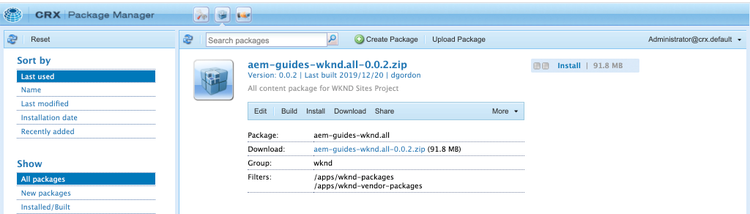
Siempre puede ver el código terminado en GitHub o desprotegerlo localmente cambiando a la rama Angular/navigation-routing-solution.
Inspeccionar actualizaciones de componentes de encabezado inspect-header
En capítulos anteriores, el componente HeaderComponent se agregó como un componente Angular puro incluido mediante app.component.html. En este capítulo, el componente HeaderComponent se quita de la aplicación y se agrega mediante el Editor de plantillas. Esto permite a los usuarios configurar el menú de navegación de HeaderComponent desde AEM.
-
En el IDE de su elección, abra el proyecto de inicio de SPA para este capítulo.
-
Debajo del módulo
ui.frontend, inspeccione el archivoheader.component.tsen:ui.frontend/src/app/components/header/header.component.ts.Se han realizado varias actualizaciones, incluida la adición de un
HeaderEditConfigy unMapTopara permitir que el componente se asigne a un componente de AEMwknd-spa-angular/components/header.code language-js /* header.component.ts */ ... const HeaderEditConfig = { ... }; @Component({ selector: 'app-header', templateUrl: './header.component.html', styleUrls: ['./header.component.scss'] }) export class HeaderComponent implements OnInit { @Input() items: object[]; ... } ... MapTo('wknd-spa-angular/components/header')(withRouter(Header), HeaderEditConfig);Observe la anotación
@Input()paraitems.itemscontendrá una matriz de objetos de navegación pasados desde AEM. -
En el módulo
ui.apps, inspeccione la definición del componente del componenteHeaderde AEM:ui.apps/src/main/content/jcr_root/apps/wknd-spa-angular/components/header/.content.xml:code language-xml <?xml version="1.0" encoding="UTF-8"?> <jcr:root xmlns:sling="http://sling.apache.org/jcr/sling/1.0" xmlns:cq="http://www.day.com/jcr/cq/1.0" xmlns:jcr="http://www.jcp.org/jcr/1.0" jcr:primaryType="cq:Component" jcr:title="Header" sling:resourceSuperType="wknd-spa-angular/components/navigation" componentGroup="WKND SPA Angular - Structure"/>El componente
Headerde AEM heredará toda la funcionalidad del componente principal de navegación a través de la propiedadsling:resourceSuperType.
Añadir el componente HeaderComponent a la plantilla de la SPA add-header-template
-
Abra un explorador e inicie sesión en AEM, http://localhost:4502/. La base del código de inicio ya debería implementarse.
-
Vaya a la plantilla de página SPA: http://localhost:4502/editor.html/conf/wknd-spa-angular/settings/wcm/templates/spa-page-template/structure.html.
-
Seleccione el contenedor de diseño raíz más externo y haga clic en su icono directiva. Tenga cuidado no al seleccionar el contenedor de diseño desbloqueado para la creación.
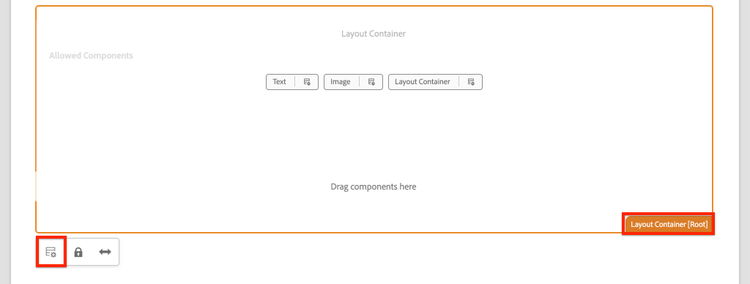
-
Copie la directiva actual y cree una directiva nueva con el nombre Estructura de SPA:
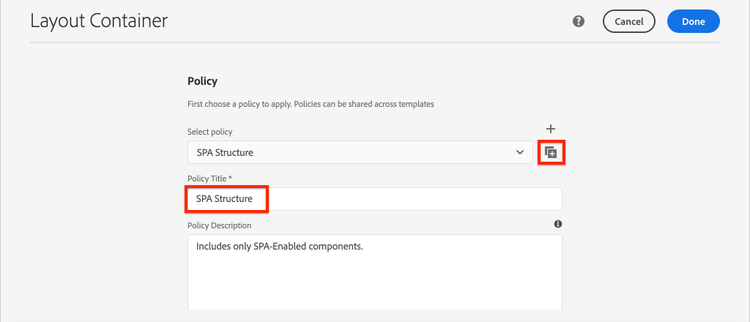
En Componentes permitidos > General > seleccione el componente Contenedor de diseño.
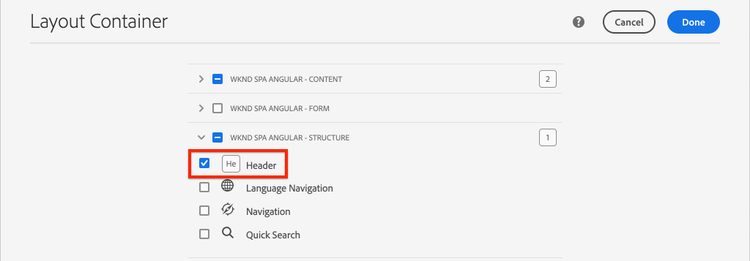
En Componentes permitidos > WKND SPA ANGULAR - ESTRUCTURA > seleccione el componente Encabezado:
En Componentes permitidos > WKND SPA ANGULAR - Contenido > seleccione los componentes Imagen y Texto. Debe tener un total de 4 componentes seleccionados.
Haga clic en Listo para guardar los cambios.
-
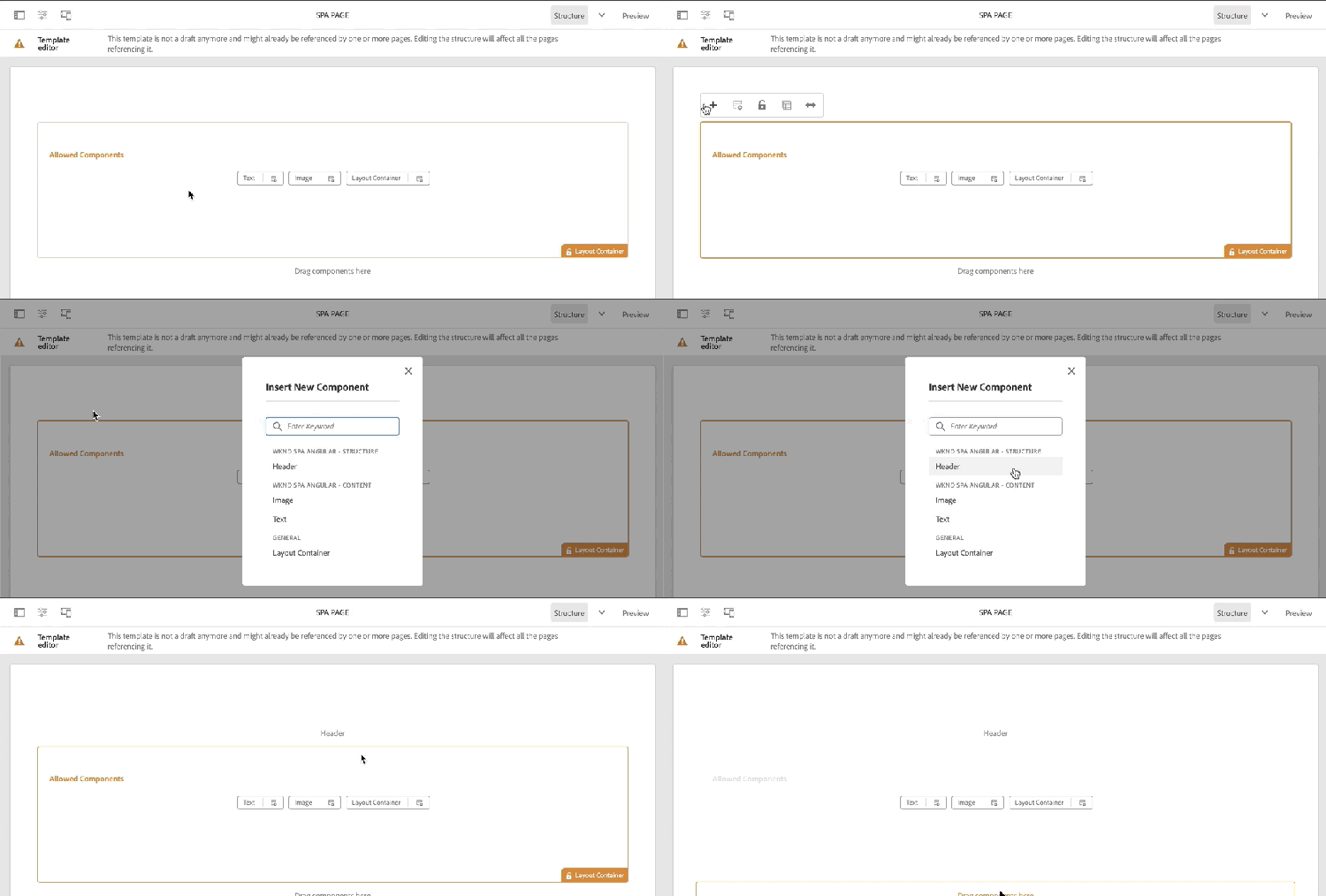
Actualizar la página. Agregue el componente Header sobre el Contenedor de diseño desbloqueado:
-
Seleccione el componente Header y haga clic en su icono Policy para editar la directiva.

-
Cree una nueva directiva con un Título de directiva de “Encabezado de SPA de WKND”.
En Propiedades:
- Establezca Raíz de navegación en
/content/wknd-spa-angular/us/en. - Establezca Excluir niveles de raíz en 1.
- Desmarque Recopilar todas las páginas secundarias.
- Establezca la Profundidad de la estructura de navegación en 3.
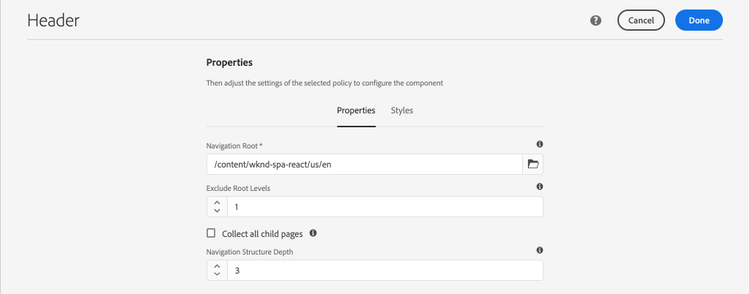
Se recopilará la navegación 2 niveles por debajo de
/content/wknd-spa-angular/us/en. - Establezca Raíz de navegación en
-
Después de guardar los cambios, debería ver los
Headerrellenados como parte de la plantilla: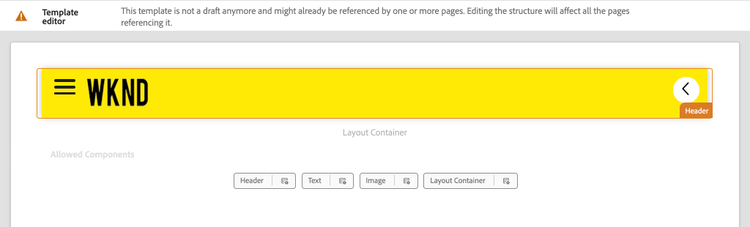
Creación de páginas secundarias
A continuación, cree páginas adicionales en AEM que sirvan como vistas diferentes en la SPA. También analizaremos la estructura jerárquica del modelo JSON proporcionado por AEM.
-
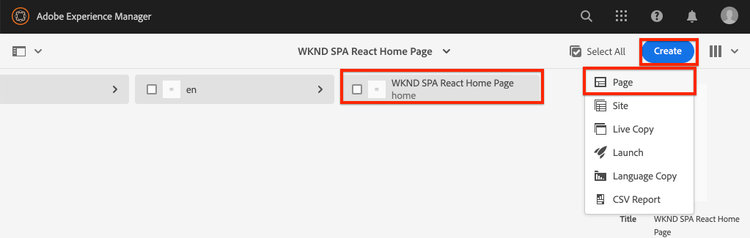
Vaya a la consola de Sites: http://localhost:4502/sites.html/content/wknd-spa-angular/us/en/home. Seleccione la página de inicio de Angular de la SPA de WKND y haga clic en Crear > Página:
-
En Plantilla, seleccione Página de SPA. En Propiedades, escriba “Página 1” para Título y “Página-1” como nombre.
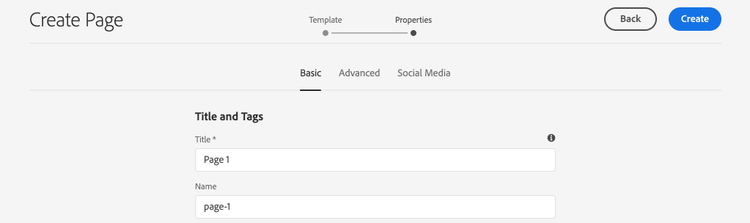
Haga clic en Crear y, en el cuadro de diálogo emergente, haga clic en Abrir para abrir la página en el Editor de SPA de AEM.
-
Agregue un nuevo componente Text al contenedor de diseño principal. Edite el componente e introduzca el texto: “Página 1” con el RTE y el elemento H1 (tendrá que ingresar al modo de pantalla completa para cambiar los elementos del párrafo)
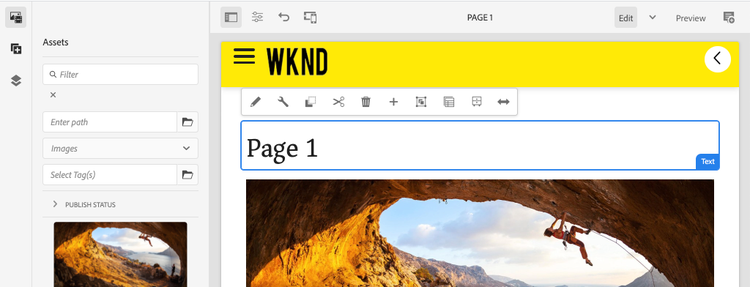
No dude en añadir contenido adicional, como una imagen.
-
Vuelva a la consola de AEM Sites y repita los pasos anteriores, creando una segunda página denominada “Página 2” como elemento secundario de Página 1. Agregue contenido a Página 2 para que se pueda identificar fácilmente.
-
Por último, cree una tercera página, “Página 3”, pero como elemento secundario de Página 2. Una vez completada, la jerarquía del sitio debe tener el siguiente aspecto:
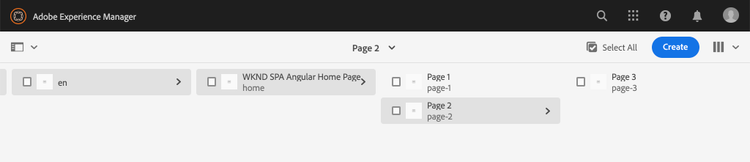
-
En una pestaña nueva, abra la API del modelo JSON proporcionada por AEM: http://localhost:4502/content/wknd-spa-angular/us/en.model.json. Este contenido JSON se solicita cuando se carga la SPA por primera vez. La estructura exterior tiene el siguiente aspecto:
code language-json { "language": "en", "title": "en", "templateName": "spa-app-template", "designPath": "/libs/settings/wcm/designs/default", "cssClassNames": "spa page basicpage", ":type": "wknd-spa-angular/components/spa", ":items": {}, ":itemsOrder": [], ":hierarchyType": "page", ":path": "/content/wknd-spa-angular/us/en", ":children": { "/content/wknd-spa-angular/us/en/home": {}, "/content/wknd-spa-angular/us/en/home/page-1": {}, "/content/wknd-spa-angular/us/en/home/page-2": {}, "/content/wknd-spa-angular/us/en/home/page-2/page-3": {} } }En
:childrendebería ver una entrada para cada una de las páginas creadas. El contenido de todas las páginas se encuentra en esta solicitud JSON inicial. Una vez implementado el enrutamiento de navegación, las vistas posteriores de la SPA se cargan rápidamente, ya que el contenido ya está disponible en el lado del cliente.No es aconsejable cargar ALL del contenido de una SPA en la solicitud JSON inicial, ya que esto ralentizaría la carga inicial de la página. A continuación, veamos cómo se recopila la profundidad de jerarquía de las páginas.
-
Vaya a la plantilla SPA Root en: http://localhost:4502/editor.html/conf/wknd-spa-angular/settings/wcm/templates/spa-app-template/structure.html.
Haga clic en el menú Propiedades de página > Directiva de página:
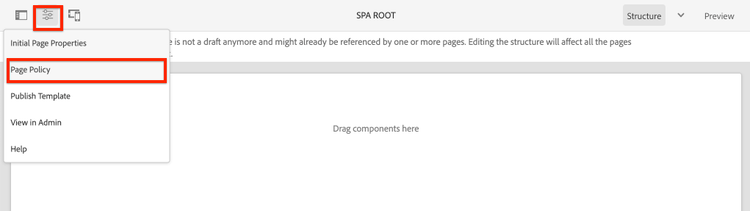
-
La plantilla SPA Root tiene una ficha Estructura jerárquica adicional para controlar el contenido JSON recopilado. La profundidad de la estructura determina la profundidad en la jerarquía del sitio para recopilar páginas secundarias debajo de la raíz. También puede usar el campo Patrones de estructura para filtrar páginas adicionales en función de una expresión regular.
Actualizar la profundidad de la estructura a “2”:
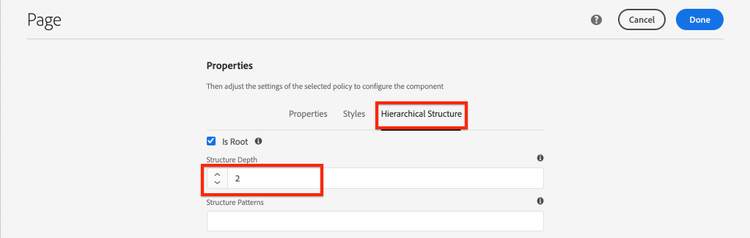
Haga clic en Listo para guardar los cambios en la directiva.
-
Vuelva a abrir el modelo JSON http://localhost:4502/content/wknd-spa-angular/us/en.model.json.
code language-json { "language": "en", "title": "en", "templateName": "spa-app-template", "designPath": "/libs/settings/wcm/designs/default", "cssClassNames": "spa page basicpage", ":type": "wknd-spa-angular/components/spa", ":items": {}, ":itemsOrder": [], ":hierarchyType": "page", ":path": "/content/wknd-spa-angular/us/en", ":children": { "/content/wknd-spa-angular/us/en/home": {}, "/content/wknd-spa-angular/us/en/home/page-1": {}, "/content/wknd-spa-angular/us/en/home/page-2": {} } }Observe que la ruta de acceso Página 3 se ha eliminado:
/content/wknd-spa-angular/us/en/home/page-2/page-3del modelo JSON inicial.Más adelante, observaremos cómo AEM SPA Editor SDK puede cargar dinámicamente contenido adicional.
Implementación de la navegación
A continuación, implemente el menú de navegación con un nuevo NavigationComponent. Podríamos agregar el código directamente en header.component.html, pero se recomienda evitar componentes grandes. En su lugar, implemente un NavigationComponent que podría reutilizarse más adelante.
-
Revise el JSON expuesto por el componente de AEM
Headeren http://localhost:4502/content/wknd-spa-angular/us/en.model.json:code language-json ... "header": { "items": [ { "level": 0, "active": true, "path": "/content/wknd-spa-angular/us/en/home", "description": null, "url": "/content/wknd-spa-angular/us/en/home.html", "lastModified": 1589062597083, "title": "WKND SPA Angular Home Page", "children": [ { "children": [], "level": 1, "active": false, "path": "/content/wknd-spa-angular/us/en/home/page-1", "description": null, "url": "/content/wknd-spa-angular/us/en/home/page-1.html", "lastModified": 1589429385100, "title": "Page 1" }, { "level": 1, "active": true, "path": "/content/wknd-spa-angular/us/en/home/page-2", "description": null, "url": "/content/wknd-spa-angular/us/en/home/page-2.html", "lastModified": 1589429603507, "title": "Page 2", "children": [ { "children": [], "level": 2, "active": false, "path": "/content/wknd-spa-angular/us/en/home/page-2/page-3", "description": null, "url": "/content/wknd-spa-angular/us/en/home/page-2/page-3.html", "lastModified": 1589430413831, "title": "Page 3" } ], } ] } ], ":type": "wknd-spa-angular/components/header"La naturaleza jerárquica de las páginas de AEM se modela en el JSON, que se puede utilizar para rellenar un menú de navegación. Recuerde que el componente
Headerhereda toda la funcionalidad del componente principal de navegación y que el contenido expuesto a través del JSON se asigna automáticamente a la anotación@Inputde Angular. -
Abra una nueva ventana de terminal y vaya a la carpeta
ui.frontenddel proyecto de SPA. Cree un nuevo(a)NavigationComponentmediante la herramienta CLI de Angular:code language-shell $ cd ui.frontend $ ng generate component components/navigation CREATE src/app/components/navigation/navigation.component.scss (0 bytes) CREATE src/app/components/navigation/navigation.component.html (25 bytes) CREATE src/app/components/navigation/navigation.component.spec.ts (656 bytes) CREATE src/app/components/navigation/navigation.component.ts (286 bytes) UPDATE src/app/app.module.ts (2032 bytes) -
A continuación, cree una clase denominada
NavigationLinkutilizando la CLI de Angular en el directoriocomponents/navigationrecién creado:code language-shell $ cd src/app/components/navigation/ $ ng generate class NavigationLink CREATE src/app/components/navigation/navigation-link.spec.ts (187 bytes) CREATE src/app/components/navigation/navigation-link.ts (32 bytes) -
Vuelva al IDE de su elección y abra el archivo en
navigation-link.tsa las/src/app/components/navigation/navigation-link.ts.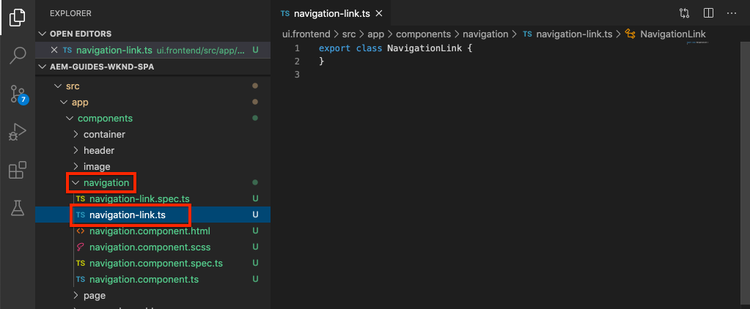
-
Rellene
navigation-link.tscon lo siguiente:code language-js export class NavigationLink { title: string; path: string; url: string; level: number; children: NavigationLink[]; active: boolean; constructor(data) { this.path = data.path; this.title = data.title; this.url = data.url; this.level = data.level; this.active = data.active; this.children = data.children.map( item => { return new NavigationLink(item); }); } }Se trata de una clase simple que representa un vínculo de navegación individual. En el constructor de clase esperamos que
datasea el objeto JSON pasado desde AEM. Esta clase se usa tanto enNavigationComponentcomo enHeaderComponentpara rellenar fácilmente la estructura de exploración.No se realiza ninguna transformación de datos, esta clase se crea principalmente para escribir de forma segura el modelo JSON. Observe que
this.childrentiene el tipoNavigationLink[]y que el constructor crea recursivamente nuevos objetosNavigationLinkpara cada uno de los elementos de la matrizchildren. Recuerde que el modelo JSON paraHeaderes jerárquico. -
Abra el archivo
navigation-link.spec.ts. Este es el archivo de prueba para la claseNavigationLink. Actualícelo con lo siguiente:code language-js import { NavigationLink } from './navigation-link'; describe('NavigationLink', () => { it('should create an instance', () => { const data = { children: [], level: 1, active: false, path: '/content/wknd-spa-angular/us/en/home/page-1', description: null, url: '/content/wknd-spa-angular/us/en/home/page-1.html', lastModified: 1589429385100, title: 'Page 1' }; expect(new NavigationLink(data)).toBeTruthy(); }); });Observe que
const datasigue el mismo modelo JSON inspeccionado anteriormente para un solo vínculo. No se trata de una prueba unitaria sólida; sin embargo, debería bastar con probar el constructor deNavigationLink. -
Abra el archivo
navigation.component.ts. Actualícelo con lo siguiente:code language-js import { Component, OnInit, Input } from '@angular/core'; import { NavigationLink } from './navigation-link'; @Component({ selector: 'app-navigation', templateUrl: './navigation.component.html', styleUrls: ['./navigation.component.scss'] }) export class NavigationComponent implements OnInit { @Input() items: object[]; constructor() { } get navigationLinks(): NavigationLink[] { if (this.items && this.items.length > 0) { return this.items.map(item => { return new NavigationLink(item); }); } return null; } ngOnInit() {} }NavigationComponentespera unobject[]denominadoitemsque es el modelo JSON de AEM. Esta clase expone un único métodoget navigationLinks()que devuelve una matriz deNavigationLinkobjetos. -
Abra el archivo
navigation.component.htmly actualícelo con lo siguiente:code language-html <ul *ngIf="navigationLinks && navigationLinks.length > 0" class="navigation__group"> <ng-container *ngTemplateOutlet="recursiveListTmpl; context:{ links: navigationLinks }"></ng-container> </ul>Esto genera un
<ul>inicial y llama al métodoget navigationLinks()desdenavigation.component.ts. Se utiliza un<ng-container>para realizar una llamada a una plantilla denominadarecursiveListTmply se pasa elnavigationLinkscomo una variable denominadalinks.Agregar
recursiveListTmplsiguiente:code language-html <ng-template #recursiveListTmpl let-links="links"> <li *ngFor="let link of links" class="{{'navigation__item navigation__item--' + link.level}}"> <a [routerLink]="link.url" class="navigation__item-link" [title]="link.title" [attr.aria-current]="link.active"> {{link.title}} </a> <ul *ngIf="link.children && link.children.length > 0"> <ng-container *ngTemplateOutlet="recursiveListTmpl; context:{ links: link.children }"></ng-container> </ul> </li> </ng-template>Aquí se implementa el resto de la renderización del vínculo de navegación. Tenga en cuenta que la variable
linkes del tipoNavigationLinky que todos los métodos/propiedades creados por esa clase están disponibles.[routerLink]se usa en lugar del atributohrefnormal. Esto nos permite vincular a rutas específicas en la aplicación, sin una actualización de página completa.La parte recursiva de la navegación también se implementa creando otro
<ul>si el objetolinkactual tiene una matrizchildrenque no esté vacía. -
Actualizar
navigation.component.spec.tspara agregar compatibilidad conRouterTestingModule:code language-diff ... + import { RouterTestingModule } from '@angular/router/testing'; ... beforeEach(async(() => { TestBed.configureTestingModule({ + imports: [ RouterTestingModule ], declarations: [ NavigationComponent ] }) .compileComponents(); })); ...Se requiere agregar
RouterTestingModuleporque el componente usa[routerLink]. -
Actualice
navigation.component.scsspara agregar algunos estilos básicos aNavigationComponent:code language-scss @import "~src/styles/variables"; $link-color: $black; $link-hover-color: $white; $link-background: $black; :host-context { display: block; width: 100%; } .navigation__item { list-style: none; } .navigation__item-link { color: $link-color; font-size: $font-size-large; text-transform: uppercase; padding: $gutter-padding; display: flex; border-bottom: 1px solid $gray; &:hover { background: $link-background; color: $link-hover-color; } }
Actualización del componente del encabezado
Ahora que NavigationComponent se ha implementado, HeaderComponent debe actualizarse para hacer referencia a él.
-
Abra un terminal y vaya a la carpeta
ui.frontenddentro del proyecto SPA. Inicie el servidor de desarrollo de Webpack:code language-shell $ npm start -
Abra una ficha del explorador y vaya a http://localhost:4200/.
El servidor de desarrollo de Webpack debe configurarse para representar el modelo JSON desde una instancia local de AEM (
ui.frontend/proxy.conf.json). Esto nos permite codificar directamente en el contenido creado en AEM anteriormente en el tutorial.
HeaderComponenttiene implementada actualmente la funcionalidad de alternancia de menús. A continuación, añada el componente de navegación. -
Vuelva al IDE que desee y abra el archivo
header.component.tsenui.frontend/src/app/components/header/header.component.ts. -
Actualice el método
setHomePage()para quitar el objeto String codificado de forma rígida y utilice las props dinámicas pasadas por el componente AEM:code language-js /* header.component.ts */ import { NavigationLink } from '../navigation/navigation-link'; ... setHomePage() { if (this.hasNavigation) { const rootNavigationLink: NavigationLink = new NavigationLink(this.items[0]); this.isHome = rootNavigationLink.path === this.route.snapshot.data.path; this.homePageUrl = rootNavigationLink.url; } } ...Se crea una nueva instancia de
NavigationLinkbasada enitems[0], la raíz del modelo de navegación JSON pasado desde AEM.this.route.snapshot.data.pathdevuelve la ruta de acceso de la ruta de acceso de Angular actual. Este valor se usa para determinar si la ruta actual es la página principal.this.homePageUrlse usa para rellenar el vínculo de anclaje en el logotipo. -
Abra
header.component.htmly reemplace el marcador de posición estático para la navegación con una referencia alNavigationComponentrecién creado:code language-diff <div class="header-navigation"> <div class="navigation"> - Navigation Placeholder + <app-navigation [items]="items"></app-navigation> </div> </div>El atributo
[items]=itemspasa@Input() itemsdeHeaderComponentaNavigationComponent, donde generará la navegación. -
Abra
header.component.spec.tsy agregue una declaración paraNavigationComponent:code language-diff /* header.component.spect.ts */ + import { NavigationComponent } from '../navigation/navigation.component'; describe('HeaderComponent', () => { let component: HeaderComponent; let fixture: ComponentFixture<HeaderComponent>; beforeEach(async(() => { TestBed.configureTestingModule({ imports: [ RouterTestingModule ], + declarations: [ HeaderComponent, NavigationComponent ] }) .compileComponents(); }));Dado que
NavigationComponentse utiliza ahora como parte deHeaderComponent, debe declararse como parte del banco de pruebas. -
Guardar cambios en cualquier archivo abierto y volver al servidor de desarrollo de Webpack: http://localhost:4200/
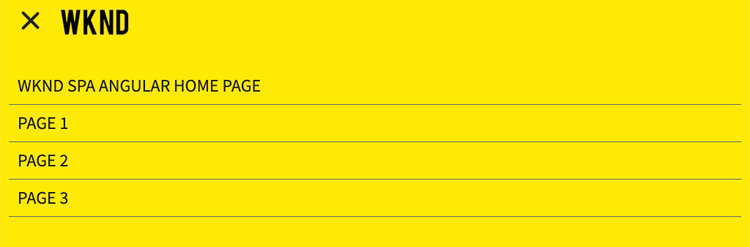
Abra la navegación haciendo clic en el botón de opción de menú y verá los vínculos de navegación rellenados. Debe poder navegar a diferentes vistas de la SPA.
Comprender el enrutamiento de SPA
Ahora que la navegación ha sido implementada, inspeccione el enrutamiento en AEM.
-
En el IDE, abra el archivo
app-routing.module.tsa lasui.frontend/src/app.code language-js /* app-routing.module.ts */ import { AemPageDataResolver, AemPageRouteReuseStrategy } from '@adobe/cq-angular-editable-components'; import { NgModule } from '@angular/core'; import { RouteReuseStrategy, RouterModule, Routes, UrlMatchResult, UrlSegment } from '@angular/router'; import { PageComponent } from './components/page/page.component'; export function AemPageMatcher(url: UrlSegment[]): UrlMatchResult { if (url.length) { return { consumed: url, posParams: { path: url[url.length - 1] } }; } } const routes: Routes = [ { matcher: AemPageMatcher, component: PageComponent, resolve: { path: AemPageDataResolver } } ]; @NgModule({ imports: [RouterModule.forRoot(routes)], exports: [RouterModule], providers: [ AemPageDataResolver, { provide: RouteReuseStrategy, useClass: AemPageRouteReuseStrategy } ] }) export class AppRoutingModule {}La matriz
routes: Routes = [];define las rutas o rutas de navegación a las asignaciones de componentes de Angular.AemPageMatcheres un enrutador de Angular personalizado UrlMatcher, que coincide con cualquier elemento que “se parezca” a una página de AEM que forma parte de esta aplicación de Angular.PageComponentes el componente de Angular que representa una página en AEM y que se utiliza para representar las rutas coincidentes.PageComponentse revisa más adelante en el tutorial.AemPageDataResolver, proporcionado por AEM SPA Editor JS SDK, es un Angular Router Resolver personalizado que se usa para transformar la dirección URL de ruta, que es la ruta en AEM incluyendo la extensión .html, a la ruta de recurso en AEM, que es la ruta de página menos la extensión.Por ejemplo,
AemPageDataResolvertransforma la dirección URL de una ruta decontent/wknd-spa-angular/us/en/home.htmlen una ruta de acceso de/content/wknd-spa-angular/us/en/home. Se utiliza para resolver el contenido de la página en función de la ruta en la API del modelo JSON.AemPageRouteReuseStrategy, proporcionado por AEM SPA Editor JS SDK, es una RouteReuseStrategy personalizada que evita la reutilización dePageComponententre rutas. De lo contrario, el contenido de la página “A” podría mostrarse al navegar a la página “B”. -
Abra el archivo
page.component.tsenui.frontend/src/app/components/page/.code language-js ... export class PageComponent { items; itemsOrder; path; constructor( private route: ActivatedRoute, private modelManagerService: ModelManagerService ) { this.modelManagerService .getData({ path: this.route.snapshot.data.path }) .then(data => { this.path = data[Constants.PATH_PROP]; this.items = data[Constants.ITEMS_PROP]; this.itemsOrder = data[Constants.ITEMS_ORDER_PROP]; }); } }Se requiere
PageComponentpara procesar el JSON recuperado de AEM y se usa como componente de Angular para procesar las rutas.ActivatedRoute, que proporciona el módulo Angular Router, contiene el estado que indica qué contenido JSON de la página de AEM debe cargarse en esta instancia de componente de página de Angular.ModelManagerService, obtiene los datos JSON en función de la ruta y asigna los datos a las variables de clasepath,items,itemsOrder. Estos se pasarán a AEMPageComponent -
Abrir el archivo
page.component.htmlenui.frontend/src/app/components/page/code language-html <aem-page class="structure-page" [attr.data-cq-page-path]="path" [cqPath]="path" [cqItems]="items" [cqItemsOrder]="itemsOrder"> </aem-page>aem-pageincluye AEMPageComponent. Las variablespath,itemsyitemsOrderse pasan aAEMPageComponent. ElAemPageComponent, proporcionado mediante el Editor de SPA de JavaScript SDK, iterará estos datos e instanciará dinámicamente componentes de Angular basados en los datos JSON, tal como se ve en el tutorial de componentes de mapa.PageComponentes realmente solo un proxy paraAEMPageComponenty esAEMPageComponentel que hace la mayor parte del trabajo pesado para asignar correctamente el modelo JSON a los componentes de Angular.
Inspeccionar el enrutamiento de SPA en AEM
-
Abra un terminal y detenga webpack dev server si se inició. Vaya a la raíz del proyecto e implemente el proyecto en AEM con sus habilidades con Maven:
code language-shell $ cd aem-guides-wknd-spa $ mvn clean install -PautoInstallSinglePackagenote caution CAUTION El proyecto de Angular tiene habilitadas algunas reglas de vinculación muy estrictas. Si la generación de Maven falla, compruebe el error y busque Errores de Lint encontrados en los archivos enumerados.. Corrija los problemas que encuentre el filtro y vuelva a ejecutar el comando de Maven. -
Vaya a la página de inicio de SPA en AEM: http://localhost:4502/content/wknd-spa-angular/us/en/home.html y abra las herramientas para desarrolladores del explorador. Las capturas de pantalla a continuación se capturan desde el navegador Google Chrome.
Actualice la página y debería ver una solicitud XHR a
/content/wknd-spa-angular/us/en.model.json, que es la raíz de la SPA. Tenga en cuenta que solo se incluyen tres páginas secundarias en función de la configuración de profundidad de jerarquía en la plantilla raíz de SPA realizada anteriormente en el tutorial. Esto no incluye Página 3.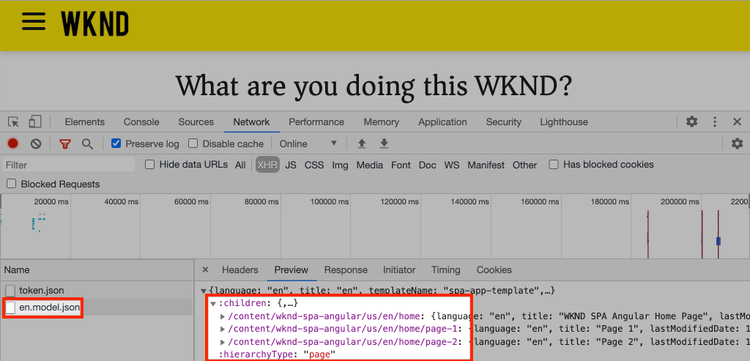
-
Con las herramientas para desarrolladores abiertas, vaya a Página 3:
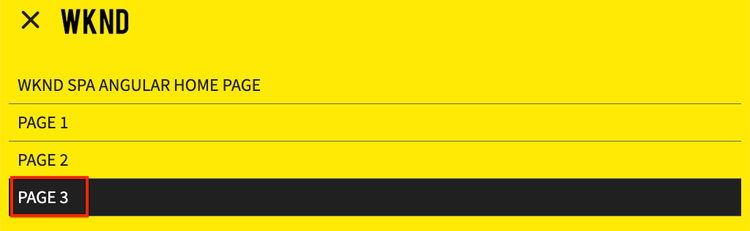
Observe que se hace una nueva solicitud XHR a:
/content/wknd-spa-angular/us/en/home/page-2/page-3.model.json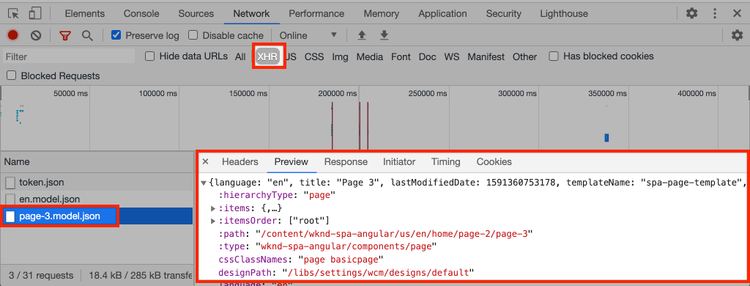
El administrador de modelos de AEM comprende que el contenido JSON de la página 3 no está disponible y déclencheur automáticamente la solicitud XHR adicional.
-
Continúe navegando por la SPA utilizando los distintos vínculos de navegación. Observe que no se realizan solicitudes XHR adicionales y que no se actualiza la página completa. Esto hace que el SPA sea más rápido para el usuario final y reduce las solicitudes innecesarias a AEM.
-
Experimente con vínculos profundos directamente a: http://localhost:4502/content/wknd-spa-angular/us/en/home/page-2.html. Observe que el botón Atrás del explorador sigue funcionando.
Enhorabuena. congratulations
Felicidades, ha aprendido cómo se pueden admitir varias vistas en la SPA asignando a páginas de AEM con el SDK del Editor de SPA. La navegación dinámica se ha implementado mediante el enrutamiento Angular y se ha agregado al componente Header.
Siempre puede ver el código terminado en GitHub o desprotegerlo localmente cambiando a la rama Angular/navigation-routing-solution.
Próximos pasos next-steps
Crear un componente personalizado: aprenda a crear un componente personalizado para utilizarlo con el Editor de SPA de AEM. Aprenda a desarrollar cuadros de diálogo de autor y modelos Sling para ampliar el modelo JSON y rellenar un componente personalizado.