Marketing leaders are sitting on a high-value signal stream—customer replies, out-of-office notes, and other “messy” inbox messages that traditional automation can’t use. In this article, I’ll show how an AI-powered inbox scraper turns those signals into governed actions in Marketo Engage to protect revenue, improve brand empathy, and strengthen data quality—and at the end I’ve include two sample code assets to help you implement it.
The silent intelligence in your inbox: where the best customer intelligence actually lives
Marketing teams have spent the last decade optimizing what happens before a customer responds.
We obsess over audience segments, subject lines, send times, deliverability scores, click-through rates, lead scoring models, and lifecycle progression. We have built highly sophisticated systems for outbound precision.
But a surprising amount of strategic intelligence lives after the send.
It lives in the replies.
In the out-of-office notes. In the “I’m no longer with the company” responses. In the “Can someone give me a demo?” messages. In the “Please stop emailing me while I’m on medical leave” moments. In the signals that never fit neatly into a dropdown field or a static smart campaign.
This is where LLM operations become a genuine marketing strategy, not just a shiny AI experiment.
The next evolution of Marketing Operations is not simply better automation. It is building systems that can listen, interpret, classify, and act on unstructured customer feedback at scale.
That is the strategic role of an AI-powered email scraper.
The shift: from campaign automation to signal intelligence
Traditional marketing automation was built for structured data.
A form fill? Easy. A lead score change? Easy. A program status update? Easy.
But the real world is messy. Human beings do not respond in structured fields. They respond in fragments, emotion, ambiguity, and context.
They say:
-
“I’m interested, but this isn’t my area anymore.”
-
“Please reach out in Q3 after I return from leave.”
-
“Our teammate passed away last month.”
-
“Can someone contact me directly? I need a demo this week.”
To a rules engine, those are just emails. To an LLM, those are operational signals.
That distinction matters.
Because once marketing teams can reliably synthesize those signals, they move from basic automation to something much more valuable: adaptive marketing operations.
This is not just list hygiene. This is not just inbox management. This is not just another workflow.
This is the beginning of a marketing function that can interpret the market in real time.
Why this matters strategically
An AI-driven scraper does three things that matter at the leadership level:
1. It protects revenue
The most obvious example is the hidden hand-raise.
Sometimes a lead replies directly to a nurture email asking for pricing, a demo, or a conversation. If that inbox is unmonitored or treated as a support mailbox, the organization misses intent that was already earned.
That is not a workflow gap. That is a revenue leak.
An LLM can identify these messages instantly, classify them with confidence, and trigger a high-priority path into sales follow-up. In that moment, marketing stops being just a sender of journeys and becomes a detector of buying motion.
2. It improves brand empathy
Modern marketing should not behave like a loudspeaker with no ears.
If someone is on disability leave, out of office for an extended period, retired, deceased, or no longer employed, continuing to nurture them with generic promotional messaging is not just inefficient. It can feel tone-deaf.
This is where AI supports something deeper than efficiency: operational empathy.
Sophisticated marketing organizations will increasingly be judged not only by personalization, but by situational awareness. LLM operations create the ability to respond to human context with nuance instead of blunt-force automation.
3. It strengthens data quality and sender reputation
Every poor-quality record in your database introduces drag:
-
Lower engagement rates
-
Wasted send volume
-
Bad routing decisions
-
Weaker scoring accuracy
-
Avoidable deliverability risk
But the more interesting point is this: data hygiene is no longer just a database exercise. It is now an interpretation problem.
Many of the most important signals never arrive as structured fields. They arrive as natural language. Marketing teams that can convert that language into operational action will maintain cleaner systems, sharper audience targeting, and more trustworthy engagement metrics.
The real lesson: LLM ops is a marketing operating model
When people hear “AI email scraper,” they often think of a tactical hack.
That undersells the opportunity.
The real value is not the scraper itself. The value is the operating model behind it.
LLM operations in marketing means designing a system that can do five things consistently:
-
Listen for signals across inbound channels
-
Interpret messy, human language with context
-
Classify against business-safe categories
-
Document decisions for QA and governance
-
Act inside the systems that run revenue operations
That architecture is repeatable far beyond one inbox.
Today it might classify autoresponder replies. Tomorrow it can interpret webinar chat, form free-text, event follow-up notes, SDR inboxes, partner inquiries, survey comments, or product feedback.
In other words, the inbox is not the end state. It is the proving ground.
What the architecture looks like
Here is how I think about building this kind of intelligence layer.
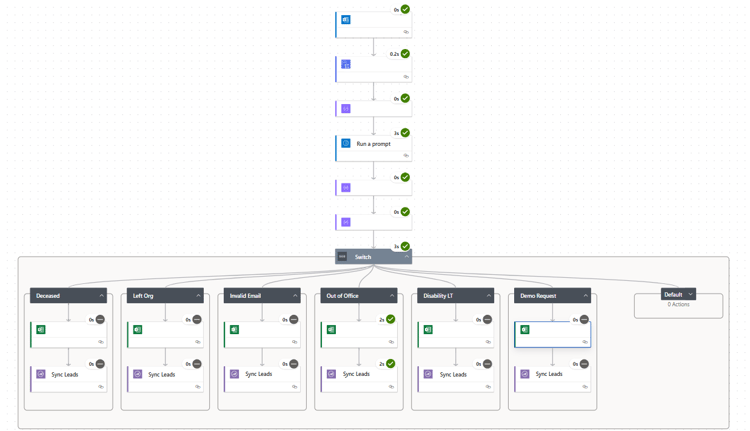
1. Establish the listener
Just like a Smart List in Marketo, you need a trigger layer that continuously listens to a defined marketing inbox. In Power Automate, that might start with an Outlook trigger, but the principle is bigger than the tool.
The first design choice in LLM ops is always the same: Where does valuable unstructured signal enter the business?
For many marketing teams, the answer is hiding in plain sight: the inbox.
2. Clean the data before the AI ever sees it
LLMs are powerful, but they are not magical. Messy inputs create messy outputs.
That means stripping out HTML, signatures, images, legal footers, and thread noise before sending content for classification. Good preprocessing is not glamorous, but it is what separates a novelty demo from a reliable operational system.
This is a useful leadership lesson in itself: AI performance is often more dependent on process design than model sophistication.
3. Define business guardrails, not just prompts
If your AI is going to influence marketing actions, it needs boundaries.
That means establishing a controlled taxonomy of categories such as (reasoning context starter below):
-
Demo Request
-
Left Organization
-
Deceased
-
On Leave / Disability
-
Vacation / Temporary Pause
-
Unclear / Needs Review
It also means requiring structured outputs like:
-
Category
-
Confidence score
-
Reasoning
-
Matching phrases
This is where many teams get AI wrong. They treat prompting like improvisation when it should be treated like policy design.
The best LLM operations are not “creative.” They are governed.
4. Create a system of record for trust
One of the smartest things you can do is log every AI decision into a reviewable record, such as Excel, a database, or a lightweight QA table.
Why?
Because adoption depends on trust. Trust depends on transparency. Transparency depends on reviewability.
When marketers can see not just the classification, but why the model made it, they become more willing to operationalize it. Human-in-the-loop review is not a sign the AI is weak. It is a sign the system is mature.
This is the bridge between experimentation and scale.
5. Close the loop in Marketo
The final step is where strategy becomes execution.
Once the AI has classified the reply, that signal should sync back into Marketo through a custom field or operational status. From there, your existing programs can do what they already do best:
-
Alert Sales on demo intent
-
Suppress records temporarily
-
Pause nurture streams
-
Route to ops review
-
Clean lead-to-account mappings
-
Update lifecycle logic
This is the moment where AI becomes useful because it becomes operationalized.
Insight without action is just theater. Insight with workflow is strategy.
A better way to think about marketing strategy
For years, marketing technology has been designed primarily to help us speak more efficiently.
LLM operations introduce a different question:
How do we help our systems listen more intelligently?
That question changes the role of Marketing Operations.
It means MOPs is no longer just the team that manages campaign logic. It becomes the team that translates messy real-world customer language into system-wide intelligence.
That is a bigger strategic mandate.
Because the future competitive edge in marketing will not come only from who can generate the most content or launch the most campaigns. It will come from who can build the best feedback loops.
The best teams will not merely automate outreach. They will operationalize interpretation.
Why the email scraper is the perfect example
An email scraper is powerful because it makes the invisible visible.
It captures signals that most organizations already receive but rarely operationalize. It turns inbox clutter into business intelligence. It connects customer context to marketing action. And it proves, in a very practical way, that AI can do more than generate copy. It can improve judgment at scale.
That is the heart of LLM operations.
Not replacing marketers. Not replacing strategy. Not replacing human review.
Enhancing the organization’s ability to detect what matters, respond with relevance, and continuously learn from the signals customers are already giving us.
The vision for the modern marketer
The modern marketer is not just a campaign builder. Not just a systems admin. Not just a performance analyst.
The modern marketer is an architect of intelligence.
And in that world, the inbox is no longer a dusty backroom full of ignored autoresponders. It is a listening post. A signal stream. A source of truth hiding in plain sight.
The teams that figure this out first will have an advantage that is easy to miss from the outside but hard to beat in practice:
They will build marketing organizations that do not just communicate at scale.
They understand at scale.
That is where LLM operations stop being a technical experiment and start becoming a strategic differentiator.
Asset examples to get started
Context Doc for AI Reasoning (GPT 4.1 model)
You classify email messages into one of the following categories:

- DECEASED: The email indicates that the person has passed away.
- LEFT_ORG: The email indicates the person has left the organization or company (resigned, terminated, retired, etc.).
- INVALID_EMAIL: The email states the address is invalid, mailbox does not exist, domain is wrong, or similar.
- TEMP_LEAVE: The email indicates a temporary leave that is NOT disability-related (e.g., sabbatical, parental leave, vacation, secondment).
- DISABILITY_LEAVE: The email indicates a leave related to illness, disability, injury, or medical leave.
- REQUEST_DEMO: The email indicates the person has expressed interest in a demo to learn about our product.

- OTHER: Use this if none of the above clearly apply.

Classify this email:

"""
outputs('EmailResponse')
"""

Return your answer as a **single JSON object** in this exact format:

{
  "category": "ONE_OF_THE_ABOVE",
  "confidence": NUMBER_BETWEEN_0_AND_1,
  "reason": "SHORT EXPLANATION",
  "matches": ["PHRASE_1", "PHRASE_2"]
}

Rules:
- The "category" value MUST be exactly one of:
  "DECEASED", "LEFT_ORG", "INVALID_EMAIL", "TEMP_LEAVE", "DISABILITY_LEAVE", "REQUEST_DEMO", "OTHER"
- Do not include any explanation.
- Do not add any other properties.
- Do not add trailing text before or after the JSON.
JSON Schema:
{
    "type": "object",
    "properties": {
        "category": {
            "type": "string"
        },
        "confidence": {
            "type": "number"
        },
        "reason": {
            "type": "string"
        },
        "matches": {
            "type": "array",
            "items": {
                "type": "string"
            }
        }
    },
    "required": [
        "category"
    ]
}