A tour of the Commerce delivery floor, where the objection changes at every phase and the discipline never does.
Commerce implementations are more complex, and more costly, than they look, and the cost tends to arrive as late surprises. This article explains where that complexity actually lives, phase by phase, why customers raise a different objection at each step, and the single discipline that keeps the complexity from turning into rework and overruns.
Why implementations cost what they do
Two questions sit behind almost every Commerce engagement. From the sponsor's side: why is this so involved, and why does it cost what it costs? From the delivery side: why do the same problems keep surfacing, phase after phase? They are the same question seen from two ends, and the answer to both is complexity that is real, layered, and easy to underestimate.
Commerce delivery does not look like most enterprise software implementations. It is less about configuring features and more about writing code, building catalogs, and building the connectors that move data between systems. The complexity concentrates in a few places, the shape of the catalog and its data, the layers of pricing logic, and the integrations that tie the platform to everything around it, and it does not sit still. It runs through the whole lifecycle and surfaces a little differently at every phase.
The way it surfaces is worth attention, because it is where cost is either contained or created. At each phase, the customer raises a different objection, and each one is a signal that an assumption is about to collide with what lies underneath. These objections are reasonable. They reflect real prior experience and a fair reading of how software usually works, and the fact that they turn out to be wrong for Commerce is itself a measure of how far this kind of delivery sits from the norm. Each objection is real, each can add cost, and each feels, in the moment, like a distinct problem to solve.
But walk the whole lifecycle and a pattern emerges. The objections shift by phase. The discipline that answers them does not. The same underlying move resolves every one of them: align early, reset expectations before they harden, and pull ambiguity forward so it gets resolved while resolving it is still cheap. That discipline is what separates an implementation that costs what it should from one that balloons through change orders and late rework. This article walks the lifecycle phase by phase to show both the complexity and the discipline that manages it.
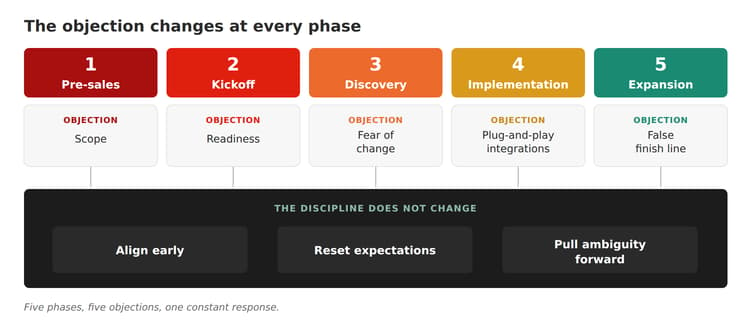
A note before the walk: the five phases are drawn cleanly here to make the pattern visible. Real engagements are more fluid than this, phases overlap, work iterates, and the boundaries blur. But the phases are where the work meaningfully shifts, and where each new objection tends to appear, so they are the right lens for seeing the pattern even if no real project runs in five tidy steps.
Pre-sales: the objection is scope
The work begins before the deal closes. This is where the solution gets scoped, the architecture point of view takes shape, and the statement of work gets aligned with what delivery will actually build.
What is specific to Commerce here is that the scope conversation is not about which features to turn on. It is about how many catalogs the customer has, whether they are B2B or B2C or both, whether they need customer-specific pricing, and how many storefronts they are running. The complexity gets defined at this phase, not discovered later.
The objection heard most often is that the scope sales recommended does not match what delivery would recommend. Left alone, that gap becomes change orders later. The discipline that answers it is alignment before commitment: sales and delivery agree on the target architecture before the statement of work is signed, so the gap closes while closing it costs nothing.
The stake: alignment here costs a conversation; misalignment here costs change orders.
Kickoff: the objection is readiness
Kickoff is the phase immediately after signing. Team mobilization, knowledge transfer, project plan setup. It is quick and largely procedural, but it sets the tone for everything after.
The objection at this phase is a natural eagerness to start building. The customer is ready to ship, understandably, they have signed and want to see progress. But the team is not ready to ship yet, because discovery work, real decisions, and code all come first.
The discipline is the same move applied to a different objection: reset the expectation early. Kickoff itself is used to name what is actually ahead, that there are decisions to make and work to do before anything ships. Naming it at kickoff, rather than letting the assumption run until it collides with reality, is how the engagement starts on honest footing.
The stake: a reset expectation at kickoff prevents a frustrated customer three sprints in.
Discovery: the objection is fear of change
Discovery is where Commerce delivery starts to look distinctly different, and where most of its character lives. This is where the first two sources of complexity get examined in earnest. The catalog comes first, its structure, its cleanliness, how its data is organized. Then pricing, which in Commerce is rarely simple: multiple overlapping rules and layers of logic that have to be understood before anything is built on top of them. Neither the catalog nor the pricing is a setting to switch on. Both are logic to be worked out, not configuration to be toggled.
The objections at discovery are the loaded ones, and they are both about change. One is a fear that a heavily customized operation cannot survive a move to a more standardized platform. The discipline that answers it is to frame the first step as a low-risk one that preserves what works, so the customer is not being asked to rebuild everything at once to get value.
The other is treating a re-platform as if it were a migration, a lift-and-shift of what already exists. The discipline is the same reset-expectations move: name explicitly, and early, that re-platforming means new decisions rather than a copy of the old system. That conversation belongs in discovery. Deferred to implementation, it becomes rework.
The stake: the decisions made here shape the whole build; getting them right in discovery is the cheapest they will ever be.
Implementation: the objection is plug-and-play
Implementation is where the floor is busiest, where most of the actual building happens. It looks like software engineering because it is software engineering. The team works in development sprints, building the catalog structures that hold the customer's product data, the pricing rules and account hierarchies, checkout and payments, and the integrations that move data between systems. That last piece, integration, is the third source of complexity, and it is the one that bites hardest here. Integration testing and user acceptance testing are where late surprises tend to surface, because integration is where assumptions finally meet reality.
One objection here is the expectation that integrations will be close to plug-and-play. It is a fair assumption: if the platform is managed, it is natural to expect the connections to it to be managed too. In practice they are not, because each connection to an external system is bespoke. The discipline is to define integration ownership early and map those systems during discovery, before scope locks, so that reality is understood well before the build reaches it rather than discovered inside it.
The other objection is that scope gaps surface late, deep in the build, where they are most expensive to fix. A requirement that reads as one line in a document can turn out to touch half the integration surface once someone starts building against it, and by then the cost of resolving it has multiplied. The discipline is the pull-ambiguity-forward move: push as much uncertainty as possible into discovery, where it can still be resolved without rework, instead of carrying it into implementation where it cannot.
The stake: every ambiguity that reaches this phase unresolved is paid for at the highest rate in the project.
Expansion: the objection is the finish line
Expansion is the phase after go-live, and its role is easy to underestimate. The real work of this phase is adding more products or more sites, rolling out personalization once the data is ready, and planning the next horizon of investment.
The objection is a natural one: go-live feels like the finish line, because so much effort has pointed toward it. The discipline is to reset that expectation, the same move once more, by framing go-live as the start of the expansion motion rather than its end. This is the phase where the customer's investment compounds, where the relationship deepens, and where new revenue lines open. But only for teams set up to support that expansion, not for those who effectively packed up at launch.
The stake: treated as an end, go-live caps the return; treated as a start, it compounds it.
The pattern underneath
Step back from the phase-by-phase walk and the pattern is unmistakable. Pre-sales brings an objection about scope. Kickoff brings one about readiness. Discovery brings fear of change. Implementation brings the expectation that integrations will be plug-and-play. Expansion brings the false finish line. Five phases, five genuinely different objections.
And one response underneath all of them. Align early, before commitments harden. Reset expectations the moment they start to drift from reality. Pull ambiguity forward into the phase where resolving it is still cheap. Different parts of that discipline lead at different phases, alignment does the work in pre-sales, expectation-setting carries kickoff and discovery, pulling ambiguity forward dominates implementation, but it is one discipline throughout, not five. The objection changes shape at every phase. The discipline that answers it does not.
That reframes how a delivery leader should treat these objections. They are not five separate fires needing five separate tactics. They are one constraint that keeps reappearing in a new phase's clothing, and a team that sees the pattern stops being surprised, because it recognizes each new objection as the last one wearing a different costume. Manage the constraint once, as a discipline, and you have managed it everywhere.
Where acceleration fits
None of this is an argument against tooling. It is an argument about what tooling sits on top of.
The accelerators worth discussing right now are largely AI-driven, and there is real opportunity to build or adopt them to speed up the work. The discipline above tells you exactly where to place them. Each phase has a characteristic point of friction, and an accelerator earns its place by being applied to that specific friction rather than sprinkled everywhere. The value comes from matching the tool to the phase where it relieves the most pressure, in service of the discipline, not as a substitute for it.
That ordering matters, and it is easy to get backward. AI accelerates good delivery. It does not fix broken delivery. A team that aligns early, resets expectations, and pulls ambiguity forward will get more from it, because the acceleration is speeding up work that was already headed in the right direction. A team without that discipline will simply arrive at its problems faster. The practices are the foundation. The tools sit on top. Not the other way around.
Why this matters now
The phases of Commerce delivery are not going away. But what happens inside each of them, especially discovery and implementation, is going to look different as acceleration reshapes the work. That makes the constant underneath more valuable, not less.
When the pace of the work increases, the cost of a late objection increases with it, because there is more built, and built faster, sitting on top of the assumption that turned out to be wrong. The discipline that pulls objections forward and resolves them early is exactly what keeps acceleration from amplifying mistakes. The faster the work moves, the more the discipline earns its keep.
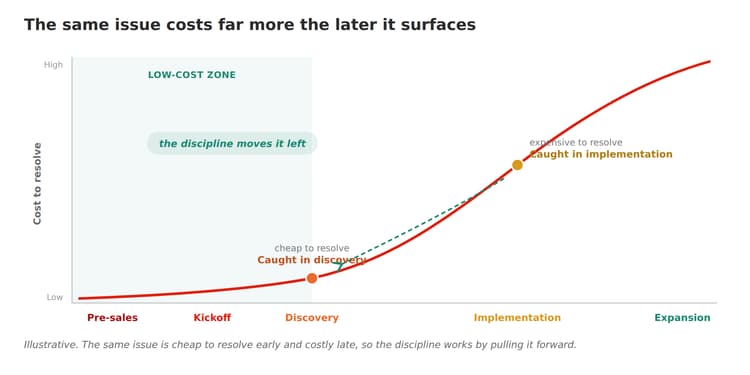
This is where the two questions from the start meet. The complexity is why implementations cost what they do. The discipline is what keeps that cost from growing beyond what it should. A sponsor evaluating an engagement, and a delivery leader running one, are both really asking whether the complexity will be managed early, where it is cheap, or discovered late, where it is not. That single difference, more than any tool or platform choice, is what separates a predictable implementation from an expensive one. And it is a choice, not luck. Whether a problem surfaces early or late is decided by how the engagement is run, not by fortune.
Framed that way, the discipline is not project hygiene. It is a strategic choice about where cost and risk get absorbed, early and deliberately, or late and expensively. That is why it belongs on the agenda of the people funding the work, not only the people doing it.
It also takes real judgment to run a project this way. Seeing the objection coming a phase ahead, holding the line on resolving ambiguity early when the pressure is to push forward, and keeping expectations aligned when it would be easier to defer, none of that comes from a checklist. It comes from experience and intent. That is why two teams with the same tools and the same playbook can produce very different outcomes: the difference is less in what they know and more in the discipline they bring to applying it. The good news is that it compounds. Every engagement run this way builds the instinct to run the next one better.
So the takeaway is not a new tactic for each phase. It is the recognition that the tactics were never really different. The objection shifts by phase, and it always will. The discipline holds across all of them, and it always should.
Actionable takeaways
-
Expect the objection to change at every phase. Scope at pre-sales, readiness at kickoff, fear of change at discovery, plug-and-play expectations, the false finish line at expansion. Each is real and each can derail the work.
-
Recognize that the response never changes. Align early, reset expectations before they harden, and pull ambiguity forward into the phase where resolving it is still cheap. It answers all five objections.
-
Treat objections as one pattern, not five fires. A team that internalizes the discipline stops being surprised, because it recognizes each new objection as the same constraint in a new phase's clothing.
-
Resolve the loaded conversations in discovery. Fear of change and the re-platform-as-migration assumption both belong in discovery. Carried into implementation, they become rework.
-
Push ambiguity upstream. The cheapest place to resolve uncertainty is always earlier than where it tends to surface. Move it forward deliberately.
-
Place accelerators where the friction is. Match a tool to the phase where it relieves the most pressure, rather than applying it everywhere. Acceleration in service of the discipline, not as a replacement for it.
-
Keep the ordering right. AI accelerates good delivery; it does not fix broken delivery. Get the discipline in place first, then let the tools speed up work that was already headed in the right direction.