AI is automating more of delivery, but the judgment that decides whether the work succeeds stays human. This article looks at where that judgment lives, in reading people and in solving problems, and why it is what separates one expert from another using the same tools.
Here is something I have come to believe watching AI move through delivery: the tools have changed what gets built, but not what makes the build succeed.
In the delivery work I have seen, AI can create real and significant efficiency gains. It is natural that the savings number is the first thing we look for. But there is something the number does not capture. Give the same AI tools to two capable teams on similar work, and the results do not come out the same. The output holds up on one engagement and needs rework on the next. The tool is identical. What differs is the judgment of the person directing it.
That is the part of the work AI has not replaced, and it is worth being precise about where it lives. It has become common to say that AI handles the routine while people bring the judgment. That is true, and it is too vague to act on. The useful question is where that judgment actually lives, and why the same tool produces such different results in different hands. It shows up in two places: judgment about people, and judgment about problems. Together they build the anatomy of an expert, the parts that live beyond any certification but decide how the work turns out. Neither is what most technical teams spend their time talking about.
Why AI results do not replicate on their own
The build is increasingly automated. AI can scaffold the code, suggest the configuration, draft the data model, and produce a working first pass faster than any of us could a few years ago. It can generate a large share of a build. What it does not do is the rest: validating the output, wiring it into the real system, making it accessible and responsive, and refining it to production quality against the actual design. That is a genuine gain, and it is not the interesting part.
The interesting part is what happens next. A strong AI-generated result on one implementation does not port cleanly to the next. The client context is different, the data is messier, a constraint no one documented changes the shape of the problem. Repeatability, the thing we most want from a tool, turns out to be a human achievement rather than a tool guarantee. Call it the replication gap: the distance between what AI can generate once and what a person makes reliable every time. The gap does not close on its own. Someone has to adapt the generic output to the specific situation, recognize when it is subtly wrong, and make it land the same way twice. Closing that gap is judgment, and it is where the human value now concentrates.
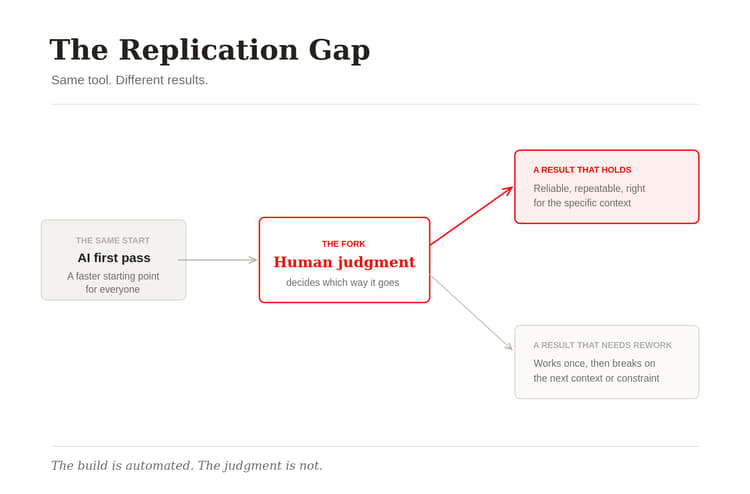
AI raises the floor for everyone. The ceiling still depends on the expertise of the person directing it. The differentiator in delivery is moving away from who can produce the work and toward who can judge it, shape it, and make it fit.
The judgment that reads people
Even when the technical work is sound, engagements still fail. They fail on trust, on alignment, on a conversation that did not happen or happened badly. This is the judgment technical teams undervalue most, precisely because it does not look technical at all. The most valuable thing on a struggling engagement is often not a better architecture. It is someone who can read what the client is actually worried about beneath the concern they lead with, name the real disagreement in a tense room, and rebuild confidence after a hard week. That work does not show up in a commit history, but it is frequently the difference between an account that renews and one that quietly walks.
A note on the customer story: The customer journey described below is a composite drawn from multiple customer experiences. Names and identifying details have been omitted or changed. The technical patterns reflect common considerations when modernizing with Adobe Commerce as a Cloud Service.
Picture the kind of engagement that arrives already fragile. A growing business has been through a painful outage on its legacy platform during its biggest sales period, and it cannot afford another. To scale reliably, it decides to modernize, re-platforming to Adobe Commerce as a Cloud Service and rethinking the storefront on Edge Delivery Services. The customer has never run an implementation at quite this scale, and the territory is new to them. Their own subject-matter experts have turned over more than once, so institutional knowledge is thin on their side. Work like this is intensely process-driven, decisions come fast, and the discipline is knowing when to adjust and when to hold. The dry runs pass, and then comes the go-live, the tense part, as it always is when everything new goes on at once. The stakes are highest for a customer who knows exactly what is on the line. When the launch holds, the thing that carried it through was not just technical caliber. It was trust, and the steadiness to lead the customer through a stretch that felt precarious. This is the pattern worth seeing clearly: trust is not the reward for a successful delivery, it is what makes one possible. That held before AI. It holds harder now that everyone has access to the same tools.
That kind of steadiness gets filed under soft skills, a phrase that makes it sound optional and secondary to the real work. It is neither. It is high-judgment work, and it is hard. Emotional intelligence is not softness or hesitation. It is doing the difficult thing, having a hard conversation with a teammate, delivering news a client does not want to hear, making the call that disappoints someone, and doing it decisively and with compassion at once. That combination is rare, and it is exactly what AI cannot do for you.
It is not instinct alone, either. That is the other thing the soft-skills label gets wrong: it treats this as a feel for people, something you either have or you do not. In delivery it is the opposite of vague. It is emotional judgment made with intent and precision. Perceiving accurately what a room actually needs, then choosing the response deliberately, the moment, the words, the clarity to deliver even hard facts well. That is as exacting as any technical decision on the build, and no tool can make those calls in your place.
The judgment that solves problems
This second kind of judgment sits closer to the technical work, but it is no more automated than the first. It is the invention that happens when the standard approach does not fit.
As AI absorbs more of the execution, the value moves to the decisions around it. Which approach actually fits this situation. Where this build will break under real load. How to reframe a rigid requirement into something buildable without fighting the platform. This is creativity, though it rarely gets called that, because it wears a technical hat and happens in architecture calls and configuration files rather than on a canvas. And it is not only technical: sometimes the constraint that needs an inventive answer is not in the system at all.
Consider a long-running engagement where the customer wants flexibility through the implementation cycle, well outside the standard best-practice playbook. They own the timeline, so it is a reasonable thing to want. The orthodox approach allows no room to diverge: follow the sequence, or fall out of step. The easy answer is to hold the line and treat the request as a problem. The harder, better answer is to see that the same outcome can be reached another way, and to design the approach around how the customer actually needs to work. That is a creative act, and it carries real risk assessment, because diverging from the proven path means owning what could go wrong.
When it works, the effects compound. The freedom built into how an engagement runs is often a large part of why a relationship lasts and why the team delivering it stays intact. That is not normal. Long engagements are rare, and rarer still is one where delivery and customer start to feel like one team. None of it happens if the standard playbook is treated as the only option. The inventive move, seeing that the same result can be reached a different way and being willing to own the risk of trying, is what makes the difference, and it pays out over years.
That kind of inventive freedom continues into Adobe Commerce as a Cloud Service itself. The platform is built to invite it. Standardization does not eliminate invention, it creates the conditions for it, and that is as true for how a capability is built as for how an engagement is delivered. Its API-first, out-of-process extensibility model, with tools such as App Builder, API Mesh, and the Admin UI SDK, helps protect the managed core while leaving the inventive work to the people building on top of it. The platform takes care of what should be common, freeing a team to do the work that only judgment can do: create the distinctive capability and find the approach that actually fits. That is the platform setting the customer up to invent.
Why this matters now
None of this means technical depth matters less. It is the opposite. Depth is the foundation. You cannot exercise good judgment about a Commerce build without deeply understanding Commerce, and you cannot direct an AI tool well without knowing what good output looks like. The same deep experience that used to produce the work by hand is now what shapes what the AI produces: it is how you prompt well, catch what is subtly off, and make the output right. AI is only as good as the person guiding it. The depth is what makes the judgment possible.
What is changing is where the value sits on top of that foundation. When execution was the scarce thing, execution was the differentiator. Now that AI has made competent execution more available, the scarce thing is judgment, about people and about problems, and that is where the difference between one expert and another now lies. It is what closes the replication gap: the reason the same tool, in a stronger pair of hands, produces a result that holds.
This has a consequence worth naming for anyone deciding where the savings go. The temptation, once AI takes on more of the execution, is to bank the efficiency and thin the team. The trap is that this cuts into the exact capability that now sets one expert apart from another. Those efficiency gains are worth capturing. But some of what AI returns is best reinvested in the judgment it cannot replace, because that judgment is what the efficiency is now competing on.
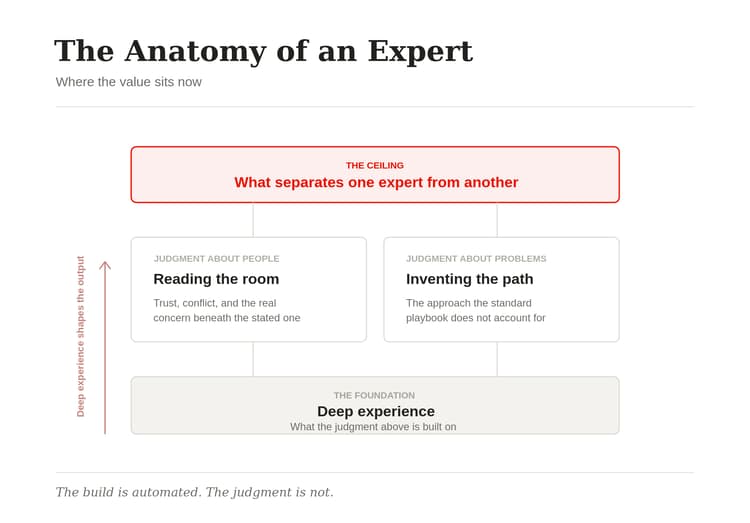
Getting delivery right is where it starts, not where it ends. Once execution is something many providers can deliver, retention is rarely won on execution alone. It is won on the judgment that builds trust and invents the right approach, the things that make a customer stay for years. And that judgment travels. The shape of the work keeps changing, and will keep changing faster, and a specialist with one rigid skill grows brittle as it does. The expert who can read the room, invent around the constraint, and adapt to whatever the work becomes next is the one who endures. That adaptability is not a nice-to-have anymore. It is the core of what it means to be an expert now.
The build is automated. The judgment is not. The whole anatomy of an expert, the judgment about people and problems resting on hard-won depth, is what closes the gap the tools leave open. That is not something to defend against. It is the clearest signal yet of where the human value was all along, and where it is worth investing now.
FAQ
Does this mean AI results are unreliable?
No. AI produces strong results, and it can create real efficiency gains. It means consistency is not automatic. The same tool gives you a strong starting point, and a person makes it reliable, repeatable, and right for the specific context.
Isn't emotional intelligence just soft skills?
Only if you think the hardest conversations in delivery are easy. Reading a client's real concern, resolving conflict, and making a difficult call with compassion are high-judgment work. The "soft" label undersells how hard and how decisive it is.
Where does AI actually help most in a Commerce build?
With the routine and the repeatable, the scaffolding, the first-pass configuration, the known patterns. That is genuine leverage. It frees the team to spend more of its attention on the judgment the work still requires.
If AI raises everyone's floor, does expertise still matter?
More than before. The gap between a strong expert and an average one widens when both hold the same tools, because the tool amplifies the judgment behind it rather than replacing it.
If AI cuts delivery costs, where should those savings go?
Those efficiency gains are worth capturing. But the capability that now sets one expert apart from another is judgment, the thing AI cannot replace. Reinvesting part of the efficiency into that judgment protects the very advantage the savings are competing on.
Actionable takeaways
Treat consistency as a human achievement, not a tool feature.
When an AI-assisted approach works on one engagement, do not assume it will carry to the next. Name what the person actually did to make it fit, the judgment calls behind the result, and treat those as the thing worth teaching and repeating, not just the tool that produced the first draft.
Reclaim relationship work as high-judgment work.
Stop filing conflict resolution and client-reading under soft skills. Recognize and develop it as deliberately as any technical capability, because it is often what decides whether an engagement succeeds.
Invest where AI cannot follow.
As AI absorbs more of the routine, put your growth, and your team's, into the two things it cannot do: reading people, and inventing around hard problems. That is where the difference between one expert and another now lives.