Most Adobe Experience Platform implementations stall not because of technical failure, but because the organization never made the underlying shift. The Adobe Experience Platform Mindset Matrix is a 9-dimension self-assessment that helps teams diagnose exactly where they are and what to fix first.
There is a pattern I keep seeing across Adobe Experience Platform implementations, and it goes something like this. The platform is live. Data is flowing. A few use cases have run. The implementation partner has handed over the keys. And then, somewhere around month twelve, things get quiet.
Not because the technology broke. Because the organization never made the shift.
I have heard it described in different ways. “We are struggling to get internal buy-in.” “Nobody knows what to do with it.” “It depends entirely on one person.” “Management keeps asking whether we really need it.” The words change. The problem does not.
The problem nobody talks about
Adobe Experience Platform does not fail because of bad data engineering. It does not fail because the XDM schema (Adobe’s Experience Data Model, the standard data format for the platform) was wrong, or because the datastream (the configuration that routes data to Adobe Experience Platform and its applications) was misconfigured, or because the audiences didn’t sync. Those problems exist, but they get fixed.
What does not get fixed – quietly, slowly, expensively – is the organizational layer underneath. The department that still thinks Adobe Experience Platform is an IT project. The management layer that does not understand why it matters. The team that knows the platform exists but has no process for turning business questions into use cases. The single person in the room who carries the entire program on their shoulders and calls it evangelism.
The technology works. The organization has not yet made the shift.
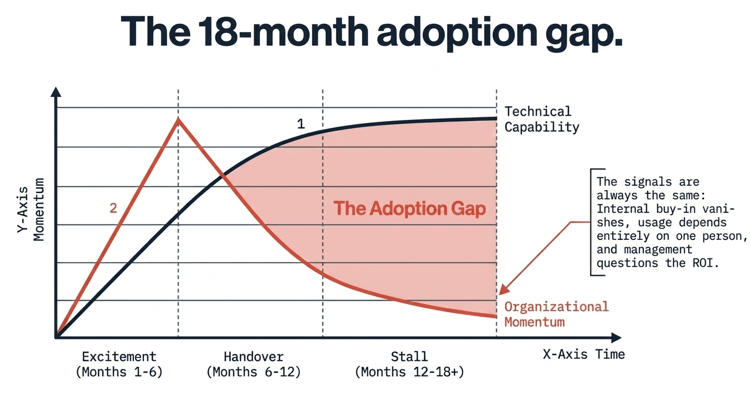
Figure 1: Adoption gap
This is not a niche problem. It is the default state for most Adobe Experience Platform implementations at the 12–18 month mark. The platform is live, the first use cases ran, and then momentum stalled because nobody built the organizational infrastructure to sustain it.
I wanted to build something that helps organizations diagnose where they actually are, and what to do about it.
Framework foundations: Covey and People, Process, Technology
Two models sit underneath this.
The first is Stephen Covey’s habit formation model. Covey argued that lasting habits require three things working together: Knowledge (what to do and why), Skill (how to do it), and Desire (wanting to do it at all). If any of the three is missing, the habit does not form. Most organizations invest heavily in Knowledge: documentation, training, onboarding, and almost completely ignore Desire. They wonder why nothing sticks.
The second is the People, Process, Technology triad that anyone who has worked in operational transformation will recognize. The instinct in tech projects is always to start with the technology. This is almost always a mistake. Technology is an enabler. It amplifies whatever process and people layer sits underneath it. If that layer is broken, better technology makes things worse faster.
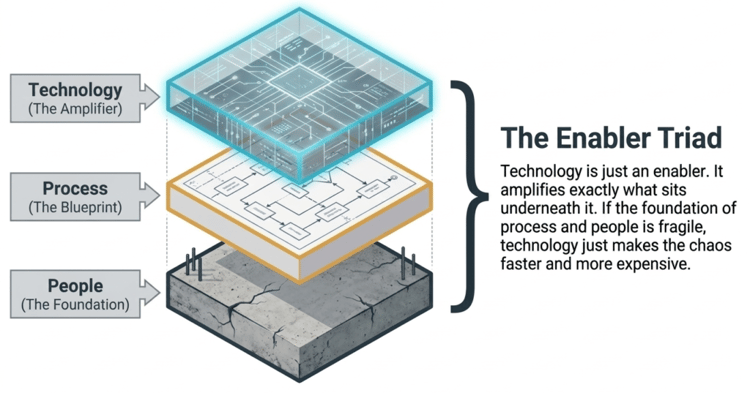
Figure 2: The enabler Triad
I put these two models together into a 3×3 matrix, nine dimensions that sit at the intersection of both frameworks. The result is a self-assessment that tells you not just what is broken, but why it is broken and where to start fixing it.
The nine dimensions are:
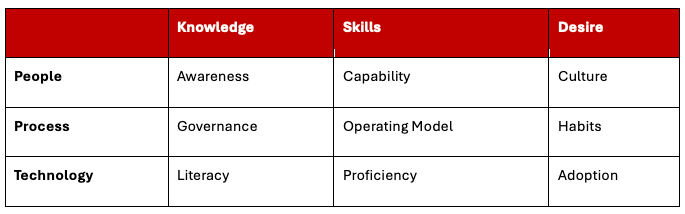
Take the assessment
Rate your organization honestly across all nine dimensions. This is a diagnostic, not a report card. The results are only useful if the scores reflect reality.
How to read your results
The heatmap is the first thing to look at. Not the individual scores, the pattern of scores.
Most organizations cluster low in one of three places:
If your Desire column is red, the problem is not understanding or capability, it is pull. People know Adobe Experience Platform exists and some can operate it, but nobody is asking for it. Use cases get pushed by the Adobe Experience Platform team rather than pulled by the business. This is the most common pattern, and the hardest to fix, because it requires changing how people relate to the platform rather than what they know about it. Executive sponsorship and visible wins matter more here than any amount of training.
If your Process row is red, the org has energy around Adobe Experience Platform but no structure to channel it. Use cases arrive as informal requests, get prioritized arbitrarily, and stall at handoffs. The same questions get answered repeatedly because nobody wrote down the answers. This pattern often hides behind the feeling that things are “progressing”, there are meetings, there are ideas, there are good intentions. But there is no repeatable system.
If your Knowledge column is red, the foundation is missing. Teams do not know what Adobe Experience Platform can do, or why it exists, or how it relates to their work. This is the easiest pattern to address, but it is also the one where organizations stop. Running a workshop and writing a one-pager feels like progress. It is necessary but not sufficient. Knowledge without desire produces no behavior change.
The tool also includes a “Where to start” block that applies a specific sequencing principle to your scores. I want to explain that briefly.
The sequencing principle
The instinct in technology projects is to start with technology. It feels productive. You can point to something concrete. But it almost always optimizes the wrong thing.
A more reliable sequence is: Process first, then People, then Technology.
Define what the system is supposed to enable before investing in who operates it or which platform supports it. This means getting clear on the business outcome, the workflow that leads to it, and who owns each step. Only once that is defined do the capability gaps become visible, and only then does technology investment compound rather than evaporate.
The “Where to start” block in your results applies this logic to your specific scores. It identifies the weakest Process dimension as the entry point, surfaces the linked People dependency, and shows which Technology dimension becomes the enabler once both are moving.
The sequence is not rigid. It is a default that prevents the most common mistake.
How to use your results over time
The Adobe Experience Platform Mindset Matrix is a diagnostic. It tells you where you are. It does not build the operating model for you, or create the executive sponsor, or run the quarterly brainstorming sessions. That work still has to happen.
What it does is give you a shared language for the conversation. When you can say “our Process row is solid but we have a Desire problem” rather than “something isn’t working with our Adobe Experience Platform adoption,” you can have a much more productive discussion about what to do next.
A few things to keep in mind as you use it:
-
Score with your organization, not alone. The most valuable version of this assessment is one where three or four people score independently and then compare. The disagreements are more useful than the scores.
-
Come back in 90 days. The mindset is not built in a single assessment; it compounds. Bookmark the page and retake it. See which dimensions moved and which did not.
-
This framework is deliberately universal. It applies regardless of industry, org size, or how far along your Adobe Experience Platform implementation is.
In the meantime, take the assessment. Be honest. And if your results feel uncomfortably accurate, that is the point.
The Adobe Experience Platform Mindset Matrix is adapted from Covey’s habit formation model and the People, Process, Technology framework, applied to organizational Adobe Experience Platform adoption. It was built and validated through hands-on experience running Adobe Experience Platform for more than three years, and through many conversations with practitioners across the community. Questions and pushback welcome — reach out via the Experience League community.
Frequently asked questions
Why do Adobe Experience Platform implementations stall after the first year?
The most common reason is that organizations invest in technical implementation but not in organizational readiness. Once the platform is live and the implementation partner hands over the keys, there is no internal infrastructure to sustain momentum — no process for intake, no shared ownership, no executive pull. The technology is ready; the organization is not.
What is the People, Process, Technology framework and why does it apply to Adobe Experience Platform adoption?
The People, Process, Technology framework is a widely used model in operational transformation. It holds that technology only delivers value when the right people and processes are in place first. In Adobe Experience Platform implementations, the instinct is to start with technology — configure the platform, ingest the data, build the audiences. But without clear processes and capable, motivated people, that investment evaporates. The Adobe Experience Platform Mindset Matrix applies this framework as a diagnostic lens.
How do I know if my organization has a Desire problem?
A Desire problem shows up as use cases being pushed by the Adobe Experience Platform team rather than pulled by the business. If you are the one generating ideas, proposing activation scenarios, and chasing stakeholders for input — rather than fielding requests from business teams who want to use the platform — that is a Desire gap. It is the most common pattern and the hardest to fix, because training and documentation do not solve it. Visible wins and executive sponsorship do.
What should I prioritize first if my Adobe Experience Platform adoption is stalled?
Start with your weakest Process dimension. Process creates the structure that makes People and Technology investment stick. If there is no repeatable system for how use cases are requested, prioritized, and delivered, capability-building efforts will not compound. Identify the specific process gap — intake, governance, or operating model — and address it before adding more training or tooling.
Can this framework apply to organizations that are not yet live on Adobe Experience Platform?
Yes. The nine dimensions are relevant at any stage of implementation. Organizations that assess before go-live can use the results to shape their onboarding strategy, identify capability gaps in advance, and build the process infrastructure before momentum stalls. The framework was developed from post-implementation patterns, but its diagnostic value applies earlier than that.