In large enterprises, Digital Asset Management (DAM) evolves far beyond governance and content organization. At massive scale, it becomes a distributed systems engineering challenge. For organizations running Adobe Experience Manager (AEM) 6.5 on Adobe Managed Services (AMS), performance optimization is an architectural mandate, not an operational afterthought.
Introduction
In large enterprises, Digital Asset Management (DAM) evolves far beyond governance and content organization. At massive scale, it becomes a distributed systems engineering challenge. For platforms supporting 40+ TB of binary assets, millions of assets, and hundreds of concurrent business users, traditional DAM practices are insufficient. Metadata governance and folder hierarchies alone cannot ensure responsiveness, reliability, or adoption.
For organizations running AEM 6.5 on Adobe Managed Services (AMS), performance optimization is an architectural mandate, not an operational afterthought. Some of these optimizations are no longer needed or can be accomplished using capabilities in AEM as a Cloud Service, Dynamic Media with OpenAPI and Edge Delivery Services (EDS). That said, until you are able to move to AEM Assets as a Cloud Service, here are effective strategies for optimization in AEM 6.5 on Adobe Managed Services.
Enterprise DAM reality: operating at 40+ TB scale
Modern enterprises face unprecedented scale in digital asset management. Understanding the typical scale and user concurrency helps highlight why traditional DAM operations often break under pressure.
A high-volume DAM typically exhibits:
-
40 - 60 TB of binary storage, with millions of high-resolution assets
-
1.5 - 3 million managed assets, including multiple renditions and version histories
-
600 - 1,000 concurrent authors, marketers, and business users, particularly during seasonal campaigns
-
200 - 300 metadata fields organized across layered schemas
-
Periodic high-volume bulk ingestion, often with automated image/video processing pipelines
At this magnitude, inefficiencies in repository structure, workflow design, indexing strategy, and replication amplify exponentially. Small architectural oversights can escalate into systemic performance failures, slowing author productivity, delaying campaigns, and undermining DAM adoption.
Why performance becomes the primary risk vector
As DAM platforms grow, the risk to performance escalates beyond simple governance challenges. Identifying the root causes of latency, workflow congestion, and repository saturation is critical to sustain adoption and user trust.
Key constraints in Adobe Experience Manager 6.5 AMS deployments include:
-
Stateful repository architecture: Oak/TarMK performs well under normal load, but bottlenecks under overlapping queries, workflows, and replication.
-
JVM execution and garbage collection: Heap pressure during bulk ingestion causes latency spikes and GC pauses.
-
Index-bound queries: Poorly tuned Lucene or property indexes amplify query latency and CPU usage.
-
Infrastructure-bounded I/O: Storage and network caps affect large asset writes, retrievals, and replication.
Observed degradation patterns:
-
Asset searches taking 6 - 10 seconds (outliers > 12s)
-
Workflow queues building up 20 - 60 minutes during campaign peaks
-
Frequent garbage collection spikes under bulk ingestion
-
Reindex storms from overlapping triggers
-
Repository read/write contention impacting authors and automation
These symptoms directly erode user trust, encouraging shadow repositories and local file systems, which ultimately undermine DAM adoption.
Core architecture: AMS 6.5 DAM platform flow
Before diving into optimizations, it's important to visualize the end-to-end architecture. This flow highlights where the system experiences stress under high-volume operations.
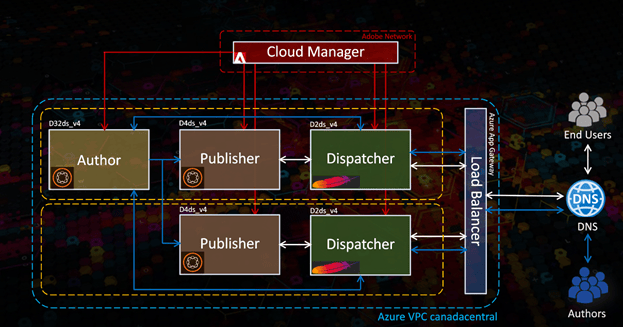
Primary performance stress zones:
-
Oak index evaluation and large query execution
-
Workflow concurrency and long-running DAM Update Asset workflows with multiple file type processing step and custom code including Scene7 rendition generations
-
JVM heap utilization under high ingestion
-
Repository I/O saturation during bulk operations
-
Permission evaluation overhead
-
Replication throughput to multiple publish instances
Common performance challenges in a large-scale DAM
By examining recurring bottlenecks, we can understand which areas - indexing, workflows, repository I/O, permissions, and replication require targeted engineering interventions.
1. Index sprawl & query inefficiency
Large enterprises often accumulate:
-
Generic or overlapping Lucene indexes
-
Excessively large metadata schemas
Impact: Increased search latency, elevated CPU usage, frequent reindex cycles, and reduced author node stability.
2. Workflow congestion & ingestion bottlenecks
Long-lived AMS environments often have:
-
Highly customized DAM Update Asset workflows
-
Synchronous validation steps
-
Heavy event listener usage
Impact: Exponential workflow queue growth, delayed asset processing, and narrowed campaign launch windows.
3. Repository growth & I/O saturation
At 40+ TB scale:
-
Asset version histories multiply storage footprint
-
Unused renditions inflate binary volumes
-
Bulk uploads saturate datastore throughput
Impact: Segment store growth, index expansion, and extended backup windows.
4. Permission complexity & access overhead
Granular ACL models increase:
-
Permission resolution cost per query
-
Search execution latency
-
Repository traversal complexity
Impact: Permission evaluation becomes a major performance contributor rather than just a governance concern.
Practical use case: Large-scale retail DAM optimization
A practical example demonstrates how performance engineering strategies are applied in a real-world high-volume DAM environment.
Platform snapshot (pre-optimization)
Metric
Value
Operational symptoms: Slow creative workflows, campaign delays, frequent platform escalations, declining DAM adoption.
Optimization strategy implemented
Each optimization lever addresses specific bottlenecks to improve system performance, user experience, and maintainability.
1. Metadata & schema rationalization
-
Reduced metadata fields from 280 → 145
-
Archived unused attributes
-
Consolidated redundant taxonomies
-
Introduced structured controlled vocabularies
Outcome: Reduced index load and improved query performance.
2. Index engineering, query optimization & oak tuning
-
Introduced targeted property indexes for high-frequency search filters
-
Eliminated wildcard-heavy queries and unbounded folder traversal
-
Fine-tuned slow-running queries using Oak query performance tooling
-
Tuned querySettingsEngine OSGI Configuration based on hardware capacity, with the threshold set to 1.5 million nodes to align query planning and execution behavior
Outcome: 65% reduction in search response time and stabilized index growth.
3. DAM Update Asset workflow optimization & ingestion engineering
DAM Update Asset workflow refactoring
-
Simplified workflows by removing redundant synchronous steps
-
Split monolithic workflows into separate launchers based on business logic, reducing unnecessary execution
-
Converted non-critical post-processing tasks to asynchronous execution
-
Eliminated duplicate event listeners
Large-scale ingestion controls
During bulk ingestion windows, additional tuning was required:
-
Disabled Metadata Writeback workflow launchers to prevent excessive synchronous repository writes
-
Suspended non-essential background workflows during peak ingestion
-
Introduced ingestion throttling to control concurrency and reduce JVM pressure
-
Implemented batch scheduling windows aligned with infrastructure capacity
-
Enforced best practices for a maximum of 1,000 assets per folder node to prevent UI rendering delays and large query result sets
Outcome:
-
70% reduction in workflow backlog
-
Significant improvement in ingestion throughput
-
Stable UI responsiveness during campaign spikes
4. Repository hygiene, maintenance & operational stability
To control repository growth and sustain performance:
-
Enforced asset version retention policies
-
Archived legacy campaign assets
-
Removed unused rendition profiles
-
Tuned datastore garbage collection cycles
-
Consider a separate cold storage server for archive vs. assets living perpetually on the DAM
Workflow purge & revision cleanup strategy
Due to high asset churn and workflow execution volume:
-
Workflow purge maintenance jobs were executed daily
-
Revision cleanup jobs were aligned with ingestion windows
-
Workflow purge retention was reduced from 5 days to 2 days, significantly lowering repository pressure and improving timeline responsiveness
Outcome: Stable repository growth curve and improved author system responsiveness.
5. Permission model simplification
-
Flattened nested user groups (e.g. brand/channel/year/campaign/images)
- Relately, also train users to find assets via Search as opposed to manually clicking through folder structures)
-
Reduced ACL inheritance depth
-
Introduction of role-based access controls
-
recommend that Users should be finding assets via Search vs. manually click through of folder structure
Outcome: 45% improvement in permission evaluation time.
Outcome metrics
Metric
Before
After
Enterprise DAM performance monitoring & observability framework
At enterprise scale, performance optimization without continuous monitoring is unsustainable. Continuous observability is required to detect regression, forecast capacity needs, and prevent operational incidents.
1. Query performance & search health
-
Continuous monitoring of slow queries via query status consoles
-
Weekly audits using Oak query diagnostic tooling
-
Validation of index selection and detection of traversal fallback
-
Monitoring index size growth and reindex frequency
Objective: Prevent silent degradation of search experience.
2. Workflow throughput & queue health
-
Daily monitoring of:
-
Workflow queue depth
-
Execution latency
-
Long-running workflow instances
-
-
Continuous tracking of DAM Update Asset runtime trends
-
Quarterly audits of workflow launchers and event listeners
Objective: Sustain ingestion velocity and protect campaign timelines.
3. Repository health & maintenance validation
-
Daily verification of:
-
Workflow purge
-
Revision cleanup
-
Datastore garbage collection
-
Tar compaction
-
-
Monitoring segment store growth and binary expansion trends
Objective: Maintain repository hygiene and prevent systemic degradation.
4. Java Virtual Machine (JVM) & infrastructure health
-
Monitoring:
-
Heap utilization
-
Garbage collection frequency and pause duration
-
CPU saturation
-
Storage I/O (input/output) wait times
-
-
Alert thresholds for early detection of infrastructure stress
Objective: Maintain predictable system behavior under load.
5. Operationalizing observability
-
Weekly performance reviews to identify regression trends
-
Monthly repository hygiene audits
-
Campaign readiness assessments before seasonal traffic spikes
This transforms DAM operations from reactive firefighting into predictive engineering.
Strategic takeaways
At 40+ TB scale, DAM is a mission-critical digital infrastructure. Key takeaways from this performance tuning guide:
-
Governance creates order
-
Architecture enables scale
-
Performance preserves trust
-
Monitoring sustains reliability
Organizations that embed performance engineering and observability into DAM governance achieve sustained adoption, operational resilience, and long-term digital growth.