Learn how AI agents interact with your website and how Adobe LLM Optimizer’s Agentic Traffic metrics reveal whether your content is accessible, reliable, and competitive in AI‑driven discovery. This article explores how to interpret agentic interactions, success rate, performance, and LLM visibility to improve how your brand is represented in AI‑generated answers.
AI systems are increasingly the first point of discovery for customers. People now ask large language models to explain companies, compare services, summarize offerings, and recommend solutions long before they ever visit a website. In this environment, being relevant is no longer enough. How a brand is represented by AI systems matters just as much as whether it is found at all.
Organizations that care about accuracy, credibility, and long term brand-trust cannot afford to let third party websites, cached search engine copies, or outdated references define how AI describes them. When AI systems generate answers, they draw from whatever information they can reliably access. If a company’s own website is not the clearest and most authoritative source, the AI fills the gaps using external sources like Google or Bing’s search-results-cache that the brand does not control.
In response, Adobe created Adobe Large Language Model Optimizer (Adobe LLM Optimizer). Adobe LLM Optimizer is designed to help organizations understand, monitor, and improve how their brand appears in AI generated answers across LLM powered search engines, chatbots, and browsers. It allows teams to see how AI systems interact with their website, track how their brand is represented in LLM responses, and focus optimization efforts on the prompts, topics, and questions that matter most to their business.
Beyond measurement, Adobe LLM Optimizer is built to help organizations act. It provides prescriptive recommendations and, in supported environments, enables teams to deploy targeted fixes that improve AI visibility and content accessibility without lengthy development cycles. These recommendations make it possible to directly influence how AI systems retrieve, interpret, and summarize information from owned digital properties.
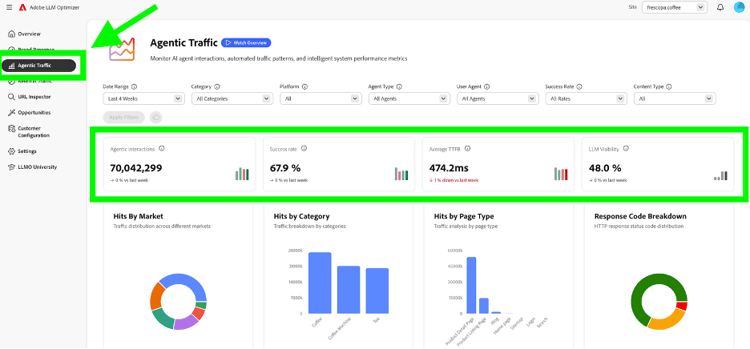
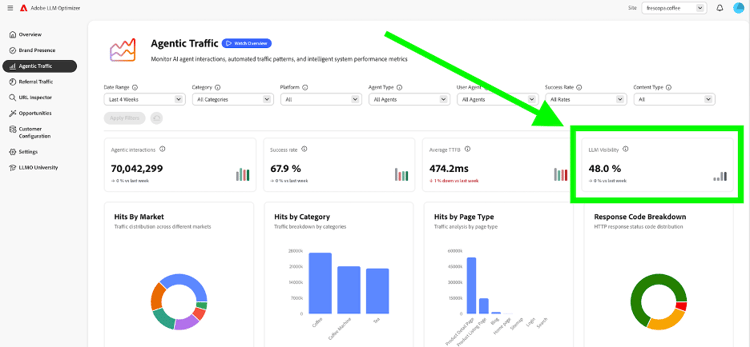
This article focuses exclusively on the Agentic Traffic tab within Adobe LLM Optimizer. At its core, the Agentic Traffic tab helps determine whether a website is structurally prepared to participate in AI mediated discovery. To do this, it surfaces four key metrics:
-
Agentic interactions
-
Success rate
-
Average TTFB
-
LLM visibility
How agentic traffic data Is collected
Before reviewing the four key metrics, it is important to understand how Adobe LLM Optimizer captures accurate data within the platform. Agentic Traffic data is sourced from CDN log forwarding.
To populate the Agentic Traffic dashboard, CDN log forwarding must be configured. Without CDN log forwarding, the dashboard remains empty.
When CDN logs are forwarded, Adobe LLM Optimizer ingests and processes a subset of request fields. Because different CDN providers expose different raw log formats, Adobe normalizes these fields into a consistent structure so they can be analyzed uniformly.
The normalized fields exposed in the Agentic Traffic view include:
-
URL path only
-
User agent
-
Status code
-
Referrer header
-
Host header
-
Time to first byte
-
Request method
-
Timestamp
-
Content type
This normalized data enables analysis of how AI agents interact with a website based on request behavior and user agent signatures. No personally identifiable information is processed or stored during this ingestion process.
1. Agentic interactions
Agentic interactions represent the total number of requests made by AI agents to your website.
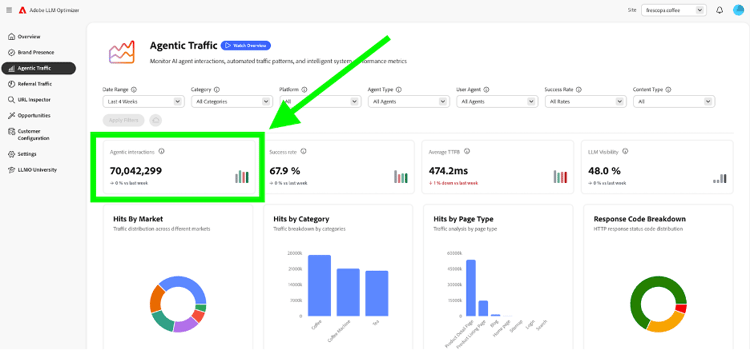
This includes requests from:
-
Chatbots
-
Training bots
-
Web Search crawlers
High agentic interaction volume indicates that AI systems consider your site relevant enough to evaluate as a potential source. Low or zero agentic interactions indicate that AI systems are not requesting your content, which means the site is effectively invisible in AI driven discovery.
This metric measures AI demand, not whether the content was ultimately used.
2. Success rate
Success rate measures how often AI agent requests return usable responses.
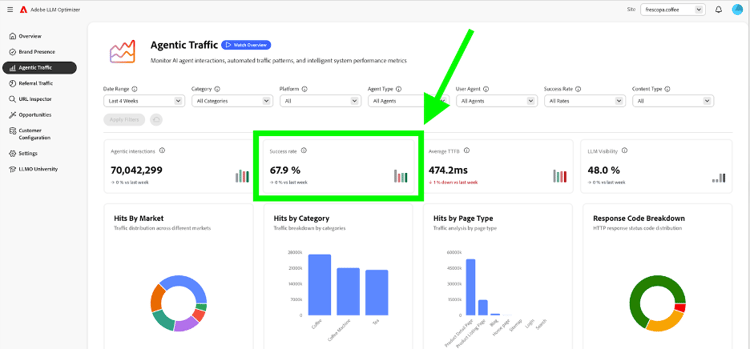
This includes:
-
Successful responses with 2xx status codes
-
Valid redirects with 3xx status codes
Requests that result in 4xx or 5xx errors reduce the success rate.
LLM agents operate under strict time and resource limits. When a request fails due to a server error, broken page, or unresolved redirect, the agent does not retry repeatedly. It simply moves on to another source.
From the agent’s perspective:
-
Failed requests reduce trust in the site
-
Unreliable endpoints are deprioritized
Success Rate reflects whether a site can reliably participate in AI retrieval activities. If content cannot be fetched consistently, it cannot be evaluated or cited.
3. Average TTFB
Average TTFB, or Time to First Byte, measures how quickly a server begins responding after an AI agent makes a request.
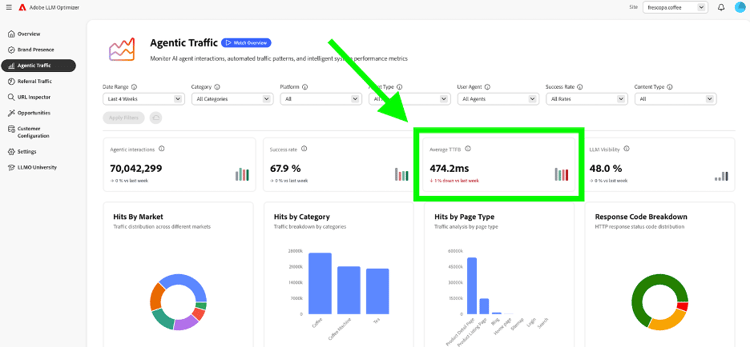
LLM agents typically request multiple candidate pages at the same time. They evaluate which responses arrive quickly enough to be useful.
If a page responds slowly, it may still be fetched, but it often arrives too late to influence the final answer. When multiple sources provide similar information, faster responses are more likely to be selected.
TTFB determines whether content arrives in time to compete during AI source selection, and it particularly matters for chatbot user agents, which visit for retrieval rather than crawl or training, making performance especially important.
Interpreting TTFB for agentic traffic
-
Under 200 ms: Ideal. Content consistently arrives early enough to compete in AI source selection.
-
200 to 400 ms: Acceptable. Content is usable but less competitive when faster alternatives exist.
-
Over 400 ms: Risk zone. Content is often fetched but frequently arrives too late to influence AI answers.
4. LLM visibility
LLM visibility reflects how much of your website can be clearly read, understood, and trusted by AI systems.
Most LLMs primarily consume server side rendered HTML. They rely on the initial response returned by the server. Many AI agents do not execute JavaScript or wait for client side rendering to complete.
When important content is rendered only through JavaScript, that content may not be visible to the AI. In these situations, the model must infer or guess what is missing.
How AI fills visibility gaps
When content is not clearly visible:
-
AI systems often rely on cached versions indexed by Google or Bing
-
They may reference third party websites that describe the brand
-
They may summarize outdated or incomplete information
The AI answer is still generated, but its accuracy is no longer controlled by the organization.
Why LLM visibility is central to GEO
In Generative Engine Optimization (GEO), the goal is not simply to produce relevant and high quality content. The goal is to ensure that your own website is the authoritative source of truth for how your brand is understood and represented by AI systems. As large language models increasingly mediate discovery, comparison, and early stage research, they rely on what they can reliably access, interpret, and trust.
LLM visibility is where Artificial Intelligence Optimization (AIO) and GEO converge.
-
AIO determines whether AI systems can clearly read and understand your website
-
GEO determines how your brand and content are described once that understanding exists
Both are required to maintain accuracy, consistency, and control in AI generated answers.
Optimizing for LLM visibility
AIO focuses on strengthening how readable and accessible a website is for large language models. Optimizing for LLM Visibility at this level means:
-
Prioritizing server side rendering so that critical content is present in the initial HTML response
-
Maintaining clean, valid HTML syntax that can be parsed without ambiguity
-
Applying structured data and schema where appropriate to reinforce meaning and context
-
Enforcing clear content hierarchy and information architecture so relationships and intent are explicit
-
Ensuring accessibility and overall machine readability to reduce interpretation gaps
These foundations determine whether AI systems can reliably access, interpret, and understand a site’s structure and signals. Without them, AI systems may be unable to evaluate the content accurately, regardless of its quality.
Optimizing for representation in AI answers
Once a website is readable and accessible, GEO governs how that content is selected, summarized, and surfaced in AI generated responses. Optimizing for GEO means ensuring that content is:
-
Relevant and useful, aligned to real user questions and informational needs
-
Trustworthy and accurate, minimizing ambiguity or conflicting signals
-
Structured to demonstrate E E A T (Experience, Expertise, Authoritativeness, Trustworthiness)
-
Written in clear, answer ready formats that AI systems can confidently summarize
-
Supported by a consistent digital footprint that reinforces the same facts across sources
GEO relies on the website as a primary data source for AI systems. When that source is incomplete, unclear, or inconsistent, AI models compensate by relying on external or cached references.
When LLM visibility Is high
When AIO and GEO are aligned:
-
AI systems rely on your website first
-
Brand representations are accurate and consistent
-
Answer quality improves, leading to a clearer and more reliable customer understanding
-
AI mediated discovery reinforces, rather than distorts, your intended messaging
When LLM visibility Is low
When LLM visibility is weak or fragmented:
-
AI systems rely on external, cached, or third party sources
-
Accuracy degrades as models infer or guess missing context
-
Brand control is lost, even if content quality is high
How the four metrics work together
The four metrics represent a single evaluation pipeline:
-
Agentic interactions show AI demand
-
Success rate shows reliability of access
-
Average TTFB shows competitiveness during retrieval
-
LLM visibility shows usability and trust
All four must work together for consistent AI visibility and accurate AI generated answers.
Closing perspective
Adobe LLM Optimizer’s Agentic Traffic metrics exist because AI visibility begins long before citation. It starts with access, reliability, speed, and clarity, whether AI systems can reach your content, retrieve it successfully, receive it fast enough, and understand it without ambiguity.
While AI visibility outcomes cannot be guaranteed or perfectly measured today, leading organizations accept a practical reality: improving technical readiness increases eligibility for AI driven discovery over time. By ensuring their websites are structurally accessible, performant, and legible to AI systems, they maximize the likelihood that their owned digital properties are considered during LLM retrieval and response generation.
As AI becomes a more prominent part of early stage research and consideration, visibility within LLM conversations has the potential to function as an upstream nurturing layer. Long before a user clicks a link, AI systems may already be shaping their understanding of a brand, its offerings, and its credibility. When a user eventually arrives on the website, they are more likely to do so as a warmer, better informed lead—having encountered consistent, accurate representations earlier in their journey.
Organizations that treat their website as strategic digital infrastructure, and invest accordingly, are best positioned to remain visible, accurate, and competitive as AI mediated discovery becomes the default.