Unified adoption of Adobe Experience Platform is not a technical milestone, it is an organizational commitment. While enterprises deploy Real-Time CDP, Adobe Journey Optimizer, and Customer Journey Analytics successfully, teams still experience fragmentation. This article explores how organizations can move from siloed tool usage to a unified operating system for customer experience.
Implementing Adobe Experience Platform is not the same as operationalizing It
Designing and implementing Adobe Experience Platform involves a series of technical milestones. Achieving unified adoption is an organizational one.
Many enterprises deploy components of Adobe Experience Platform successfully, implementing Real-Time Customer Data Platform, orchestrating customer experiences through Journey Optimizer, and evaluating performance in Customer Journey Analytics. Yet across teams, the platform is often experienced as fragmented.
In many cases, this fragmentation is reinforced by architectural and operating decisions. Organizations adopt individual applications while continuing to rely on parallel systems for core capabilities. For Example - Adobe Analytics may remain the primary environment for cross-channel measurement, while a legacy email service provider continues alongside Journey Optimizer. These decisions are often pragmatic, but selective adoption limits ecosystem value.
Adobe Experience Platform is designed as an integrated system where unified profiles, orchestration, and analytics reinforce one another. When native integrations are bypassed, the feedback loop weakens. The result is not technical failure; it is partial realization of platform value.
This perspective examines why AEP implementations feel fragmented, how the illusion of separate tools forms, and how organizations can operationalize Adobe Experience Platform as a cohesive, measurable enterprise system.
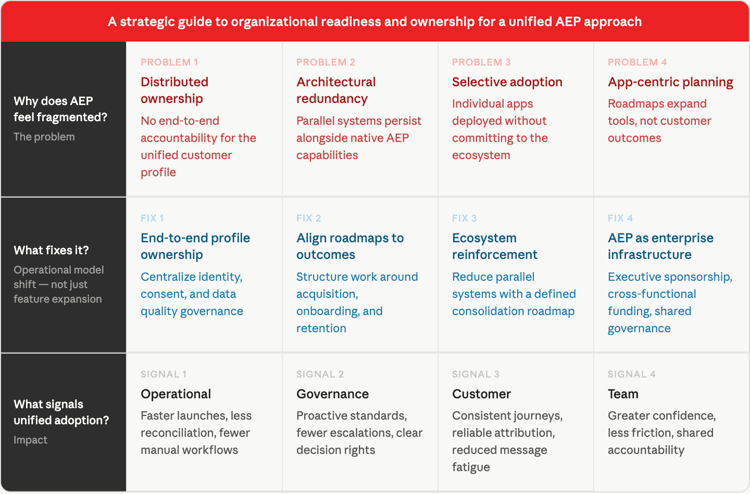
Why does Adobe Experience Platform feel fragmented after implementation?
The Illusion of separate tools and the reality of structural misalignment
Real-time Customer Data Platform, Journey Optimizer, and Customer Journey Analytics are frequently experienced as distinct initiatives. They may be implemented in different phases, owned by different teams, and evaluated against different success metrics. Over time, this reinforces the perception that Adobe Experience Platform is a collection of loosely connected applications.
Architecturally, that perception is inaccurate. The applications are designed to operate within a shared identity framework, governance construct and consent model, and integrated measurement loop. For Example, Identity resolution informs orchestration. Orchestration generates behavioral data. Analytics closes the loop by measuring performance against the same unified profile.
When the platform feels disjointed, the cause is not separation in architecture. It is misalignment in how teams understand and operate their components together.
Distributed ownership across the customer experience
In many enterprises, responsibilities remain aligned to the functional boundaries rather than customer experience continuity.
Data engineering manages ingestion pipelines and schema governance. Analytics defines attribution models and reporting standards. Marketing executes activation strategies. Information technology oversees infrastructure and compliance.
What is often undefined is end-to-end accountability for the integrity and usability of the unified customer profile across these domains.
Without a clearly designated owner of profile continuity, downstream behaviors emerge:
-
Activation teams validate audiences outside the platform before launch
-
Reporting discrepancies trigger reconciliation exercises between systems
-
Consent and suppression logic are verified at the channel level instead of at the profile level
-
Customer journey orchestration requires manual coordination between teams
The system remains technically unified but operationally misaligned.
Architectural redundancy and selective adoption
Structural misalignment is compounded when organizations adopt individual components without committing to the ecosystem.
Customer Journey Analytics may be available, yet external analytics environments continue to serve as the primary cross-channel reporting environment. Journey Optimizer may be deployed, while a legacy email service provider remains the dominant execution engine. Real-Time Customer Data Platform may unify identity within Adobe Experience Platform, but parallel profile definitions and audience logic persist in other systems for validation and activation.
These decisions protect prior investments and reduce transition risk. However, sustained parallel architectures weaken the reinforcing loop that Adobe Experience Platform is designed to create.
When identity resolution occurs within a governed framework, but orchestration and measurement continue across external systems, discrepancies become structural rather than incidental. Teams compare outputs across environments instead of operating from a single system of record.
The perception of fragmentation intensifies because dependency on the ecosystem remains partial.
App-centric planning
Planning structures further entrench the illusion. Roadmaps are frequently organized around expanding individual applications: additional segmentation capabilities, new orchestration channels, expanded dashboards.
While these enhancements strengthen individual components, they do not inherently create cross-functional reliance. Cohesion increases only when planning is structured around customer outcomes that require shared identity, governed consent, coordinated orchestration, and integrated measurement.
The illusion of separate tools persists when applications are deployed within unchanged silos and supported by parallel systems. The underlying architecture remains unified by design, but fragmentation emerges in how the organization structures and operates it.
A structured approach to unified adoption
Correcting structural misalignment requires more than expanding feature usage. It requires deliberate operating model shifts that make Adobe Experience Platform the enterprise system for identity, orchestration, and measurement.
Organizations that achieve unified adoption consistently implement four structural changes.
Establish end‑to‑end ownership of the unified customer profile
Unified adoption begins with clear accountability for customer profile integrity. This ownership must extend beyond schema management. It includes responsibility for Identity resolution logic and stitching rules, Consent and suppression governance at the profile level, Data quality thresholds and monitoring, Latency expectations for real‑time activation, Activation readiness standards.
When ownership is centralized or formally governed across functions, the unified profile becomes trusted infrastructure rather than a dataset subject to validation.
Trust drives dependency. Dependency drives adoption.
Align roadmaps to customer journey outcomes
Platform work must be structured around measurable customer journey objectives, rather than individual applications.
-
Instead of expanding Real‑Time Customer Data Platform segmentation in isolation, initiatives should support acquisition strategy.
-
Instead of adding channels in Journey Optimizer independently, orchestration should support onboarding or retention goals.
-
Instead of building dashboards within Customer Journey Analytics separately, measurement should close the loop on customer journey performance.
Customer experience alignment creates cross‑functional dependency by design.
Marketing, analytics, and engineering cannot operate independently when success is measured against shared customer outcomes. This shift moves Adobe Experience Platform from application enhancement to revenue‑enabling infrastructure.
Commit to ecosystem reinforcement over parallel expansion
Selective adoption slows unification. Full value is realized when native integrations are prioritized and redundant systems are intentionally reduced over time.
A unified approach includes:
-
Activating audiences directly from Real‑Time Customer Data Platform rather than exporting to external profile stores
-
Orchestrating cross‑channel journeys within Journey Optimizer instead of splitting execution across legacy systems
-
Measuring customer journey impact within Customer Journey Analytics using the same identity framework that powers activation
This does not require immediate decommissioning of legacy systems. It requires a defined roadmap for consolidation and a bias toward ecosystem reinforcement.When identity, decisioning, and analytics operate within the same governed environment, discrepancies decline and confidence increases.
Position Adobe Experience Platform as enterprise infrastructure
Unified adoption accelerates when Adobe Experience Platform is positioned as foundational architecture rather than a marketing enhancement. When treated as infrastructure, the platform is governed and funded with the same rigor as other enterprise systems.
This positioning requires executive sponsorship, cross‑functional funding models, shared governance structures, and multi‑year customer strategy planning. These elements signal that Adobe Experience Platform is a required system for operating customer experience, not an optional set of tools.
When the platform is treated as required infrastructure, parallel workflows decline. Data standards become clearly defined and consistently enforced, profile governance standardizes, and cross‑channel orchestration becomes expected rather than optional.
As a result, Adobe Experience Platform shifts from being evaluated by campaign output to being evaluated by enterprise capability.
Unified adoption is not achieved by expanding tool usage. It is achieved by redesigning accountability, planning structures, and architectural priorities around a unified customer system.
This framework creates the conditions for measurable operational and customer impact.
Measurable impact and enterprise implications
When Adobe Experience Platform transitions from partial deployment to a unified operating model, impact becomes visible across operational efficiency, governance maturity, customer performance, and team dynamics.
Operational impact
Organizations that formalize ownership of the unified customer profile and consolidate ecosystem usage experience clear operational gains.
Audience exports Reduces and manual reconciliation workflows decline, cross‑channel campaign deployment accelerates due to standardized segmentation, dependency on redundant activation systems decreases, and accountability for identity resolution and consent enforcement becomes explicit.
Time‑to‑launch improves because segmentation, orchestration, and suppression logic operate within a single governed environment. Teams no longer validate data across systems before activation, allowing execution to move faster with greater confidence.
Governance impact
Structural alignment produces measurable governance improvements. Identity resolution standards become documented, service‑level agreements for data ingestion and latency are defined, and consent and suppression enforcement is centralized.
As a result, governance shifts from reactive validation to proactive management. Cross‑functional escalations during campaign execution decline because expectations, standards, and decision rights are clearly established.
Customer and performance impact
When identity, orchestration, and measurement operate within the same framework, customer experience consistency improves". Organizations commonly observe higher user adoption and cross‑functional alignment, reduced message fatigue through unified suppression logic, increased engagement driven by real‑time behavioral triggers, and more reliable attribution through Customer Journey Analytics tied to a unified identity.
The performance lift varies by industry and maturity level, but the pattern remains consistent. Treating Adobe Experience Platform as a foundational ecosystem increases measurable impact.
Organizational and team impact
Structural alignment does more than improve system performance; it reduces friction across teams. When profile ownership is unclear and parallel systems persist, organizations experience repeated validation cycles, reporting disputes, consent‑related escalations, and hesitation to rely on unified segments. These dynamics create operational fatigue and erode confidence in shared data.
When unified adoption is established, behavioral shifts follow. Cross‑functional disputes decline, confidence in segmentation and identity logic increases, decision rights during campaign execution become clearer, and collaboration across marketing, analytics, and engineering improves. Teams spend less time reconciling systems and more time driving customer outcomes.
Confidence in the unified profile ultimately translates into confidence in execution.
Key Takeaways
Unified adoption is not achieved by expanding feature usage. It is achieved by:
-
Defining end-to-end ownership of the unified customer profile
-
Structuring roadmaps around customer outcomes rather than applications
-
Prioritizing native integrations over parallel systems
-
Positioning Adobe Experience Platform as enterprise infrastructure
When these conditions are met, the perception of fragmentation declines because structural misalignment has been addressed.
Adobe Experience Platform does not create cohesion on its own. It amplifies the structure of the organization operating it. When governance and accountability align, the platform is operated as a unified system, enabling its integrated capabilities to deliver more consistent customer experiences and drive the business forward with less friction and greater confidence.