Teams are being asked to deliver more personalized content than ever, but most are still stuck with outdated, friction-filled content supply chains. This article shows how Workfront transforms that chaos into true content velocity by connecting strategy, structure, and automation.
Why I care about content velocity right now
As content demands increase and AI accelerates expectations, I see many organizations trying to move faster while relying on outdated content supply chains. The result is friction everywhere: long lead times, confused handoffs, and a constant struggle to personalize at scale.
According to Adobe's 2025 AI and Digital Trends Report, compared to 2024, marketers face escalating accountability as there is a greater demand to deliver more content in 2025. The survey finds that 43% of marketers anticipate an increasing need to amplify content output while ensuring the content is personalized and pertinent to customers.¹
At the same time, leveraging advanced tools to automate a content supply chain is becoming key, especially as GenAI begins to permeate across all industries. However, the integration of GenAI into content supply chains has moved more slowly than anticipated. According to IBM®, only 50% of organizations had accomplished their anticipated AI adoption into content supply chains by the end of 2024.²
That's the tension I feel every week: expectations are rising faster than most teams' ability to execute. That's why I focus on content velocity, which in layman's terms means delivering the right content faster, rather than chasing perfection for its own sake.
The growing importance of personalization in content strategy
In today's fast-paced digital landscape, content demand is becoming increasingly critical for organizations as they strive to deliver personalization at scale. By 2025, marketing trends are increasingly spotlighting content supply chains, emphasizing the need for efficiency, personalization, and AI-powered tools to manage the surging demand for content effectively and to enhance customer experiences.
According to Deloitte's 2025 Marketing Trends, an overwhelming 75% of consumers are more likely to purchase from brands that provide personalized content. This statistic underscores the urgent need for a robust content supply chain that supports personalized marketing efforts.³
I’ve seen a few key questions emerge:
-
How do we get from brief to approved content without going back back-and-forth for days?
-
How do we ensure that stakeholders have the appropriate amount of context without drowning in email threads?
-
How do we keep versions, locales, and priorities straight when volumes spike?
The moment these questions come up is when I've seen teams shift from reactive execution to high-velocity, personalized delivery. With Workfront as the operational backbone of an organization, people start to realize that velocity seems possible, not just aspirational.
What's broken in an antiquated content supply chain
When I work with teams still operating with an antiquated content supply chain, the pain is rarely isolated to one stage. Instead, complications usually show up across the entire lifecycle: planning, collaboration, publishing, and analysis.
Planning: Fragmented briefs and siloed information
These challenges begin at the planning stage. I've seen marketing program managers upload an initial brief that most stakeholders, or other relevant team members, can't access. Marketing operations teams find their primary assets scattered across multiple locations. Teams are unaware of deadlines and unclear about the scope of deliverables due to siloed information.
This looks like scavenging for details in Slack, email, and shared drives, rather than having one centralized repository to see what's needed, when, and why.
“When teams have a clear intake process and consistent requirements, speed becomes a natural outcome. Fewer back-and-forths, less status chasing, and more time for everyone to focus on the work.”
Kaylee Richard, Marketing Operations Manager at Toll Brothers and Adobe Workfront Champion
Collaboration: Inconsistent experiences and lost versions
Next, as the collaboration phase begins, creative teams start uncovering inconsistencies in design, reflecting a lack of cohesion and care in the work. When organizations attempt to scale campaigns across different platforms, teams discover there's no centralized system to manage various versions, rendering much of the content unusable.
This is where "perfection" becomes a trap. When nothing is centralized or structured, polishing one asset doesn't solve the underlying problem; rather, it slows everything else down.
Publishing: Manual effort under tight deadlines
Following collaboration, the publishing phase presents yet another hurdle. Without a CMS authoring platform integrated with the cloud drive, teams are forced to upload assets individually, a time-consuming process that's far from ideal when facing tight deadlines.
When you're working against launch dates, this last-mile friction can be the difference between hitting a window and missing it.
Analysis: Limited visibility into what worked
Lastly, the analysis phase, which is crucial for assessing campaign effectiveness, suffers due to the lack of tracking systems. Organizations struggle to identify which assets drove engagement, making it nearly impossible to evaluate the campaign's success.
Ultimately, modernizing a content supply chain isn't just about solving current problems but also about preparing for future challenges. The scalability and flexibility of structured workflows are crucial for adapting to new marketing channels and technologies.
How I've seen teams modernize their content supply chain
What I've learned is that modernizing a content supply chain requires building blocks that turn "speed over perfection" into a workable reality. Here's what I've seen work across planning, execution, and strategy.
Custom forms: Encoding the right signals for speed
Using custom fields in Workfront forms has been a significant enabler of accelerated content velocity in my experience with enterprise content supply chains. One approach I've found particularly useful is leveraging custom forms to rank requests using custom field values.
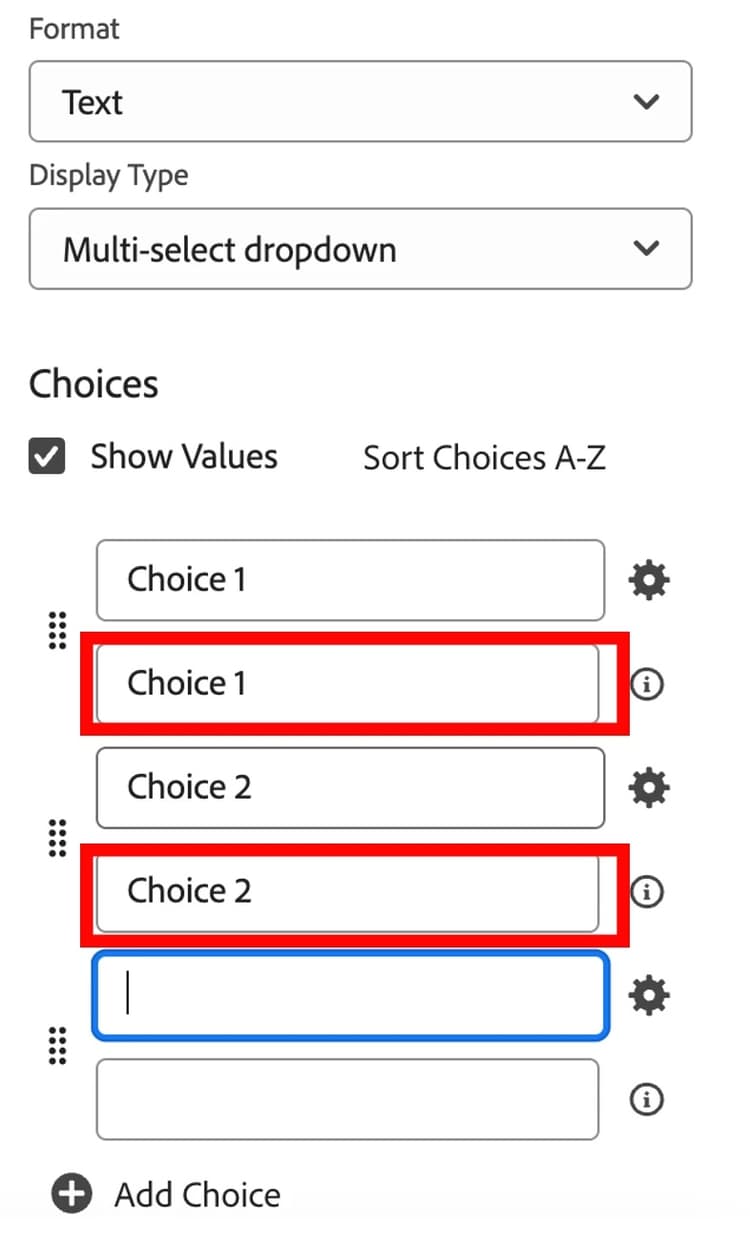
You can input a 'secret' value for custom fields when selecting a single-select dropdown and multi-select dropdown for your custom form. A 'secret' value is the second value associated with the choices you can input into the form. The 'secret' value isn't seen by the user; rather, it's in the backend of the system and is leveraged for logic and automation.
When you create a dropdown, each choice has a label and a value ('secret' value):
- A label is what users see when completing the form. One example of a label would be "Low", "Medium", "High."
- A value is what the system stores in the back-end. One example of this is "1", "2", "3."
Using numbers or priority/rank as the secret value makes it easy for:
- Fields to sort by importance
- Automated systems or scripts to apply logic—for instance, escalate this field if value equals high
- Integrations to make decisions automatically based on priority/rank
Or, you can add locale as a 'secret' value to streamline the use of content. For example, if you use PT to indicate that content should be delivered to audiences in Portugal speaking Portuguese, versus PT-BR, to indicate that content should be delivered to audiences in Brazil speaking Portuguese, it enables teams to push content out in a more efficient manner, which allows them to scale output.
What this means in practice: your forms aren't just capturing information—they're quietly encoding priority, locale, and routing logic that let automation do the heavy lifting.
Request queues: Centralizing and prioritizing work
I have seen first-hand how request queues can optimize task management by centralizing and standardizing work requests. They enable teams to prioritize tasks based on urgency, which improves both efficiency and visibility.[JM1]
By ensuring that critical components are addressed first, request queues help teams work more effectively, reducing delays and enhancing turnaround times. This systematic approach is crucial for the smooth functioning of content supply chains.
This looks like seeing fewer "random" asks showing up via chat or email, and more work flowing through a structure where you can see, triage, and act.
Templates: Making best practices repeatable
Templates play a vital role in maintaining consistency and efficiency across projects. They provide predefined structures that accelerate project setup, minimize errors, and reduce the need for constant oversight.
Templates can also automate repetitive tasks and workflows, such as:
- Sending notifications
- Assigning tasks
- Initiating approvals
This automation is essential for maintaining a consistent and efficient content supply chain. I've found that templates translate into less time rebuilding the same steps and more time focusing on content quality and optimization, which is perfect for busy teams who need to iterate!
Workfront Planning: Connecting strategy to execution
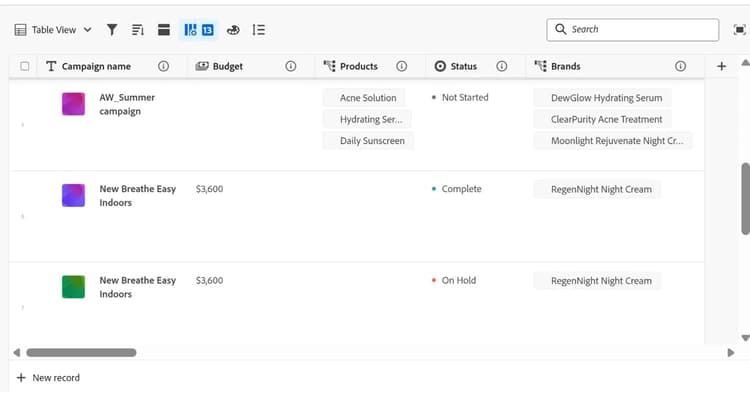
While project management tools can support timelines, budgets, reviews and approvals, and measure how the work is getting done, I've noticed these tools don't facilitate the coordination and execution of strategic work. Moreover, they lack the ability to measure the impact that this work has on the customer experience.
However, Workfront Planning is an additional capability that goes beyond the scope of regular project management. It provides a single source of truth to connect disparate plans and data across marketing teams. The result of this connection is a marketing system of record that provides visibility into the marketing lifecycle from start to finish.
Using Workfront Planning, you can begin to relate work tasks to each other. For instance, you can link two tasks in different work streams and begin to understand the connection between the two. Within a specific workstream, you can see the workstream's backlog items, which can then be activated as projects in Workfront, allowing for a seamless transition from end to end.
Why this matters for you
I’ve learned that speed over perfection isn't about lowering standards. Instead, it's about:
-
Having structured ways to capture requests, priorities, and locales
-
Reducing manual effort and rework through Workfront features, like queues, templates, and blueprints
-
Connecting strategy to day-to-day work so that time is spent on the right things
Ultimately, modernizing your organization’s content supply chain with the mentioned capabilities lets you respond to rising content and personalization demands without burning out your team. Instead of just having an obscure plan for the distant future, Workfront turns content velocity into something you can design for, measure, and improve.
"Before Workfront, one team spent more time searching for information than working. Workfront became their single source of truth—Documents, templates, Proofing, and reporting gave them instant visibility. They gained back time to focus on strategy and pivot quickly when priorities changed."
Carol Majewski, Director of Program Management at RAPP and Adobe Workfront Champion