Transforming the enterprise content supply chain is less about technology and more about managing complex organizational change. This article shares practical lessons on planning, workstreams, approvals, integrations, and change management so teams can avoid common rollout pitfalls and achieve lasting impact.
The enterprise reality of content supply chain transformation
Content supply chain transformation represents one of the most significant operational initiatives marketing organizations undertake. While the promise of streamlined workflows and seamless asset management is compelling, the implementation reality requires substantial internal preparation, cross-functional coordination, and sustained resource commitment that extends far beyond initial deployment.
I've learned that successful content supply chain implementation isn't simply a technology installation—it's a comprehensive organizational transformation that demands rigorous project management, stakeholder alignment, and strategic planning from the outset.
Strategic foundation: Discovery and requirements mapping
Our content supply chain journey began with a comprehensive discovery phase focused on overhauling our end-to-end asset lifecycle—from planning through creation to distribution. This required close collaboration with implementation partners to identify critical integration points, particularly around work management platforms and digital asset management systems. The strategic objective was clear: create a seamless operational environment where assets flow efficiently through marketing operations, from initial planning through final distribution, eliminating system friction and reducing handoff delays. But in reality, on the enterprise side of things, there’s many requirements and decisions you must make even before working with implementation partners.
Establishing the planning and project management framework
Workstream architecture and taxonomy development
Successful content supply chain implementation requires meticulous workstream documentation and organizational structure. I realized early on that it’s not just about tasks—it’s about understanding time frames, identifying the key systems that need to be integrated, and creating a dedicated place for all of it. For us, that meant to create a new workspace in Workfront Planning specifically for Marketing Operations, recognizing that operational workflows differ fundamentally from campaign execution patterns.
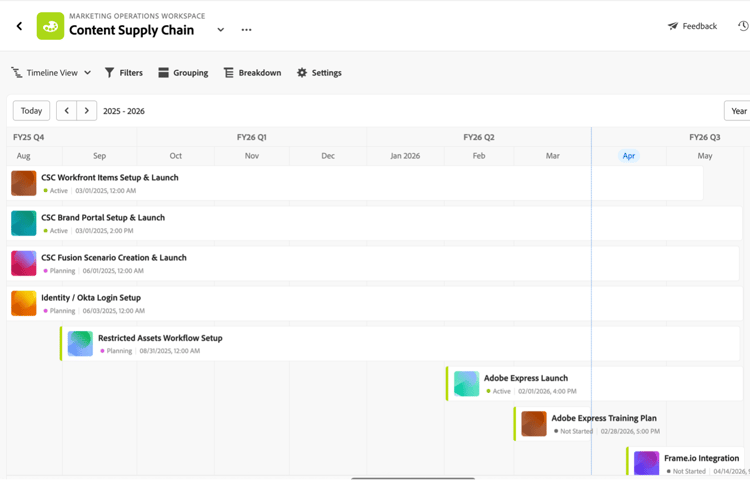
Critical early steps in Workfront Planning included:
-
Visualization strategy: Workfront Planning is the platform that I wanted to use for Marketing Operations to see an overview of planned initiative rollouts. We use table views for uploading detailed information and then timeline views for visual stakeholder communication proved most effective. Visual roadmaps demonstrating simultaneous workstreams are critical for maintaining executive alignment and cross-functional coordination.
-
Taxonomy development: Comprehensive classification systems covering tools, systems, integrations, and processes are essential. Our technology ecosystem encompassed work management platforms, digital asset management, automation tools, creative collaboration platforms, identity management, and content distribution systems. Each requires a clear definition and mapping on how they all work together and what teams and tools are needed. An example of a taxonomy in Workfront Planning for Marketing Operations teams would be your list of tools, including Okta, AEM, Workfront, Fusion, Planning, etc.
-
Workstream identification: Next, I cataloged all initiatives related to content supply chain transformation, establishing clear timelines, system dependencies, and integration requirements. This comprehensive mapping provided the foundation for coordinated execution across marketing and IT teams. Some of these workstreams included rollouts for the identity platform Okta, as well as Workfront Planning, Brand Portal, Frame.io, Approvals, GenStudio, and Express. Moreover, we created training and change management plans for the initiatives. It is important to identify the personas for each workstream so when it comes time for training plans, you can host tailored trainings. An example of one of those personas could be the group of project managers who would use the Workfront to AEM integration and meta data form to upload assets in the Brand Portal. The Workfront Planning workspace provided the overview, but the Workfront project provided the in-depth tasks on executing the work.
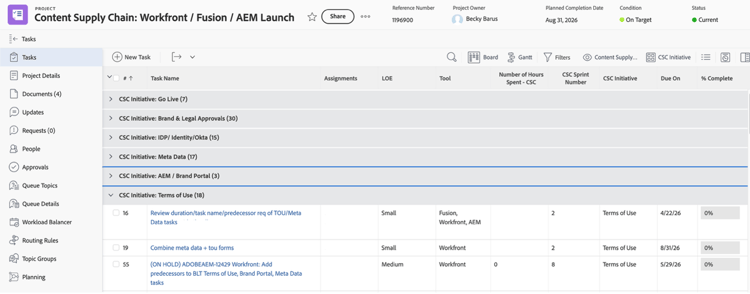
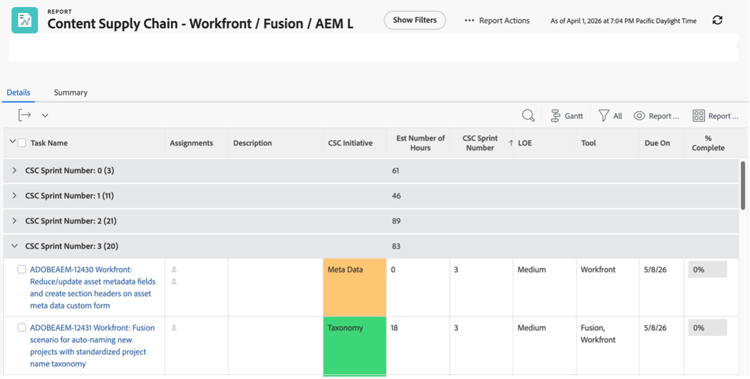
Managing the work: In Workfront, I created a Content Supply Chain project utilizing tasks and a task form. The task form categorized the tools, assignments, workstream initiative, level of effort, sprint number, and hours so that the work could be properly measured into several week sprints. This also helped with resourcing and timing. Moreover, the sum feature on the report from the hours field and report grouping worked well for tracking hours spent per sprint. I also created a UAT project when it came to testing and placed the Planning workspace, UAT project, and report showing the Content Supply Chain tasks.
The messy middle: Challenges, resistance, and surprises
The technical implementation represents only one dimension of content supply chain transformation. We encountered several organizational challenges that required proactive management.
We encountered stakeholder alignment gaps. Specifically, there was a disconnect between leadership resource planning and frontline team execution. Sometimes, the subject matter experts performing the implementation work often hold different perspectives than executive sponsors. Some differences include feasibility and sustainability, so transparent communication and expectations between the teams on resource planning is essential for success.
Another common challenge that we faced is user resistance to system migration. While rolling out the first phase of the content supply chain, which included streamlining our approvals process into one system, there was some resistance. Teams comfortable with legacy systems or processes naturally resist change, so rolling out these new systems and processes requires dedicated change management and comprehensive training.
Sustainability concerns were another challenge that we faced while implementing the content supply chain. The team questioned what was truly sustainable for long-term system maintenance, especially when integrating more tools. Organizations must commit to ongoing operational resources beyond initial deployment, as the content supply chain isn't a "set and forget" initiative. In the end, we wanted our hundreds of users to have the best experience for campaign planning, creation, and distribution. However, setting up the systems on the backend to do this require numerous upfront work and resources, which make some doubt the value.
A significant surprise for me was how much customization was required, how not out-of-the-box it is. If it were simple, that would be amazing, but most companies have complicated needs–for example, you can’t just open access to all assets for anyone to use. There must be regulations on access and usage of the assets.
Making it work: Creative solutions and customization
The first significant push of the content supply chain was streamlining approvals for brand and legal in Workfront so that users would not have to go into another system. Other companies might have their compliance and legal approvals in other systems—we did, too, at first. But step one was to get those approvals into Workfront so everything happens in one place.
Instead of integrating another system with Fusion, I trained the legal and brand teams on how to use the Marketing instance of Workfront. We have different legal counsel for each business unit and region, so I worked with ACS to build a Fusion automation for automatic routing. We made sure that the right people are always assigned based on a universal custom field selection. As Frame.io and unified approvals roll out, the next step will be ensuring those people get assigned in pre-approved templates, too.
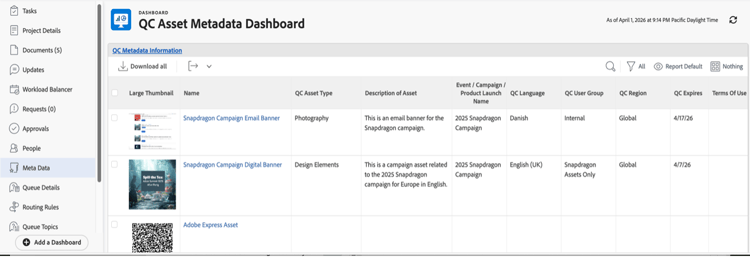
Some items required customization, such as being able to add multiple assets on the AEM side into a cart. We also needed an efficient way to input metadata beyond the automated fields. Specifically adding language once an asset is translated, and generating the terms of use and expiration dates of assets. The solution was a metadata and terms of use form added through Fusion on each asset published on the Brand Portal. We also created a reporting dashboard for users to enter these attributes was our solution, but in the future I see an opportunity for AI to help with this.
The most complex technical challenge, though, was the identified provider solution for external user access. We leveraged Workfront to accomplish what a native asset management platform database would have, which included approving external user access requests, assigning custom attributes, and in-depth reporting. Using the simpler route of IMS would not have given us the in-depth reporting we needed for user compliance. Having a seamless way for externals to access a system like Okta is tricky, but Adobe is working on a beta to be released in May 2026 solution to help make this process easier.
Measuring the impact
While implementing the content supply chain, it’s important to take a step back and realize the large business impact the transformation will make across multiple dimensions. The content supply chain enhances the user experience, eliminating system fragmentation and creating unified workflows to improve the content creation experience without platform switching and process friction.
There’s also a significant cost and time savings – the automation of manual processes, particularly asset uploading and metadata tagging, which can take hours, can be done in a single-button automation. Anytime you streamline and get things happening in one place, you save time and resources.
And shutting down old systems saves money, too. It can reduce licensing costs and maintenance overhead - so that’s another significant win.
Lessons learned: What matters most
The most essential takeaways for success in content, supply chain planning and project management are:
-
Comprehensive requirements documentation: Comprehensive upfront requirements gathering is non-negotiable. Organizations must document minimum viable product (MVP) criteria and validate technical feasibility before committing to implementation timelines.
-
Resource planning: Set dedicated roles for initial implementation, such as content librarians, integration engineers, and fusion developers. Partnership with IT for identity and security solutions are especially critical.
-
Infrastructure readiness: Verify that your foundational capabilities are properly configured and compatible with the planned implementations.
-
System mapping and migration: Transferring from legacy systems to new systems require meticulous mapping of workflows, taxonomies, and configurations. This is not a simple data transfer.
-
Change management: Ongoing support and training for adoption are critical so frontline teams have the confidence to execute the new workflows.
-
Compliance and governance: marketing asset management is unfortunately not simple. Content supply chain systems must support Rights Management, access controls, and governance frameworks. My team has spent hours creating processes like terms of use and accessing restricted assets.
Why it matters
Why does this all matter? We’ve had hiccups along the way, so that’s why I’m sharing all this — so people know what to look out for and can set themselves up for success.
Change is the only constant. Things are always changing, which is why ongoing support is so important. Between AI, new integrations, and new betas, workflows change. Being prepared for change and having the right resources on board is key to maintaining the content supply chain system.