The article explores and promotes shared responsibility for rights‑managed assets in Adobe Experience Manager (AEM) Assets, helping users understand usage limits and make compliant decisions. Strong rights-management and governance reduces organizational risk and supports confident self‑service of digital assets.
Introduction
The objective of this document is to establish a culture of shared ownership and accountability around rights-managed assets within Adobe Experience Manager (AEM). By equipping Digital Asset Management (DAM) users with the knowledge and tools to recognize asset rights, understand usage limitations, and make informed decisions at the point of use, the organization can move from passive awareness to active rights management. This approach ensures that both content managers and end users clearly understand their roles and responsibilities in maintaining compliance and protecting enterprise value.
Digital Rights Management in AEM matters because it protects the organization from legal, financial, and reputational risk by ensuring licensed assets are used only within approved terms, while enabling teams to move quickly and confidently in a self-service environment. Success looks like standardized rights metadata, clear visual indicators, accountable end-user decisions at the point of download, and active governance that shifts the organization from reactive compliance to proactive risk management.
Definition of rights-managed assets
A rights-managed asset is any piece of content that carries one or more restrictions governing when, where, or how it may be used. These restrictions are typically defined through licensing agreements or contractual obligations and may include, but are not limited to:
-
Talent likeness, name, or voice
-
Photographer or videographer rights
-
Quotes, artwork, book titles, and logos
-
Music (with or without voice)
-
Directors or creative contributors
-
Regional or geographic usage limitations
-
Approved media channels
-
Usage dates or expiration requirements
-
Screen Actors Guild (SAG) agreements
-
Institutional or enterprise contracts (e.g., NFL, Apple)
Typically, Business Affairs or Legal teams are responsible for advising which restrictions must be tracked and enforced for each asset, however all users are responsible for understanding restrictions on assets they utilize. Depending on your library, you may have a small number of rights restricted assets, or a large number.
Restrictions and multi-level rights
Assets may carry multiple, overlapping rights. For example, a single video may include:
-
On-camera talent governed by SAG agreements
-
Licensed music with a defined usage window
-
Stock imagery limited to specific channels
-
Vendor-provided content restricted to certain placements
All associated rights remain in effect regardless of whether the asset is used in full, edited, or segmented. Some licensing agreements may also prohibit extracting still images, altering audio, or repurposing content in derivative formats. The most restrictive or first restriction will override the other restrictions. End users should rely on a librarian or Business Affairs if there are any questions about restrictions to ensure compliance.
Documents
There are many documents that are part of the rights management process, some examples are:
-
releases
-
indemnifications
-
contracts
Keep the rights documents connected the rights managed asset is important. One approach is to store the documents in a separate library (typically a legal database), assign a number to the document and then enter the number into metadata of the rights managed asset in the DAM. Or you could store the documents in a private area in your DAM and connect/relate the documents to the assets. Releases and contracts contain personal information that should not be searchable or seen by the public. Storage is flexible by organization or by what systems are available.
Why Digital Rights Management matters
Financial impact
Improper use of rights-managed assets can expose the organization to legal penalties, licensing violations, and unexpected financial risk. Proactive rights management helps ensure licensed content is used as intended, protecting the value of those investments and reducing the likelihood of costly disputes with talent and photographers. Beyond direct penalties, misuse of rights-managed assets can lead to unplanned remediation costs, including asset takedowns, rework, and emergency re-licensing. These disruptions divert time and budget away from strategic initiatives, increasing operational friction and reducing overall marketing efficiency.
Brand reputation risks
Misuse of licensed assets can erode trust with partners, talent, and customers, exposing the organization to significant reputational risk. Effective rights management preserves brand integrity and contractual credibility, helping prevent costly legal disputes that can arise from improper use of assets with complex or overlapping rights. Inconsistent or unauthorized use of licensed assets can also strain relationships with agencies, licensors, and internal partners, complicating future negotiations and approvals. Over time, these breakdowns can slow campaign execution and reduce confidence in the organization’s ability to manage licensed content at scale responsibly.
Identifying rights-managed assets
Visual indicators
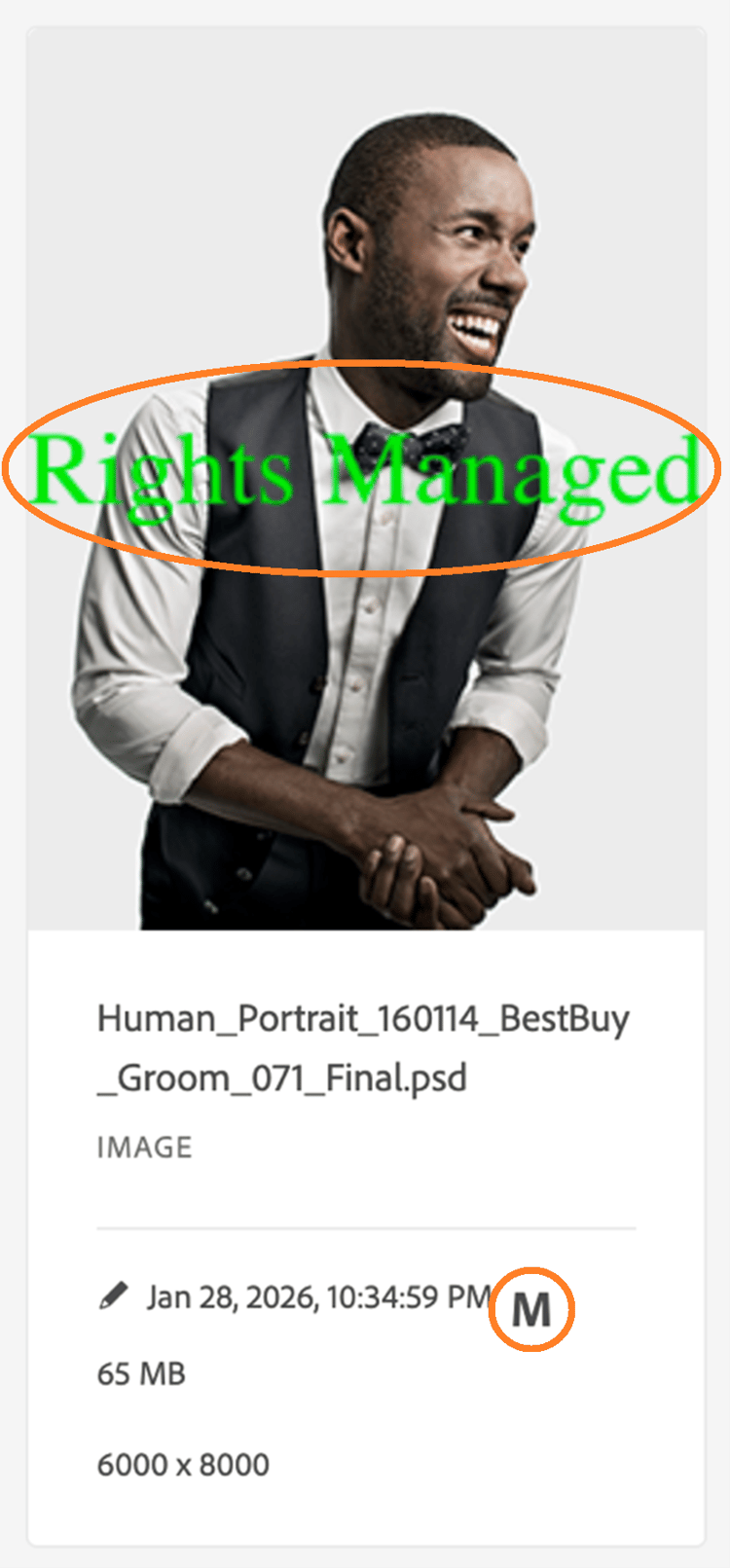
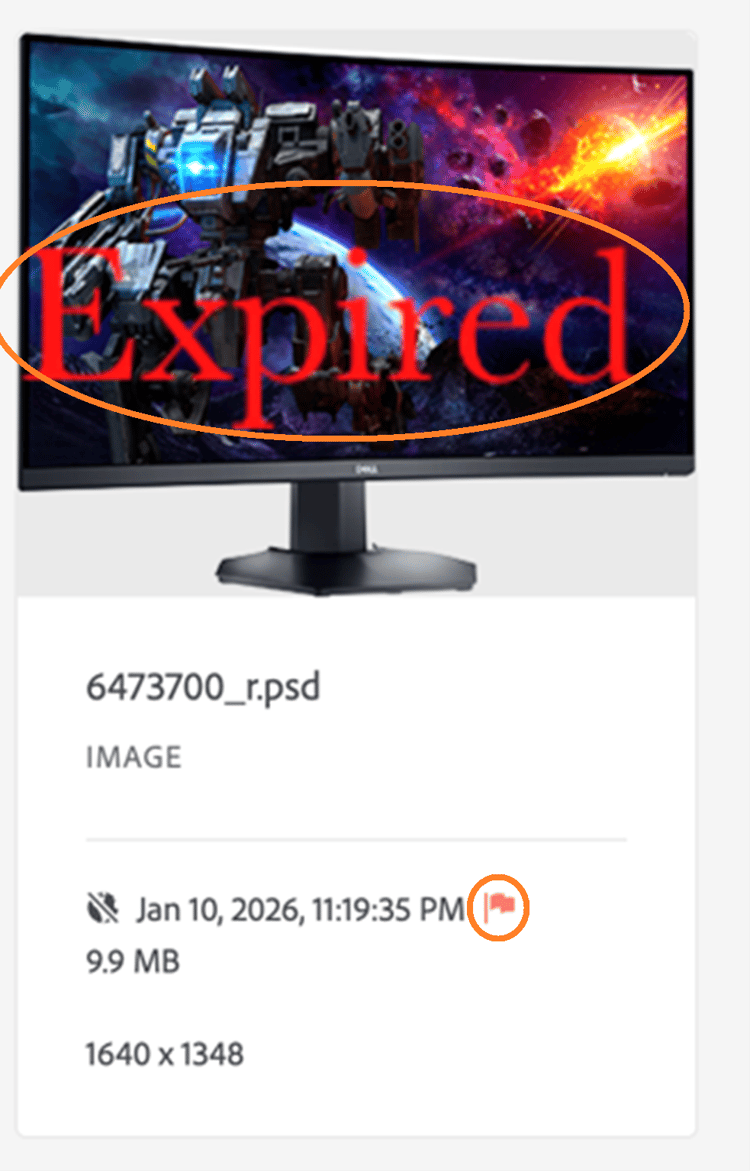
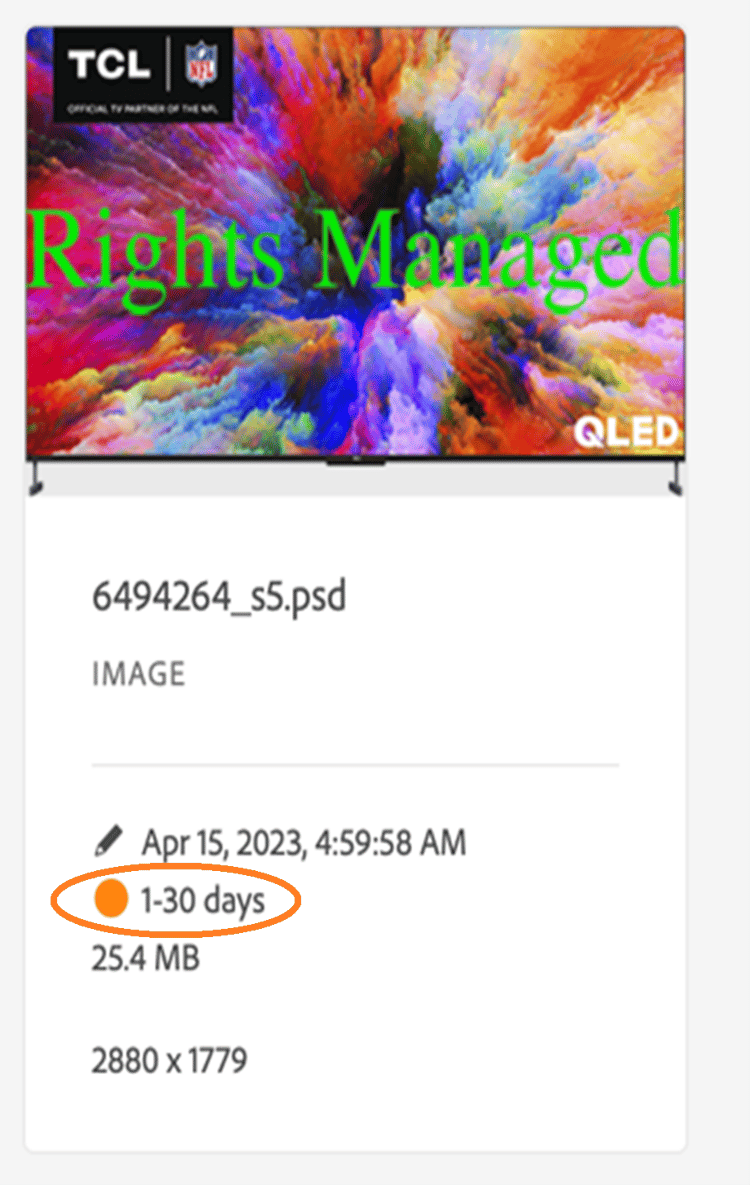
Each organization should decide how to indicate rights-managed assets in their DAM. In our organization we aimed to enable quick identification by adding visual indicators to the asset thumbnails, such as:
-
Rights-managed watermark (green) indicating one or more restrictions
-
“M” icon indicating media usage restrictions
-
Expired Watermark (green) indicating one or more restrictions have expired
-
Expired Flag indicating one or more restrictions have expired and preventing user download
-
Upcoming expiration date indicators with color-coded status:
-
Orange: 1–30 days remaining
-
Yellow: 31–60 days remaining
-
Blue: 61–90 days remaining
-
See the images below for examples of how these visual clues appear to assets users.
Metadata
The visual indicators allow users to instantly recognize rights-managed assets without relying solely on filters or comprehending metadata.
Storing this information in metadata is also important. Search filters should also allow users to filter on the rights type of assets – rights-managed vs. no rights restrictions.
Both visual indicators and the search filter should be regular tools that end users rely on to find assets and quickly understand how to use them. However, visual indicators and filters are tools, they are not replacements for reading and understanding the restrictions details.
User agreement and accountability
Before downloading rights-managed assets, users must acknowledge a rights agreement confirming compliance with licensing terms, permitted usage, and legal standards. Users are accountable for ensuring assets are not shared or used outside approved parameters. End user agreement should be tracked and recorded to inform reporting, which is discussed later in this article.
Form example:
Below is an example of a form that each user must complete to download the asset. Once they enter in the intended use, the DAM reconciles the intended use to the rights management metadata for the asset. If the intended use aligns with the rights, the user is prompted an unwatermarked version of the asset. If the intended use does not align with the rights, the user gets a message indicating which right is mis-aligned.
If the user just needs an image to use For Placement Only (FPO) or concepting, they can download a watermarked rendition of the asset, and place into their design.
1. User enters the name of the person who directed them to use the asset (or selects N/A if they selected the asset themselves).
2. The tool displays the restrictions that apply to the asset.
3. If the user selects concepting/FPO, the tool provides a low-resolution, watermarked version. To download a high-resolution, non-watermarked version, the user must complete steps 4–6.
4. User enters where the asset will be used geographically.
5. User selects the media type(s) the asset will appear in (e.g., paid, owned, social, email, print).
6. User is prompted to confirm the intended use falls within the asset’s expiration date(s) (if applicable)
7. User selects whether to download the high-resolution, non-watermarked asset (and any additional sizes/formats).
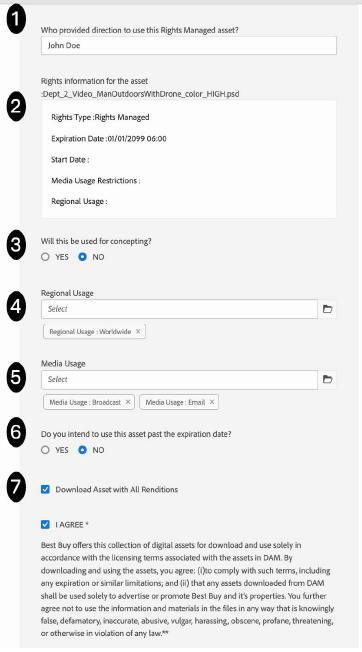
Lastly, the user must agree to the terms to receive a “download” button. When the user downloads, their download action and file information is added to reporting for the AEM Admin. Details of the terms is below:
o I agree (radio button)
[X] company offers this collection of assets for download and use solely in accordance with the licensing terms associated with the assets in DAM. By downloading and using the assets, you agree: (i) to comply with such terms, including any expiration or similar limitations; (ii) that any assets downloaded from DAM shall be used solely to advertise or promote Best Buy and its properties. You further agree not to use the information and materials in the files in any way that is knowingly false, defamatory, inaccurate, abusive, vulgar, harassing, obscene, profane, threatening, or otherwise in violation of any law.
End-user responsibilities
Users can review asset rights by:
-
Examining visual icons on thumbnails
-
Reviewing usage rights in the metadata
-
Reading rights information presented during download or linking
-
Using the filter to filter on rights type
When downloading or linking a rights-managed asset, users are responsible for:
-
Understanding the rights associated with the asset
-
Accurately entering intended usage details
-
Complying with restrictions displayed during the download process, including expiration dates
-
Collaborating with cross-functional partners when asset rights do not align with campaign timelines or placements
Users must submit an intended-use form when downloading rights-managed assets. DAM automatically reconciles the intended use against the asset’s rights metadata:
-
If aligned, the user is granted access to an unwatermarked asset
-
If misaligned, the system identifies the specific rights conflict and presents to end user
-
For concepting or placement-only needs, users may download a watermarked version
In practice, this means users can search and find assets, clearly understand the rights of the assets, agree to use the assets according to the restrictions, and use them confidently in their work in a fast-paced environment
Reporting and governance
Effective Digital Rights Management requires more than system controls - it depends on clear governance protocols. Governance provides the structure that ensures rights-managed assets are used appropriately, risks are identified early, and corrective actions are taken consistently.
The objective of rights management governance is to reduce legal, financial, and reputational risk by ensuring that rights-managed assets are accurately classified, actively monitored, and used only within approved terms. Governance enables leadership to understand where the organization may be exposed, confirm that controls are functioning as intended, and reinforce accountability across teams.
Rights management governance is a shared responsibility, with clear distinction between governance ownership and operational execution:
-
Governance owners
Senior DAM leadership, Business Affairs and possibly Legal partners are responsible for establishing rights standards, approving metadata requirements, and reviewing compliance and risk reporting. Governance owners ensure alignment between licensing obligations, enterprise risk tolerance, and system enforcement. -
Operational stewards
DAM librarians and asset managers are responsible for maintaining metadata consistency, monitoring expiration and usage restrictions, managing reporting accuracy, and issuing takedown notices when required. Cross-functional partners should be brought in as needed to discuss system updates or new metadata needs. -
End users
All users are responsible for understanding and complying with asset rights at the point of download, linking, or publication, and for responding promptly to takedown notices or rights conflicts. It’s highly recommended to have senior leadership continually provide reminders of end user responsibility.
Effective rights governance should include the following:
-
Consistency in metadata
Consistent metadata is foundational to accurate reporting and effective enforcement. Rights information must be captured using standardized terms and controlled values to ensure reliability across the asset library. Required metadata fields—such as rights type, usage dates, and media restrictions—must be applied consistently to enable automated monitoring, reporting, and enforcement. -
Reporting
In addition to out of the box reports, reports can be created to capture who has downloaded/linked to what assets, or what rights-managed assets have been published. Custom reports could search external or internal sites for instances of rights-managed assets, or search for high-risk assets that are embedded in work in progress documents. Reporting should be monitored as needed, typically monthly. Reporting can help drive conversations about future licensing needs. -
Training
Training reinforces the importance of individual responsibility within a self-service DAM model. Users must understand that rights compliance is a condition of access to licensed assets. Executive-level messaging should clearly state that adherence to rights management guidelines is mandatory and that users will be held accountable. Failure to comply with rights management requirements may result in revoked access, required retraining, or escalation to leadership, depending on severity and recurrence. -
Take down notices
Librarians or Business Affairs may send take down notices prior to an asset expiring to ensure the end user removes the asset from public view. While end users should do this on their own, the business may choose to add this additional step to ensure compliance for high-risk assets.
Conclusion
Digital Rights Management is not solely a system capability - it is an enterprise governance discipline. Effective rights management requires leadership alignment, clear accountability, and consistent enforcement embedded into everyday workflows. When rights standards, reporting, and user responsibilities are clearly defined and actively governed, the organization moves from reactive compliance to proactive risk management.
By combining standardized metadata, leadership-relevant reporting, formal enforcement mechanisms, and ongoing training, the organization ensures that rights-managed assets are used only within approved terms. This governance led approach reduces legal, financial, and reputational exposure while reinforcing trust with partners, talent and customers.
Ultimately, strong rights governance protects the value of licensed content and enables teams to work confidently and efficiently; knowing that compliance is built into the way assets are managed, accessed, and used across the enterprise.