Agentic marketing represents a shift from AI as a support tool to AI as an autonomous partner that can make decisions, take action, and orchestrate personalized customer experiences at scale. This article outlines how marketers can adapt their mindset, workflows, and governance to collaborate with AI agents using Adobe Experience Platform and Journey Optimizer.
Introduction
Marketing is entering an era of intelligent automation where AI “agents” act as autonomous partners in orchestrating customer experiences. This emerging model, known as agentic marketing, goes beyond using AI for simple predictions or chatbots. In an agentic approach, AI systems don’t just assist by generating insights; they actively make decisions and take actions on marketers’ behalf to personalize content, optimize campaigns, and manage customer journeys in real time. The result is a marketing operation that is faster, more responsive, and able to deliver one-to-one experiences at scale.
However, capitalizing on agentic AI requires more than new technology – it demands a shift in marketing mindset and operations. Marketers must evolve their workflows and strategy to collaborate with these AI agents as teammates. Instead of manually executing every campaign detail, teams need to reengineer processes and roles so that AI agents handle the heavy lifting under human guidance. In practice, this means marketers define the high-level strategy, set goals and guardrails for the AI, and then supervise and refine the AI-driven outcomes. From a partner implementation perspective, organizations should prepare to upskill their teams, adjust governance processes, and embrace more agile, data-driven ways of working to fully leverage AI as a co-pilot in marketing.
This article explores the role of agent-based orchestration in modern marketing and provides a roadmap for integrating AI agents into your strategy using Adobe Experience Platform (with Real-Time CDP) and Journey Optimizer. We’ll also look at a real-world example and outline practical steps so you can begin transforming your customer experience with AI-powered decisioning.
Agents as intelligent marketing orchestrators
Agentic marketing centers on AI agents that autonomously handle tasks and decisions within marketing workflows. An AI agent in this context is more than just a script or chatbot – it’s an AI-driven entity with a degree of autonomy and “agency.” Unlike traditional automation that follows pre-set rules or simple bots that only respond to queries, these agents can adapt, learn, and act based on goals you set . In other words, an agent can monitor the environment and proactively take steps (for example, adjust an offer, trigger a campaign, fetch data) to achieve a marketing goal, without needing a human to prompt every action . This capability to perceive context and act independently makes agents akin to digital team members who collaborate with human marketers.
Importantly, AI agents are designed as partners and consultants rather than replacements for marketers. They excel at handling repetitive, complex, or real-time tasks, freeing human teams to focus on strategy and creativity. For example, an AI agent might continuously analyze incoming customer data to find micro-segments and determine the best next offer for each individual – a task too time-intensive for manual
Execution. The marketer’s role then shifts to setting the high-level strategy, defining goals and guardrails for these agents, and supervising the outcomes. Adobe’s vision for agentic AI emphasizes this balance: once marketers define the goals and constraints for the AI, the agents get to work in the background making proactive suggestions, while the marketer remains in control of final decisions. In essence, agentic marketing allows you to delegate certain decisions and actions to AI “colleagues,” accelerating marketing operations without losing human oversight.
AI Agents transforming customer experience
AI agents are already beginning to transform how customer experiences are delivered through real-time decisioning, autonomous workflows, and dynamic journey orchestration. One prominent example is Adobe’s Adobe Experience Platform Agent Orchestrator, introduced at Adobe Summit 2025, which provides a unified interface to manage multiple specialized marketing AI agents . Adobe launched this framework with ten purpose-built agents addressing specific challenges – from website content optimization to experimentation and offer management . A standout among them is the Adobe Brand Concierge, an AI agent that delivers personalized, conversational shopping experiences in a brand’s unique voice, showing how generative AI can be applied to customer service and sales in real time . These agents all operate on a shared customer experience knowledge base, and the Orchestrator can even incorporate third-party AI agents alongside Adobe’s under consistent governance . In practice, this means that an ecosystem of AI assistants can coordinate with each other – for example, an experimentation agent tweaking a webpage and a journey agent adjusting an email offer – all informed by the same unified customer profile and rules of engagement.
The impact of such agents on marketing is significant. They enable real-time decisioning at a scale and speed that humans alone could never achieve – reacting to customer behaviors or data changes instantly with tailored responses. They also drive autonomous workflows by taking over multi-step processes. For instance, an agent could detect a customer browsing high-value products, automatically trigger a relevant email or in-app message via the journey orchestration tool, personalize the content with generative AI, and even allocate a budget boost to a related ad campaign – all without human intervention in that moment. This level of autonomy creates a fluid, always-on marketing engine where routine customer interactions and optimizations happen continuously in the background.
Another key area is cross-channel journey orchestration. Traditional marketing campaigns often required manual planning and had limited ability to adjust once launched. AI agents flip this model by making journey management dynamic. Adobe Journey Optimizer (AJO), enhanced with AI, exemplifies this shift from static campaigns to “living” journeys that adjust based on real-time customer states . AI agents can monitor customer signals across touch points and decide the next-best action within milliseconds – whether it’s suppressing a promotion because the customer just purchased, or recommending a new product on the website due to a surge in social media interest. Early adopters report that this real-time orchestration leads to higher engagement and conversion lift, as each interaction is contextually relevant. Equally important, it relieves marketers from micromanaging every journey path; the AI agent takes care of optimizing sequences and timing, while humans guide the overall strategy.
Crucially, these AI-driven decisions remain aligned with marketing strategy and brand guidelines. The agents are trained on the organization’s data and governed by business rules, so they execute within defined boundaries. This keeps automated actions on-brand and compliant. As Adobe’s SVP of Digital Experience, Amit Ahuja, noted, the move to agentic orchestration is a step toward more agile and streamlined customer experience delivery – unifying AI, data, and content workflows so organizations can deliver precise, personalized experiences at scale, all while freeing teams to concentrate on strategic initiatives. In short, AI agents are transforming marketing by doing the heavy lifting of analysis and execution in real time, enabling personalization and customer experience management to happen autonomously and at scale.
Agentic marketing in action: a real-world example
The concepts of agentic marketing are not just theoretical; companies are already putting them into practice. In a recent Credera case study, a global marketing and communications group implemented an enterprise-scale AI platform that leveraged generative AI and agentic workflows to accelerate marketing innovation. Credera helped this organization build a custom AI tool – essentially a conversational AI Assistant – accessible through a web interface that acted as a gateway to agentic workflows . Marketing teams across dozens of agencies could interact with this AI agent to generate content, obtain data-driven insights, and even draft campaign proposals simply by engaging in natural language dialogue. For example, a marketer could ask the AI to analyze campaign data and suggest optimization ideas, or request a first draft of a creative brief, and the AI agent would autonomously gather the necessary information and produce the output.
The results were transformative. According to the case study, this agentic solution dramatically improved content creation speed and enabled rapid innovation, while ensuring compliance and brand consistency across outputs . By offloading tasks like initial copywriting, data analysis, and routine decision-making to the AI, human marketers and creatives could focus on higher-level ideation and strategy. The platform’s success underscores how an agentic approach can scale across a large enterprise: it provided consistent, on-brand experiences and deeper insights by integrating new AI models with governance guardrails in a single workflow hub. This real-world example shows that agentic marketing isn’t a distant vision – it’s happening now, with AI agents acting as collaborative consultants that boost the productivity and effectiveness of marketing teams.
Adopting agentic marketing: next steps
As agentic AI becomes a reality, marketers should take proactive steps to embrace this shift. Successful adoption is not just about technology—it hinges on people and process changes. Here are key focus areas for driving adoption and value with AI agents:
- Champion Organizational Adoption: Secure executives' buy-in and build a culture open to AI experimentation. Communicate the benefits of AI agents across the marketing organization, addressing concerns about job roles by framing AI as an augmenting “co-pilot” rather than a replacement. Establish cross-functional alignment (marketing, IT, data science) early on to ensure everyone understands the goals and to set up proper governance for AI-driven processes.
- Upskill Your Team in AI: Invest in training programs to raise AI literacy among marketers and strategists. Team members should learn how to interpret AI outputs, craft effective prompts or rules for AI agents, and work alongside these systems. By developing skills in data analysis, journey orchestration, and content automation, marketers will be better equipped to guide and collaborate with AI agents.
- Start with High-ROI Use Cases: Identify marketing activities that are highly repetitive, data-intensive, or impact a broad audience – these are prime candidates for agentic automation. Prioritize one or two pilot projects (for example, an AI agent for subject line optimization or for re-engaging lapsed customers) where you can quickly demonstrate value. Monitor the results closely (e.g., uplift in engagement or efficiency gains) and use those early wins to refine your approach and expand agentic marketing into other processes.
Integrating AI agents with Adobe Experience Platform
To bring agent-based orchestration to life, organizations should integrate AI agents deeply into their marketing technology stack. Adobe Experience Platform provides a strong foundation for this integration, with each component playing a role in enabling agentic marketing. In essence, you need to connect your data, decisioning, journey execution, and generative content capabilities so that AI agents can leverage all of them holistically. Adobe Experience Platform unifies these pieces to support an end-to-end agentic marketing strategy.
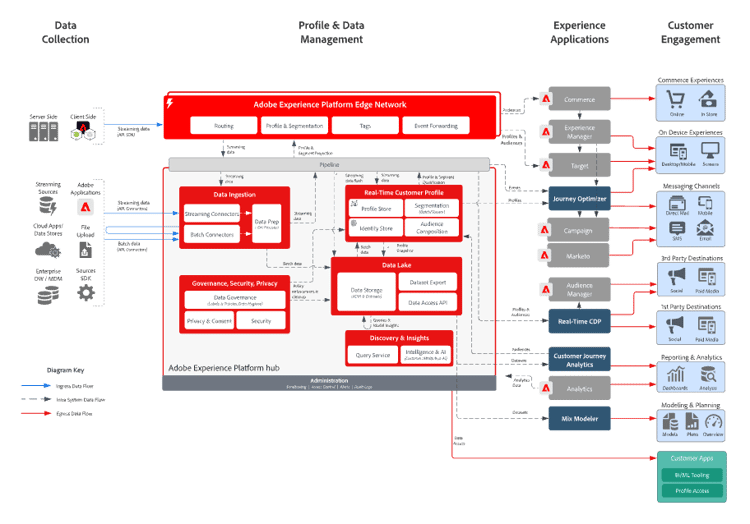
With this architectural foundation in mind, here are some best-practice steps for integrating AI agents into your marketing strategy using Adobe Experience Platform and its applications:
- Unify and Prepare Customer Data in AEP and RTCDP: A successful agentic marketing strategy starts with a solid data foundation. Consolidate your first-party customer data into Adobe Experience Platform and build unified profiles using Real-Time CDP. This single source of truth ensures that your AI agents have access to complete, up-to-date customer insights for decisioning. Invest in data governance and schema design upfront so that profile attributes (behaviors, preferences, segments, etc.) are well-defined – agents rely on these to make relevant decisions. With a 360° customer view in place, any AI-driven decision or content will be grounded in accurate context. (For example, Adobe’s Real-Time CDP can leverage Sensei GenAI to automatically create rich audience segments for intelligent personalization, giving your agents precise target groups to act on.)
- Infuse AI into Decisioning and Journey Orchestration: Next, integrate AI-driven decisioning into your cross-channel customer journeys. Adobe Experience Platform’s new Agent Orchestrator provides a framework to deploy and manage specialized AI agents within your marketing workflows. You can assign each agent a specific goal (for instance, one agent for offer selection and another for timing optimization) and let them work in concert with your execution engines. For example, when a customer triggers a journey, an AI agent could determine in real time which content or offer is most suitable for that individual, and then your journey orchestration tool (such as Adobe Journey Optimizer) delivers that experience through the appropriate channel. Take advantage of AEP’s real-time customer profile and streaming data integration – Journey Optimizer’s deep integration with RTCDP allows agents to react to live events and recent behaviors. Ensure that autonomous decisions by agents (like skipping a step or altering a message) are logged and reviewable so your team can monitor outcomes and refine the agents’ logic over time. By embedding AI agents into your decisioning and orchestration processes, you enable truly autonomous, personalized customer journeys that adapt on the fly across email, mobile, web, and beyond.
By following these steps – unifying data, infusing AI into decisioning, and scaling content with generative AI – you create a synergistic system. Your AI agents function effectively as they draw on rich data, operate within orchestrated journeys, and deliver compelling content. It’s equally important to establish governance and measurement around these agentic processes: define KPIs to track agent-driven outcomes (for example, lift in conversion or retention due to AI decisions), and use analytics tools to monitor performance. This helps you continuously train and fine-tune the agents for better results.
Conclusion
Agentic marketing represents a transformative shift in how customer experiences are delivered. By introducing AI-powered agents into the marketing team, brands can achieve levels of personalization and responsiveness that would have been impossible with manual operations alone. Marketers who embrace these AI “colleagues” find they can elevate their focus to high-level creativity, customer understanding, and strategic goals, while delegating execution details to data-driven automation. The closed-loop learning inherent in this approach – where data drives decisions, decisions create experiences, and those experiences generate new data – allows marketing programs to run and improve continuously with minimal human intervention.
At the same time, it’s critical to maintain a human-centered approach. AI agents are powerful, but marketing is ultimately about human connection and creativity. Brands should ensure that their use of AI preserves empathy, ethics, and an authentic brand voice. Keep humans in the loop for oversight and to inject the kind of strategic thinking that machines can’t replicate. When marketers and AI agents work together in harmony, they can deliver truly exceptional customer experiences – combining the best of machine efficiency with human insight. Adopting agentic marketing now positions your organization to delight customers in this new age of AI-powered experiences, giving your business a competitive edge through smarter decisioning and automation.