Our journey with Adobe AI has moved from predictive intelligence to generative creation and now to agentic systems that act with intent. Along the way, it’s changed how we scale personalization, unlock productivity, and drive innovation. Here’s what we’ve learned, what it took to get here, and what comes next.
Introduction
AI is no longer a futuristic buzzword in digital experience; it is the engine driving modern personalization, productivity, and scale. In the Travel, Hospitality, and Entertainment industry, where precision and scale are critical, many organizations began with predictive AI capabilities in Adobe Analytics and Adobe Target. From there, adoption expanded to Generative AI through tools like Adobe Experience Platform AI Assistant and is now progressing toward Agentic AI capabilities within and beyond Adobe Experience Platform. Along the way, important lessons have emerged around adoption, governance, and innovation. These insights are increasingly relevant for any organization shaping its AI powered digital experience strategy.
AI foundations
Adobe Analytics and Adobe Target were our entry points into AI-driven marketing. Analytics delivered predictive insights through anomaly detection, contribution analysis, and forecasting, while Target made personalization practical with automated targeting, personalization, and recommendations.
These capabilities laid the foundation for trust in AI, demonstrating ROI in multiple ways:
- Efficiency gains: reducing the manual effort required to uncover insights or optimize content.
- Revenue lift: driving measurable improvements in conversions and average order value through personalized experiences.
- Customer experience impact: enabling faster, more relevant interactions that improved engagement and satisfaction.
Together, these outcomes showcased the tangible business value of predictive AI and helped build stakeholder confidence to expand into more advanced use cases.
How-to: 3 steps to start leveraging AI in Adobe Analytics & Adobe Target
- Start small with anomaly detection and contribution analysis in Adobe Analytics to validate AI-driven insights.
- Leverage Automated Personalization in Adobe Target to deliver the best content variation for each visitor, dynamically optimized by predictive AI.
- Track lift and ROI across Auto-Target and Recommendations to showcase tangible business impact early.
The leap to generative AI with Adobe Experience Platform AI Assistant
The real turning point came when we adopted Adobe Experience Platform (AEP) and started using Adobe AI Assistant, powered by Generative AI. The Assistant quickly proved itself as more than a novelty, it became a daily productivity tool across teams.
Why we adopted AI Assistant
The decision to use AI Assistant stemmed from three needs:
- Speed to insights: Analysts and business users needed quick answers from complex datasets without manually writing queries.
- Accessibility: Adobe Experience Platform is powerful but can feel intimidating for non-technical users. A more natural way to interact with data and insights through conversational queries helps lower that barrier.
- Onboarding: With new hires and role rotations, getting teams productive in Adobe Experience Platform was time-consuming. AI Assistant could serve as an interactive “coach” to guide exploration.
Initial use cases and how they evolved
- Onboarding & Enablement: New users leverage AI Assistant as a “guided coach” to explore datasets, understand XDM schemas, and learn platform applications capabilities (Real-Time CDP, Customer Journey Analytics, and Adobe Journey Optimizer) hands-on. Instead of reading documentation passively, they can ask, “What metrics are available for campaign performance?” or “How can I analyze audience engagement trends?” This interactive approach accelerated onboarding from months to weeks.
- Troubleshooting & Data Exploration: Early on, AI Assistant helped users understand missing fields or inconsistent data definitions. Today, it also validates queries, surfaces anomalies, and provides recommendations for more accurate insights.
Best practice tips for using AI Assistant with natural language queries
- Encourage new users to treat the AI Assistant as a first-line guide, helping them explore data and learn platform functionality interactively.
- Prepare a set of starter prompts to demonstrate typical queries and best practices.
- Combine AI Assistant usage with structured enablement sessions—this pairing drives the fastest adoption and builds confidence.
Key outcomes
- Analysts and business users receive actionable insights faster, reducing query and reporting time from days to minutes.
- Non-technical users gained confidence in working directly in Adobe Experience Platform without heavy reliance on analysts.
- New hires onboarded 2–3x faster, reducing the ramp-up burden on senior team members.
The benefits were clear: teams became more efficient, Adobe Experience Platform became more approachable, and natural language queries empowered users across functions to explore data and gain insights with minimal friction.
Adoption, however, was not without its challenges:
- Fear and misunderstanding: Legal and compliance teams initially worried that if guest data were used with an AI model, it could be exposed externally or reused by another company. Addressing these concerns required clear documentation of data usage, transparency in architecture, and ongoing education.
- Trust and adoption hurdles: Within the organization, many people feared AI might replace human judgment or reduce their control. We had to emphasize that AI was an enabler, not a replacement—we started with AI as an assistant, not a replacement.
- Data readiness struggles: Our technology teams faced the reality that Generative AI is only as good as the data it works with. Clean, well-orchestrated 360° data are essential to get accurate outputs and trustworthy insights. AEP’s unified profile layer and centralized data platform helped overcome this challenge.
Once these hurdles were acknowledged and addressed, the benefits became undeniable.
The emerging era of Agentic AI
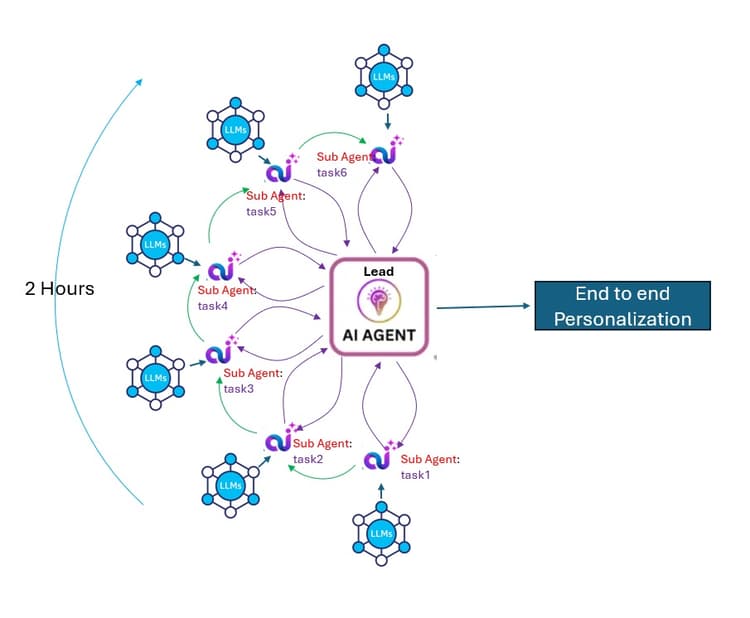
While Generative AI is powerful, Agentic AI represents the next frontier. Instead of responding only to prompts, Agentic AI enables the autonomous execution and orchestration of multi-step workflows—from strategy development to segment creation, personalization execution, and data quality checks. It’s a shift from “assistive” to “collaborative automation”: GenAI responds to questions and generates content, whereas Agentic AI coordinates multiple tasks, manages dependencies, and executes complex workflows according to defined objectives.
We are currently exploring with:
- Adobe Experience Platform Agent Orchestrator - enabling agents to work together on multi-step marketing workflows.
- Purpose-Built Adobe Experience Platform Agents - specialized agents for segmentation, activation, and insights.
- Adobe GenStudio and Firefly - generating personalized, brand-safe content at scale.
Outside of Adobe’s platform, we are also evaluating Agentic AI for data quality, identity resolution, and personalization strategy, ensuring AI operates across the full customer journey.
Today, building a campaign often involves multiple handoffs: data engineering prepares the audience, marketing designs the content, and operations manages activation. In the near future, a coordinated set of Agentic AI processes can execute these steps seamlessly, reducing manual back-and-forth. This shift allows teams to focus more on strategy and creative decision-making, and dramatically shortens time-to-market from several months to just a few days.
How-to: 3 steps to prepare for Agentic AI
- Engage legal and security early: Document architecture, workflows, and data usage, and demonstrate compliance, privacy, and security guardrails in place.
- Define agent roles and responsibilities: Specify which processes or workflows each agent manages (for example, segmentation, content generation, optimization, and validation), ensuring alignment with business objectives.
- Prototype limited workflows first: Start with small, controlled experiments before scaling to enterprise-wide orchestration, and share early results to build confidence and understanding.
GenAI vs Agentic AI: What's the difference?
Feature/Capability
Generative AI (GenAI)
Agentic AI
Key takeaway: GenAI helps you do things faster; Agentic AI helps you do things you couldn't do before.
Lessons learned & what's next
Our journey highlights a few key lessons:
- Start with small and low-risk pilots: AI as an assistant, not a replacement, keeping human in the loop and control.
- Start with AI foundations to build trust, demonstrate how enterprise-grade AI keeps data secure and privacy protections remain intact; then expand into Generative AI and Agentic AI. Establish confidence with measurable outcomes before scaling.
- Automated Personalization in Adobe Target has been one of our strongest ROI drivers, consistently delivering measurable lift while reducing manual effort. It also helps build trust with business stakeholders by showing tangible results quickly.
- Clearly document architecture, data usage, and sharing practices, and secure approvals from legal and security teams. Establish compliance guardrails including privacy, IP, and data governance before scaling into sensitive use cases.
- Measure ROI broadly: not just in dollars, but in productivity gains, speed to market, and creative output enabled by AI tools.
Understand the evolution of AI capabilities
- GenAI accelerates tasks like content creation, segmentation, and analysis.
- Agentic AI moves beyond acceleration to autonomous orchestration, handling multi-step workflows, coordinating agents, and continuously optimizing campaigns. This shift enables teams to focus on strategy, creativity, and innovation while reducing time-to-market from months to just days.
Looking ahead, we see Agentic AI transforming not only productivity, but also how experiences are designed, orchestrated, and delivered. Coordinated agents manage audiences, content, and activation seamlessly, allowing marketing teams to spend more time on strategic planning and creative innovation.
For peers and practitioners, my advice is simple: embrace AI as a partner, not just a tool. Start small, share wins, and prepare for an agent-driven future.