Function nodes
Function nodes transform the input value according to the mathematical function they represent.
Although their input connectors are generally not typed, they do not support all value types.
Node list
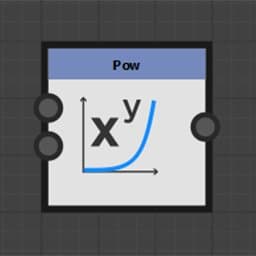
Returns the first input raised to the power of the second input: X^Y.
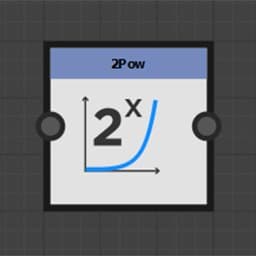
Returns 2 to the power of its input value: 2^X.
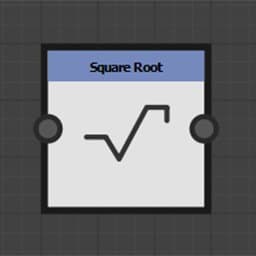
Returns the square root of its input value: √X.
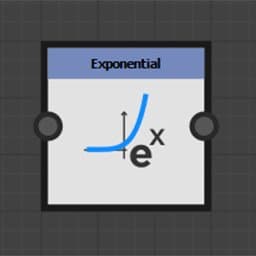
Returns the exponential value of its input value: e^X
e is approximately equal to 2.7182818.
Returns the natural logarithm of its input value: ln(X).
Returns the base 2 logarithm of its input value: log2(X).
Returns the absolute value of its input: abs(X).
Rounds its input value up. It returns the smallest integer value not less than X: ceil(X).
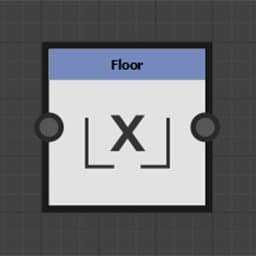
Rounds its input value down. It returns the largest integer value not greater than X: floor(X).
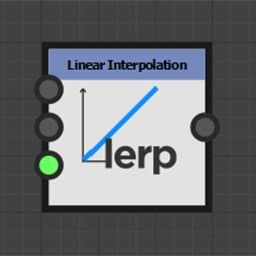
Returns the linear interpolation between two values in function of a floating value: (1 - X)*A + X*B.

Returns the lowest of the two input values: min(A, B).

Returns the highest of the two input values: max(A, B).
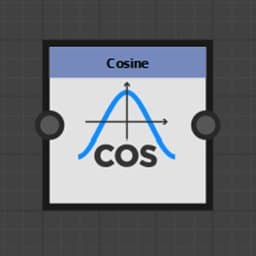
Returns the cosine of its input value in radians: cos(X).
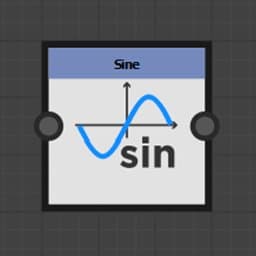
Returns the sine of its input value in radians: sin(X).
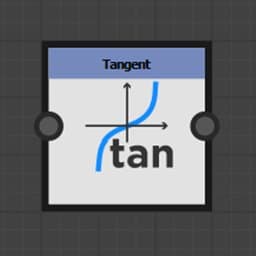
Returns the tangent of its input value in radians: tan(X).
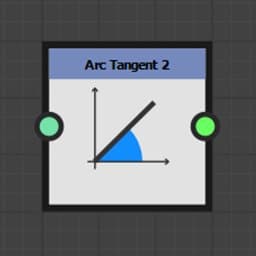
Returns the angle between the input 2D vector and the horizontal.
It is the reciprocal of the Cartesian function.
It is not necessary to switch the X and Y component of the input vector as in the usual atan2 function.
Converts polar coordinates to cartesian coordinates.
It is the reciprocal of the Arc tangent 2 function: Length * Float2(cos(Angle), sin(Angle).
Polar coordinates are a distance from the origin and an angle in radians from the horizontal.

Returns a random value between 0 and the input value X.