Wikipedia Analysis
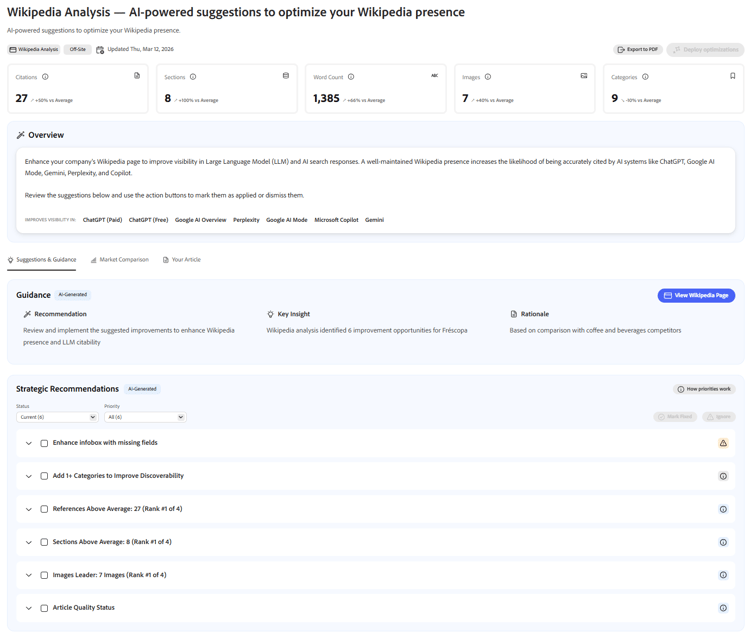
Your company’s Wikipedia page is one of the most influential sources AI systems use when generating responses about your brand. A well-maintained article increases the likelihood of being accurately cited by ChatGPT, Google AI Mode, Gemini, Perplexity and Copilot.
The Wikipedia Analysis opportunity uses AI to evaluate your Wikipedia page against industry competitors and surfaces prioritized recommendations to close the gaps that matter most for LLM citability.
It analyzes your article across five dimensions:
- References — The number of cited external sources in your article. References signal credibility and are a key factor in how LLMs evaluate the authoritativeness of a Wikipedia page, compared against the industry average and top competitor.
- Sections — Article structure and breadth of topics covered.
- Content length — Word count relative to industry benchmarks.
- Images — Visual richness of the article.
- Infobox completeness — Structured data fields present versus what competitors include.
How it works
Adobe Brand Visibility scrapes your company’s Wikipedia page and compares it against a set of industry competitors identified automatically based on your business category. For each dimension, it calculates your gap relative to the industry average and generates specific, prioritized recommendations with supporting data sources.
The results are displayed across three tabs: Suggestions & Guidance, Market Comparison, and Your Article.
Suggestions & Guidance
This tab shows strategic recommendations for improving your Wikipedia page. Each recommendation includes a priority level, a description of the gap, why it matters for LLMs and the expected result of fixing it.
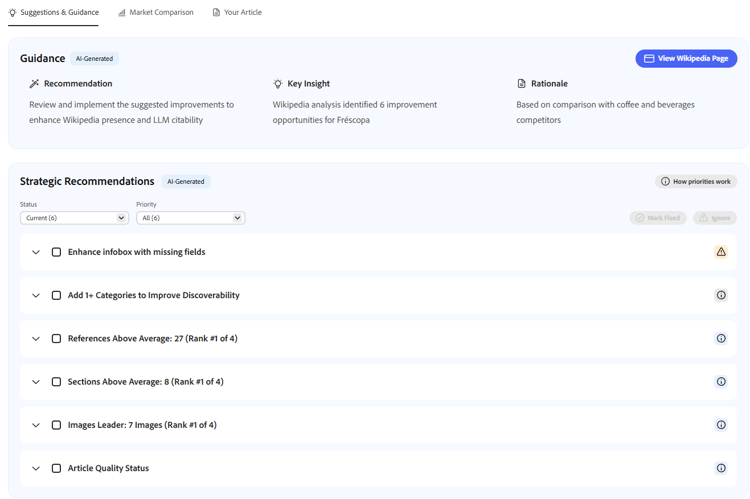
At the top of the tab, the Guidance panel provides a high-level summary of the analysis with three columns:
- Recommendation — A top-level action to take based on the full set of identified opportunities.
- Key Insight — A summary of how many improvement opportunities were identified for your site.
- Rationale — The basis for the analysis, for example which industry competitors were used for benchmarking.
Recommendations are only shown when the relevant condition is met based on real analysis data — a reference gap suggestion, for example, only appears if your reference count is below the industry average.
Recommendation types
Each recommendation includes:
- Description — A concise explanation of the gap identified.
- Why it matters — The impact on LLM citability and Wikipedia quality rating.
- Expected result — A specific, measurable outcome. For example, “Add 65+ references to reach industry average, increasing your reference count by 191%”.
Market Comparison
The Market Comparison tab shows a competitive benchmarking table and visual charts comparing your Wikipedia page against industry peers.
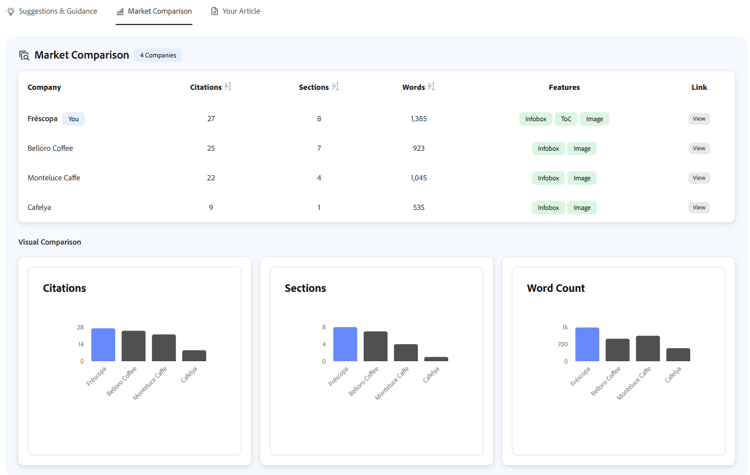
The comparison covers references, sections and word count, helping you understand where you rank within your industry and how much improvement is needed to reach or surpass the benchmark.
Your Article
The Your Article tab gives you a detailed snapshot of your current Wikipedia page.
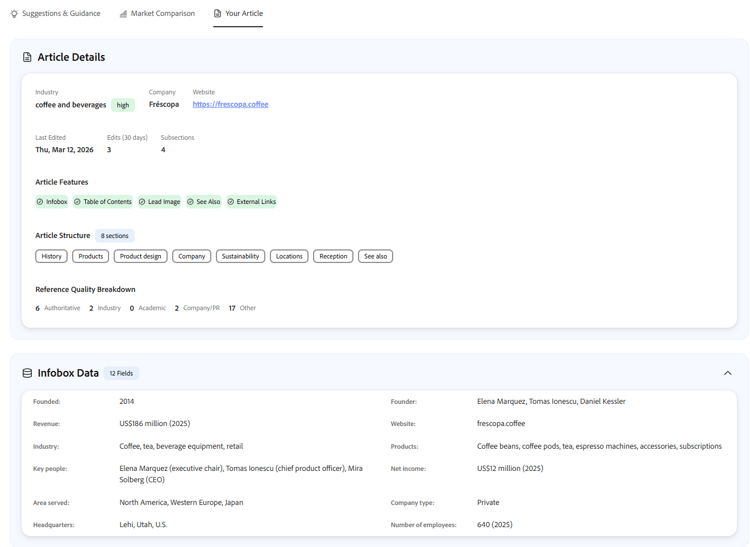
It includes:
- Article details — Industry, company name, website, last edited date, number of edits in the last 30 days and subsection count.
- Article features — Whether your article has an infobox, table of contents, lead image, See Also section and external links.
- Article structure — A list of all current sections.
- Reference quality breakdown — Categorization of your references (authoritative, industry, academic, company PR, other).
- Infobox data — All fields currently populated in your infobox.
Try it in the demo
See the Wikipedia Analysis opportunity in action using the Frescopa demo environment.
View Wikipedia Analysis in the Frescopa demo
Frequently asked questions
Why does Wikipedia matter for AI search?
Wikipedia is one of the most trusted sources in LLM training data and real-time retrieval. When AI systems generate responses about companies, they frequently draw on Wikipedia for factual grounding — founding date, products, leadership, industry classification and more. A sparse or poorly structured Wikipedia page means your brand is less likely to be cited accurately or cited at all.
Which AI systems does a stronger Wikipedia page affect?
Improving your Wikipedia page increases the likelihood of being cited by ChatGPT (Free and Paid), Google AI Overview, Google AI Mode, Perplexity, Microsoft Copilot, and Gemini.
How are industry competitors selected?
Competitors are identified automatically based on your company’s industry classification. The analysis uses up to six competitor pages to calculate benchmarks.
How do I edit my Wikipedia page?
Wikipedia edits must be made directly on Wikipedia following their editorial guidelines. Adobe Brand Visibility provides the specific recommendations and data sources you need — the edits themselves are made on Wikipedia. If your article has been flagged for tone issues, review Wikipedia’s neutral point of view policy before making changes.
Can I apply recommendations directly from Adobe Brand Visibility?
Not directly — Wikipedia edits must be made on Wikipedia itself. Adobe Brand Visibility tells you exactly what to fix, why it matters, and where to find the supporting sources to back up your changes.
How often is the analysis updated?
The Wikipedia analysis reflects the state of your Wikipedia page and competitor pages at the time of the last data refresh. Revisit the opportunity after making improvements to track your progress.
What if my company does not have a Wikipedia page?
The Wikipedia Analysis opportunity requires an existing Wikipedia article. If your brand does not have one, creating a Wikipedia page that meets Wikipedia’s notability guidelines is a foundational GEO step worth prioritizing before other optimizations.