Monitor activities in event forwarding
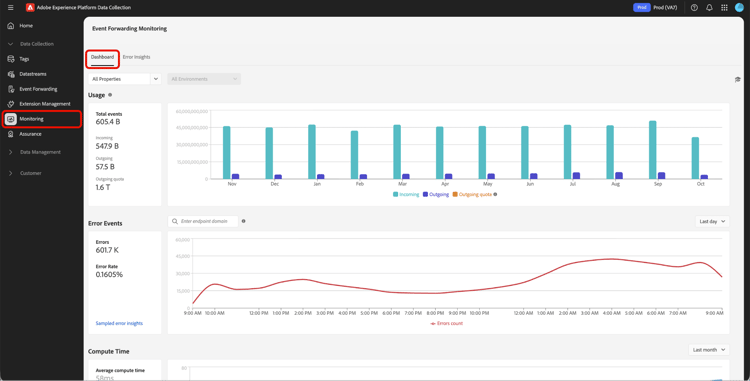
The Dashboard tab in the Monitoring interface provides insights into the performance of your event forwarding properties, including usage patterns, errors, and compute time. You can also use Error Insights to investigate aggregated error data and troubleshoot issues in your running event forwarding libraries. This guide explains how to access, view, and interpret these reports.
Prerequisites
This guide assumes that you have purchased event forwarding and that you have a working understanding of how event forwarding works. See the event forwarding overview for more information.
Video overview
Watch the following video for a high-level overview of the monitoring feature:
Selecting properties and environments
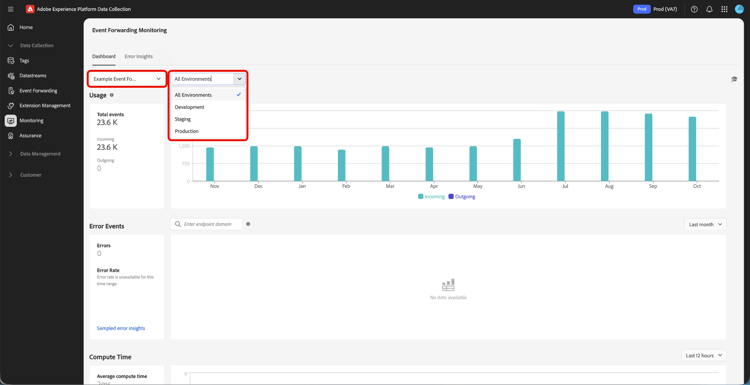
You can view metrics within an individual environment and property, or across all properties and environments owned by your organization.
To show metrics for a single property, select the property dropdown menu and choose the property of interest from the list. Once you have chosen a property, you can also use the environment dropdown to select an environment of interest.
Usage
The Usage report shows incoming and outgoing calls for a given time period. Incoming calls represent data sent to event forwarding. Outgoing calls represents data sent from event forwarding. The Total events number in the left pane is the sum of incoming and outgoing calls for the given time period.
Error Events
The Error Events report shows errors in aggregate, and broken out by HTTP response code when you hover your cursor over the line chart. The displayed errors are from outgoing calls and the response codes are from the endpoint that event forwarding is interacting with.
The errors are shown for a given time period, which can be adjusted from the provided dropdown menu.
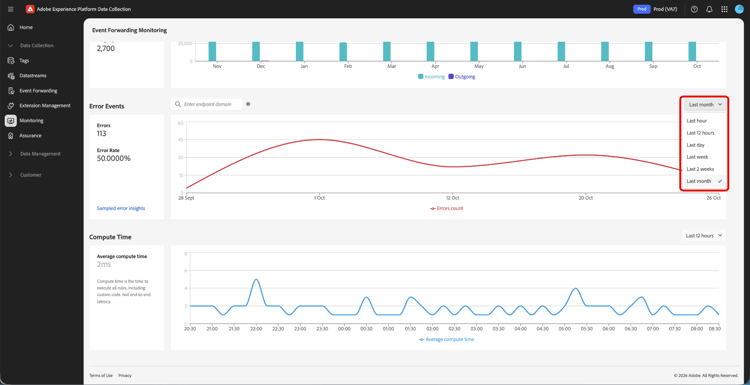
The search box for the error event allows you to query event forwarding to understand errors for a given endpoint domain. You must enter the exact domain, as the search feature does not accept approximations or “fuzzy” matches. Once you provide an exact domain for which there is outgoing error data, hit Enter and the report refreshes to show outgoing errors for that domain. For example, to see errors from the Facebook Conversions API endpoint the domain should be written as https://graph.facebook.com.
To investigate the errors behind the aggregate report, use Error Insights.
Error Insights error-insights
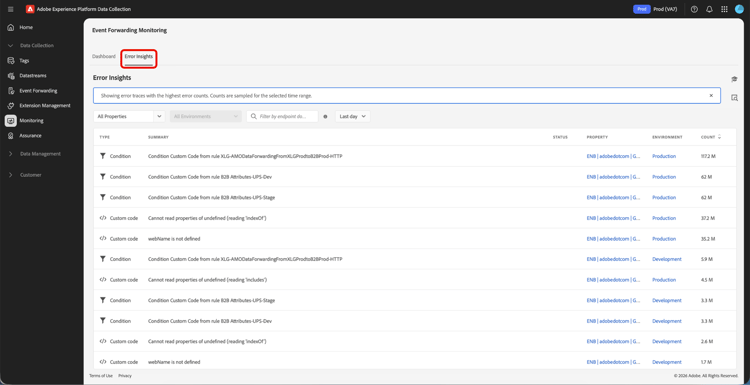
The Error Insights tab on the Monitoring page in Real-Time CDP Connections provides aggregated error details for your running event forwarding library. Use these details to troubleshoot live event streams and investigate errors that occur when your library runs or sends data to a destination.
Access Error Insights
Select the Error Insights tab from the Monitoring UI. Next, select the property and environment you want to investigate and select a rolling time window of 1 hour, 12 hours, or 24 hours to view aggregated error details for that period.
Investigate error details
Error Insights provides details about the following types of errors:
-
Destination errors: Error responses returned by an egress destination when event forwarding sends data to that destination. Use the response details to investigate failed outgoing calls.
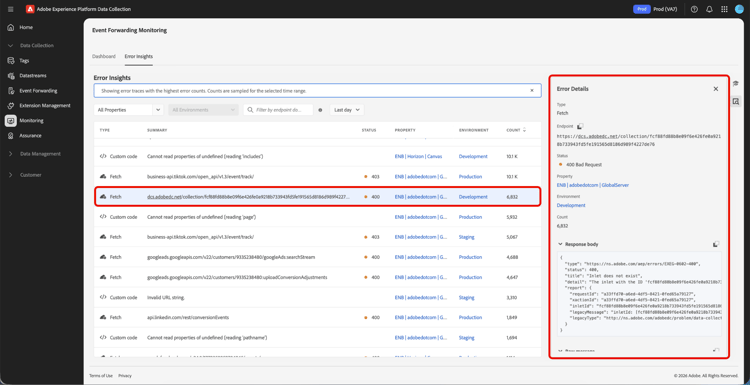
-
Code and runtime errors: Errors generated by data elements, custom code, and other runtime errors in your event forwarding library.
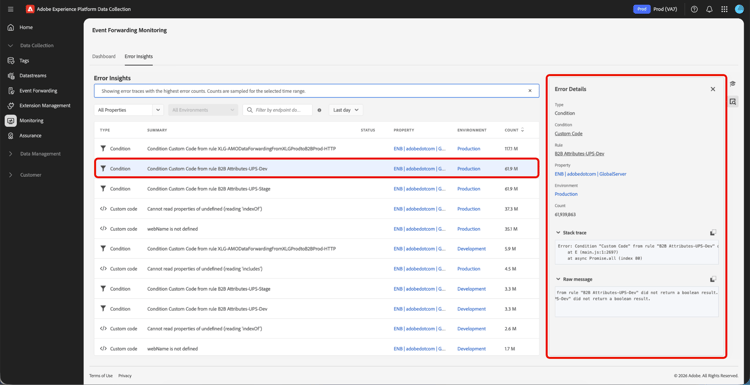
Review the available error details to identify failures in your library or responses from a destination that require further investigation.
Compute Time
The Compute Time report shows the compute time of all rules on event forwarding servers.
The following factors affect compute time:
- The number of rules
- The complexity of the rules, usually driven by the amount of custom JavaScript being executed
For example, if an action in event forwarding hits an endpoint and that endpoint takes two seconds to respond, this two-second latency will not count against compute time because event forwarding is just waiting and not actively computing anything. The response time cannot be longer than 30 seconds, otherwise data will be dropped.