Agentic commerce in 2027: five priorities for commerce leaders

Shaun McCran
Principal Product Marketing Manager
AI is changing how customers discover, evaluate, and buy products. Here are five priorities to help you prepare for the next era of commerce.
Imagine a customer asking an AI assistant to find the best running shoes for their next training session. Instead of browsing multiple websites, comparing specifications, and checking availability, the assistant helps them discover relevant products, evaluates options against their needs, and guides them toward a purchase.
This is the emerging world of agentic commerce, where AI agents can support shopping decisions and take actions on behalf of consumers.
For brands and retailers, it’s creating new opportunities to reach customers, deliver more personalized experiences, and simplify the path to purchase.
But it also raises an important question: Is your business ready for a world where AI agents increasingly influence what customers discover and buy?
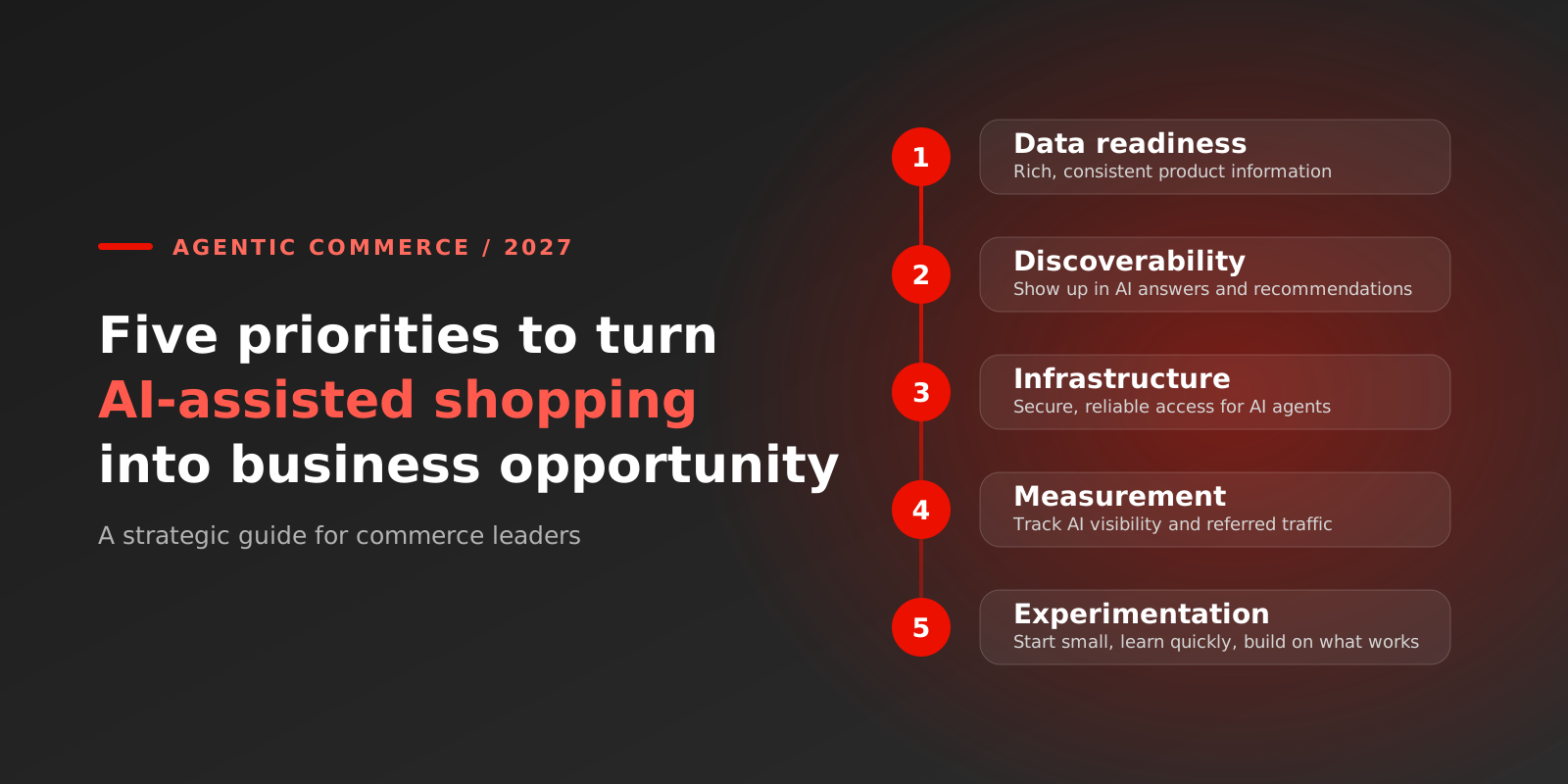
As we plan across 2027, here are five priorities commerce leaders should consider.
1. Make your product data AI-ready
In agentic commerce, product information becomes one of your most valuable assets.
AI agents need accurate, detailed, and accessible product information to understand what you’re selling and match products to customer needs.
Consider a shopper asking an AI assistant to recommend a waterproof jacket for hiking in cold weather. To make a relevant recommendation, the assistant needs more than a product name. It needs information about materials, weather protection, sizing, availability, and price.
For commerce leaders, this means prioritizing product data quality, enriching product attributes, and ensuring information stays consistent across channels.
The opportunity: Better product information can help AI systems understand your catalog, improve the relevance of product recommendations, and make it easier for customers to find what they need.
2. Make your products discoverable wherever customers shop
For years, brands have invested in search engine optimization to help customers find their products.
Now, AI-powered search and conversational shopping experiences are introducing new discovery channels.
Customers may increasingly ask AI assistants to compare products, recommend alternatives, or identify the best options for a particular need.
That means brands need to think beyond traditional search rankings and consider how their products appear in AI-generated answers and recommendations.
Structured product information, accessible content, accurate availability, and clear product differentiation can all help support AI discoverability.
The opportunity: Reach customers earlier in their buying journey and create new opportunities to connect with shoppers beyond your own storefront.
3. Build a commerce foundation that supports AI agents
AI-powered discovery is only one part of the journey.
As agentic commerce evolves, AI assistants may need to interact with commerce systems to check inventory, retrieve pricing, manage shopping carts, and support transactions.
This requires commerce infrastructure that can provide secure, reliable access to the right information and services.
For example, a shopper could ask an AI assistant to find a laptop within a budget, check whether it’s available for delivery, and help complete the purchase.
Technologies such as the Model Context Protocol (MCP) are helping establish ways for AI agents to connect with business tools and services.
The opportunity: Create more connected shopping experiences that reduce friction between product discovery and purchase, while maintaining appropriate security, governance, and customer control.
4. Rethink how you measure commerce success
As shopping journeys evolve, the metrics businesses use to measure success will need to evolve too.
Traditional ecommerce metrics such as website traffic, conversion rate, and average order value will remain important. But they may not tell the complete story when customers discover products through AI assistants.
Commerce leaders should begin exploring new ways to understand how their products are represented and recommended across AI-powered experiences.
This could include monitoring product visibility in AI-generated recommendations, the accuracy of product information, AI-referred traffic, and how these interactions contribute to sales.
The opportunity: Gain a clearer understanding of emerging shopping journeys and identify where AI-driven experiences are creating business value.
5. Start experimenting with AI-powered shopping experiences
Agentic commerce is still evolving, and businesses don’t need to transform everything overnight. Taking a more composable approach to commerce allows businesses to adopt new AI-powered capabilities incrementally, innovate faster, and experiment with emerging experiences without the complexity and disruption of overhauling their existing commerce infrastructure.
Instead, 2027 presents an opportunity to start small, learn quickly, and build on what works.
For example, a retailer could experiment with an AI-powered shopping assistant that helps customers find products based on their needs. A fashion brand could explore conversational product recommendations, while a consumer electronics business might test AI-assisted product comparisons.
These experiments can help teams understand customer expectations, identify opportunities to reduce friction, and build confidence in new approaches.
The opportunity: Turn emerging AI capabilities into practical customer experiences, while creating a foundation for future innovation.
How Adobe is helping shape the future of agentic commerce
Preparing for agentic commerce requires more than adopting individual AI tools. It means connecting product discovery, customer engagement, and purchasing experiences across the entire commerce journey.
Adobe is helping businesses navigate this shift with a vision for commerce built around three connected opportunities: discover, engage, and convert.
With Adobe Commerce as a Cloud Service and Adobe’s Commerce Optimizer, businesses can build on a modern commerce foundation designed to support evolving customer expectations.
Adobe’s agentic commerce direction includes capabilities such as AI-ready product discovery, secure agent access to commerce services through Shopper MCP, AI-assisted experience creation, and conversational shopping experiences through Brand Concierge.
Together, these innovations aim to help brands make products more discoverable, deliver trusted customer interactions, and create more connected paths to purchase.
For commerce leaders, the goal isn’t simply to adopt AI. It’s to use AI to deliver better experiences for customers and create new opportunities for business growth.
The next era of commerce starts with the decisions you make today
Agentic commerce won’t replace every shopping experience overnight. But it is changing how businesses need to think about product discovery, customer engagement, and conversion.
The brands that succeed will be those that make their product information accessible, prepare their commerce infrastructure, measure emerging opportunities, and continuously experiment with new ways to serve customers.
The future of commerce isn’t just about where customers shop. It’s about being ready to serve them wherever their shopping journey begins.
Ready to prepare your business for AI-powered commerce?
Explore Adobe Commerce as a Cloud Service and discover how Adobe can help you build more connected, intelligent shopping experiences.
Related guidance
- Design a commerce platform for shoppers and AI agents—Learn how to serve people and AI agents from a single source of truth.