Brand Claims brand-claims
Brand Claims helps you understand how AI systems describe your brand, products, and services in AI-generated responses.
AI-generated responses often contain factual statements, comparisons, opinions, and other assertions about a brand. Brand Claims identifies and organizes these statements so you can understand the perceptions AI systems are creating about your brand, identify claims that may need attention, and determine where action can help strengthen your brand presence.
Brand Claims complements Brand Presence. While Brand Presence helps you understand whether and how your brand appears in AI-generated responses, Brand Claims helps you understand what AI systems are saying about your brand.
Use Brand Claims to:
- Understand the claims AI systems associate with your brand.
- Identify favorable, unfavorable, and neutral perceptions.
- Prioritize claims that may require attention.
- Understand the sources shaping how your brand is represented.
- Review recommended actions for addressing important claims.
- Connect claims to optimization strategies and relevant offsite opportunities.
How Brand Claims works how-it-works
Brand Claims analyzes the AI-generated responses collected through your Brand Presence prompts and extracts individual assertions made about your brand.
Claims are therefore based on what AI systems say in response to the prompts you are tracking. A response may also introduce information beyond the literal subject of the prompt. For example, a prompt about a product may result in an AI response that discusses its pricing, sustainability, warranty, or other attributes. Brand Claims can identify these additional statements when they appear in the response.
Brand Claims does not discover claims about subjects that never appear in the analyzed responses. Maintaining relevant prompt coverage in Brand Presence is therefore important for understanding the range of perceptions AI systems associate with your brand.
Claims can be analyzed using signals such as:
These signals help distinguish isolated statements from recurring perceptions that may warrant greater attention.
Brand Claims overview overview
The Overview tab provides a summarized view of how AI systems are representing the selected brand.
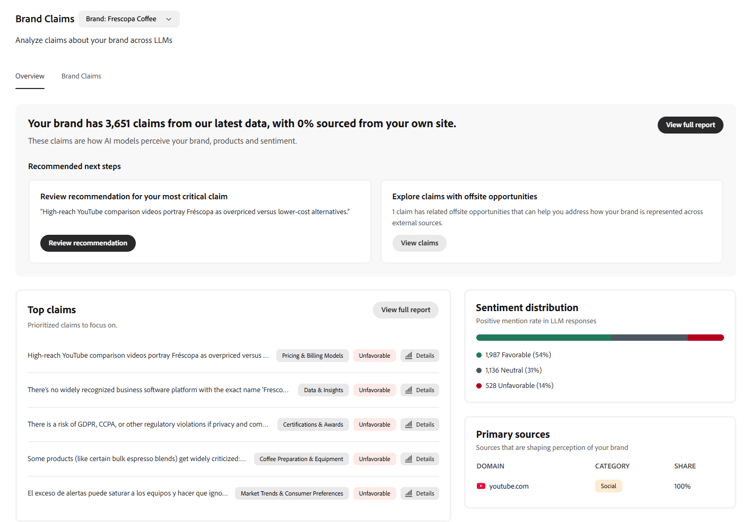
At the top of the page, you can see the total number of claims identified in the latest data and how much of that information is sourced from your own site. Recommended next steps highlights claims and actions that warrant your attention.
You can:
- Review recommendation for a prioritized claim to understand why it matters and what actions you can take.
- View claims associated with offsite opportunities to investigate how external sources may be shaping your brand’s representation.
Top claims surfaces prioritized claims to help you focus on important perceptions about your brand. Each claim can include contextual information such as its category and sentiment. Select Details to investigate an individual claim.
Sentiment distribution shows how claims about your brand are distributed across favorable, neutral, and unfavorable sentiment. This helps you quickly understand the overall perception reflected in the claims identified from your AI responses.
Primary sources identifies sources that are shaping AI-generated perceptions of your brand. Use this information to understand whether AI systems are grounding claims in your owned content or relying on external sources.
Explore Brand Claims explore
Select the Brand Claims tab to explore the full set of claims identified for your brand.
The All Claims table displays claim clusters matching the currently selected filters. Similar claims are grouped to help you analyze recurring perceptions without reviewing every individual assertion. The underlying claims system distinguishes between strict assertion clusters and broader marketer perceptions to make repeated themes easier to understand.

For each claim, you can review:
You can also filter the list of claims using the filters at the top.
View a claim view-a-claim
Select a claim to investigate in more detail.
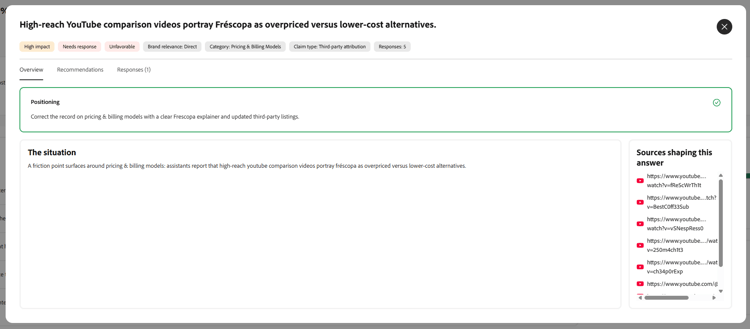
The Overview tab summarizes the situation associated with the claim and provides a positioning statement that describes the desired direction for addressing it.
You can also review the Sources shaping this answer to understand which external or owned sources are contributing to the AI-generated perception.
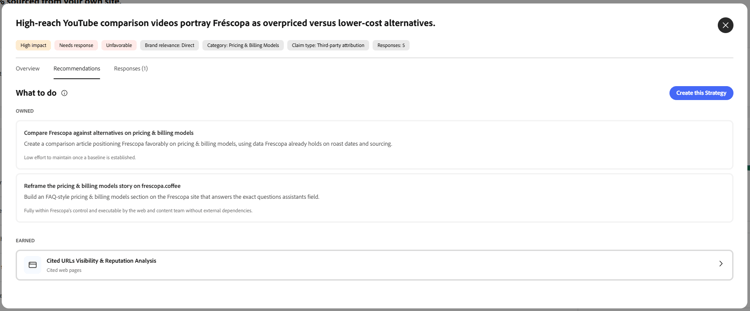
The Recommendations tab provides recommended actions for addressing the claim. Recommendations can include both:
- Owned actions are actions you can take through content or experiences that your organization controls, such as clarifying messaging or strengthening content on your own site.
- Earned actions are actions associated with external sources that may be influencing how AI systems represent your brand.
Recommendations are generated from the identified perceptions and can include actions such as reframing owned content, countering an existing narrative, correcting a source, amplifying a favorable perception, or monitoring the claim.
The Responses tab lets you review the AI-generated responses associated with the claim. This provides evidence for understanding where the claim appeared and the context in which the AI system made it.
Create a strategy to address a claim create-strategy
When a claim requires action, select Create this Strategy from its recommendations.
The resulting strategy is added to the Opportunity Workspace, where you can organize the recommended actions into opportunities and manage their progress.
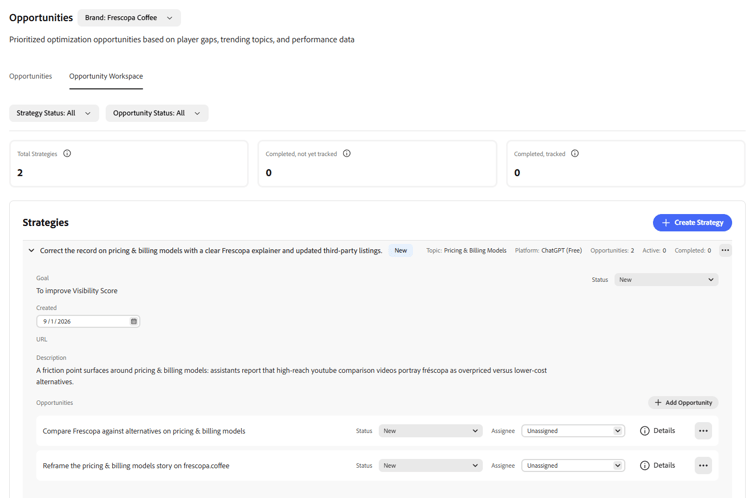
For example, an unfavorable perception about a brand’s pricing could result in recommendations to strengthen the pricing narrative on the brand’s website and address influential third-party content. Those recommendations can then become opportunities within a strategy.
Explore offsite opportunities offsite-opportunities
AI-generated perceptions can be influenced by content outside your organization’s owned properties. Brand Claims identifies cited sources associated with claims and can connect those sources to relevant offsite opportunities. The underlying analysis supports sources such as cited pages, YouTube, Reddit, and Wikipedia when corresponding opportunities are available.
From Brand Claims, you can investigate these opportunities to better understand how external content may be shaping AI-generated answers about your brand.
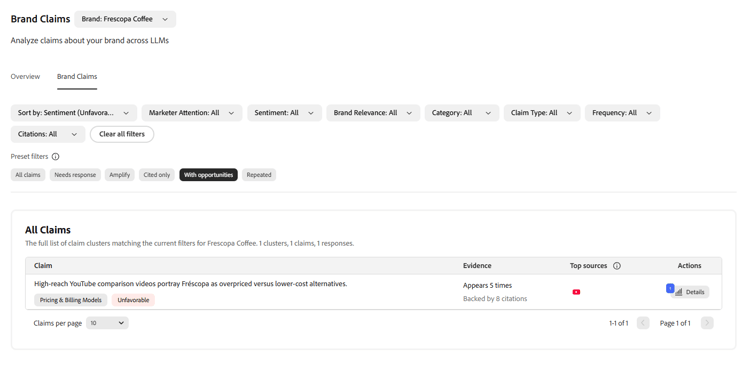
For example, a claim influenced by high-reach YouTube content may lead to a Cited YouTube Visibility & Reputation Analysis, where you can review prioritized suggestions, supporting evidence, and recommended actions for addressing the perception.